
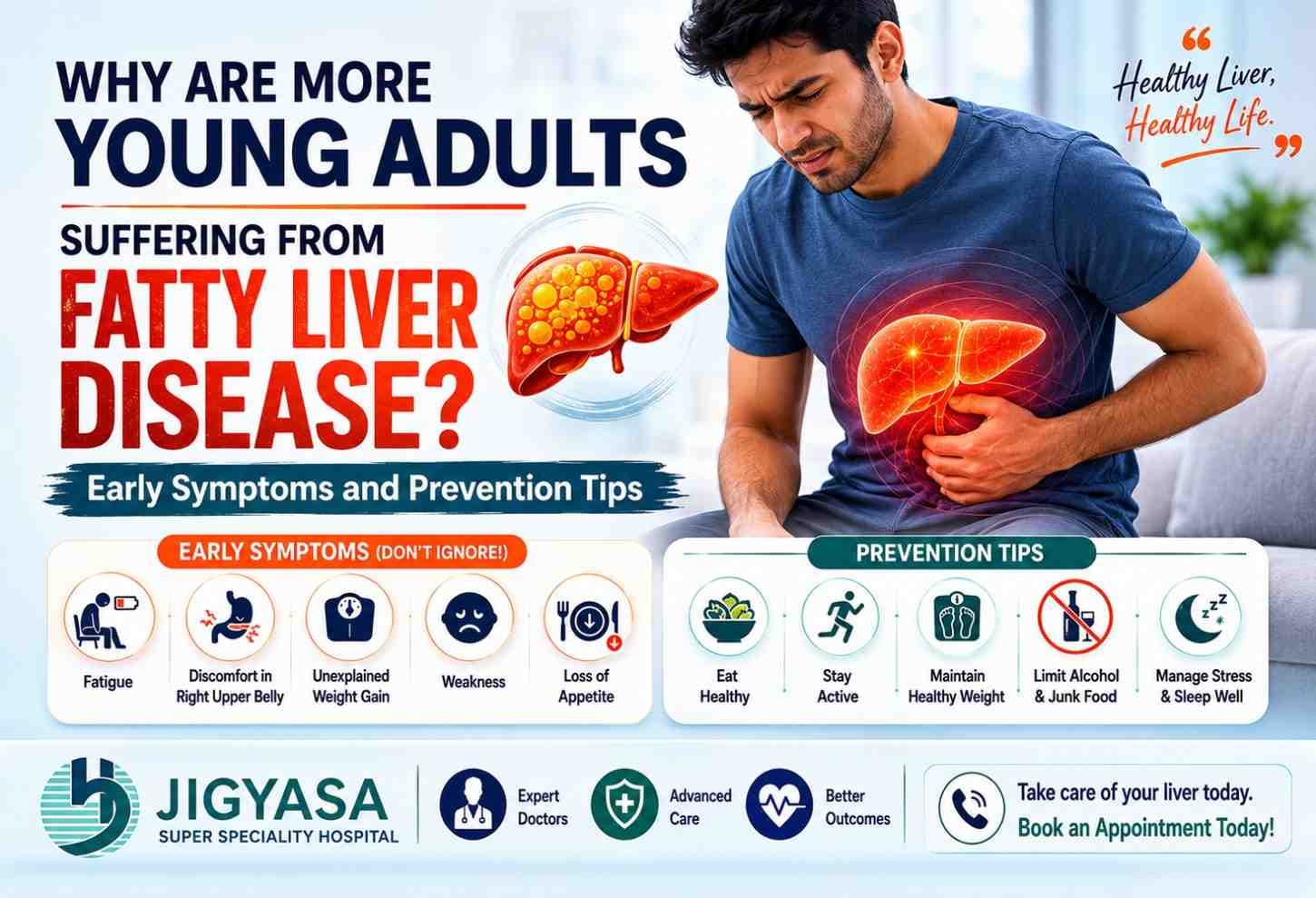
Why Are More Young Adults Suffering from Fatty Liver Disease? Early Symptoms and Prevention Tips
Fatty liver disease is silently rising in young Indians. Jigyasa Hospital Moradabad explains why, the early warning signs nobody notices & how to reverse it naturally.
India is in the grip of a silent liver epidemic — and the victims are no longer middle-aged or elderly; they are in their 20s and 30s. Non-Alcoholic Fatty Liver Disease (NAFLD) — a condition where excess fat accumulates in the liver cells of people who drink little or no alcohol — is now the most common liver disorder in India, affecting an estimated 25 to 38% of the general population. Among urban young adults aged 18 to 35, the prevalence is even more alarming — studies from major Indian cities report NAFLD in up to 40% of this age group. What makes this a public health crisis is the silence of the disease — fatty liver causes no pain, no obvious symptoms, and no warning in its early stages; most young adults discover it accidentally during an ultrasound done for another reason. Left unmanaged, fatty liver progresses from simple fat accumulation → NASH (Non-Alcoholic Steatohepatitis) → fibrosis → cirrhosis → liver failure or liver cancer. At Jigyasa Hospital, Moradabad, our gastroenterology and internal medicine team is seeing fatty liver in patients younger than ever before — and the lifestyle drivers behind this rise are entirely preventable.
Why Are Young Adults Getting Fatty Liver at Record Rates?
- •Ultra-processed food consumption: The explosion of fast food, packaged snacks, instant noodles, biscuits, chips, and refined carbohydrates in young Indian diets directly drives hepatic fat accumulation. The liver converts excess refined carbohydrates and sugars into fat through a process called de novo lipogenesis.
- •Sugary drinks and fructose overload: Colas, packaged juices, energy drinks, and flavoured milk contain massive amounts of fructose. Unlike glucose, fructose is metabolised exclusively in the liver, and excess fructose is directly converted to liver fat at a rate that overwhelms the organ's capacity.
- •Sedentary lifestyle: Desk jobs, work-from-home culture, and excessive screen time have dramatically reduced physical activity in young Indians. Physical inactivity reduces the liver's ability to oxidise (burn) fat, allowing it to accumulate.
- •Insulin resistance and metabolic syndrome: Increasingly common in young Indians due to poor diet and inactivity. Insulin resistance forces the liver to deal with chronically elevated insulin and glucose, both of which promote fat storage in liver cells.
- •Abdominal obesity: Even young adults who appear 'normal weight' by BMI may carry significant visceral fat (fat around internal organs). Visceral fat releases inflammatory fatty acids directly into the portal vein, which drains directly into the liver, causing fat deposition and inflammation.
- •Alcohol consumption: Rising alcohol use among urban young adults in India directly damages liver cells, promotes fat accumulation, and significantly accelerates progression to cirrhosis, particularly when combined with NAFLD.
- •Sleep deprivation and disrupted circadian rhythm: Staying up late, irregular sleep patterns, and night shifts disrupt the liver's natural fat metabolism cycle. The liver performs critical fat-processing and detoxification functions during specific overnight hours that are completely disrupted by irregular sleep.
- •Undiagnosed thyroid disorders: Hypothyroidism slows the liver's fat metabolism significantly. Many young adults with NAFLD have an underlying thyroid disorder contributing to the condition.
- •Rapid weight cycling ('yo-yo dieting'): Crash diets followed by weight regain stress the liver and can paradoxically worsen fat accumulation compared to maintaining a stable, moderate weight.
- •Genetic predisposition: Indians have a specific genetic variant in the PNPLA3 gene that makes them significantly more susceptible to fatty liver than Western populations — meaning Indians develop NAFLD at lower BMI, younger age, and with less alcohol exposure than their European counterparts.
Early Symptoms of Fatty Liver — The Signals Almost Everyone Misses
- •Persistent fatigue without clear cause: The most universal early symptom. The liver is the body's primary metabolic organ, and when it is struggling with fat overload, energy production suffers. Young people typically attribute this to 'stress' or 'overwork' and never investigate further.
- •Mild, dull discomfort in the upper right abdomen: Just below the ribcage on the right side. Easy to dismiss as gas, indigestion, or muscle soreness. This is the liver capsule stretching as the organ enlarges with fat.
- •Bloating and abdominal heaviness after meals: Particularly after fatty or heavy food. Impaired bile production from a fat-laden liver worsens digestion of fats.
- •Unexplained weight gain: Particularly around the abdomen, even without significant dietary changes. Reflects the underlying insulin resistance driving both weight gain and liver fat accumulation simultaneously.
- •Brain fog and difficulty concentrating: The liver produces proteins and clears toxins essential for brain function. Early liver dysfunction impairs cognitive clarity in ways patients rarely connect to their liver.
- •Increased cholesterol and triglycerides on blood tests: Elevated LDL and very high triglycerides (above 200 mg/dL) are among the earliest and most consistent laboratory signs of fatty liver, often discovered during routine check-ups.
- •Elevated liver enzymes (ALT, AST) on blood tests: Mild elevation of these enzymes is the most specific early biochemical marker of liver cell stress. Often discovered incidentally and frequently dismissed as 'mildly elevated — nothing to worry about' without further investigation.
- •Dark urine and mild jaundice: These indicate more advanced liver involvement and require immediate medical evaluation at Jigyasa Hospital.
- •Skin changes: Acanthosis nigricans (dark, velvety skin patches in the neck or armpits) reflecting underlying insulin resistance; spider naevi (small spider-like blood vessels on the skin) in more advanced disease.
- •Easy bruising or prolonged bleeding: The liver produces clotting factors. When liver function declines, bruising increases — a late and serious sign.
The Dangerous Progression — What Happens If Fatty Liver Is Ignored
| Stage | Condition | Description | Reversibility |
|---|---|---|---|
| Stage 1 | Simple Steatosis | Fat builds up in liver cells; no inflammation or damage yet | Fully reversible with lifestyle changes |
| Stage 2 | NASH (Non-Alcoholic Steatohepatitis) | Fat plus inflammation; liver cells begin to die; elevated liver enzymes | Partially reversible with aggressive lifestyle intervention and medical management |
| Stage 3 | Fibrosis | Scar tissue begins replacing healthy liver tissue; liver function impaired | Difficult but possible to halt progression; requires specialist management |
| Stage 4 | Cirrhosis | Extensive scarring; liver function severely compromised | Irreversible; risk of liver failure, portal hypertension, and liver cancer rises dramatically |
| Stage 5 | Liver Cancer (Hepatocellular Carcinoma) | NAFLD-related cirrhosis is now one of the leading causes of liver cancer in India | Requires intensive oncological management |
Stages of Fatty Liver Disease Progression
The critical window: Stages 1 and 2 are where lifestyle changes can completely reverse the disease — but most young adults are never diagnosed at this stage because they have no symptoms and are not being screened.
Prevention and Reversal — What Actually Works
- •Lose 7 to 10% of body weight: The single most evidence-based intervention for fatty liver. Even a 7% weight loss has been shown to significantly reduce liver fat, lower liver enzymes, and reduce inflammation in NASH. The weight loss must be gradual — rapid weight loss paradoxically worsens fatty liver.
- •Cut out sugar and refined carbohydrates: Eliminate sugary drinks, packaged juices, white bread, maida, and excess white rice. Replace with whole grains (oats, bajra, jowar), legumes, and vegetables. This directly reduces de novo lipogenesis in the liver.
- •Eliminate or severely restrict alcohol: Alcohol and NAFLD together progress to cirrhosis far faster than either alone. For young adults with any degree of fatty liver, no safe level of alcohol exists.
- •Exercise 150 to 300 minutes per week: Aerobic exercise (brisk walking, cycling, swimming) and resistance training both independently reduce liver fat, improve insulin sensitivity, and lower liver enzyme levels. 30 minutes of brisk walking daily produces measurable liver fat reduction within 8 to 12 weeks.
- •Coffee (2 to 3 cups unsweetened): Consistently associated with lower rates of liver fibrosis and liver cancer in NAFLD patients.
- •Turmeric: Curcumin reduces liver inflammation and supports detoxification enzyme activity.
- •Green leafy vegetables: Reduce fat absorption and support liver detoxification.
- •Walnuts and flaxseeds: Omega-3 fatty acids reduce hepatic fat and inflammation.
- •Garlic: Reduces liver fat and improves antioxidant enzyme activity in the liver.
- •Green tea: Catechins in green tea reduce liver fat accumulation.
- •Treat underlying conditions: Insulin resistance, hypothyroidism, PCOS, and dyslipidaemia all worsen fatty liver. Managing these conditions with specialist guidance is essential.
- •Sleep 7 to 8 hours consistently: Prioritise a fixed sleep schedule. Disrupted sleep is a direct, modifiable fatty liver risk factor.
- •Get regular liver function tests and ultrasound: Particularly if you have diabetes, PCOS, thyroid disorders, high cholesterol, or abdominal obesity. Early detection is everything with fatty liver.
Foods and Habits to Strictly Avoid
- •Sugary drinks and packaged juices: The fastest route to liver fat accumulation. One can of cola delivers 40g of sugar directly to the liver.
- •White bread, maida, and refined grains: Spike insulin and drive de novo lipogenesis.
- •Fried and fast food: Saturated and trans fats are stored directly in liver cells.
- •Alcohol in any quantity: No safe dose when fatty liver is present.
- •Self-prescribed medications and supplements: Many common over-the-counter painkillers (NSAIDs, paracetamol in high doses) are directly hepatotoxic. Always consult a doctor before taking any medication if you have fatty liver.
- •Skipping meals then binge eating: Creates extreme insulin spikes that overwhelm the liver's metabolic capacity.
- •Crash diets: Very low calorie diets cause rapid fat mobilisation that floods the liver. Safe, gradual weight loss is the target.
When to See a Doctor at Jigyasa Hospital
- •Your ultrasound report mentions fatty liver or hepatomegaly (enlarged liver) — even if your doctor said 'it is mild, don't worry'
- •Your ALT or AST liver enzymes are elevated on a blood test — even mild elevation deserves investigation
- •You have persistent fatigue, right-sided abdominal discomfort, or bloating for more than 4 to 6 weeks
- •You have triglycerides above 200 mg/dL or significantly elevated LDL cholesterol
- •You have diabetes, PCOS, thyroid disease, or metabolic syndrome — all dramatically increase fatty liver risk and progression
- •You are overweight with abdominal fat — even if your overall BMI appears normal
- •You have a family history of liver disease, cirrhosis, or liver cancer
"Fatty liver does not hurt. That is the most dangerous thing about it. By the time patients feel pain from their liver, we are often managing cirrhosis — not a lifestyle disease. Come to us early. Come to us when the ultrasound first shows fat. That is when we can actually change the outcome." — Internal Medicine & Gastroenterology Team, Jigyasa Hospital, Moradabad
Your Liver Cannot Be Replaced — Protect It While You Still Can
Fatty liver is the only liver disease that is largely self-inflicted through lifestyle and almost entirely reversible through lifestyle — at least in its early stages. The fact that it is silent in early stages is not reassuring — it is dangerous; silence means the damage continues without accountability until it is too late to reverse.
Stage 1 fatty liver reversed → 0 liver disease. Stage 4 cirrhosis → liver transplant or death. The difference between these two outcomes is often just a few years of ignored symptoms and missed check-ups.
At Jigyasa Hospital, Moradabad, our gastroenterology and internal medicine team offers comprehensive liver evaluation — from LFT and lipid panels to liver ultrasound and fibroscan — to give you the full picture of your liver health before it becomes a crisis.
📞 Call: 7900903333
📍 Address: Near Miglani Cinema, Rampur Road, Moradabad – 244001
📧 Email: info@jigyasahospital.in
🌐 Website: jigyasahospital.com
✅ Liver Function Test | Liver Ultrasound | Fibroscan | Gastroenterology OPD | Ayushman Bharat Accepted
Your liver works silently for you every second. Return the favour — before it is too late.
Frequently Asked Questions
Can fatty liver be reversed completely?
Yes — Stage 1 (simple steatosis) and Stage 2 (NASH) fatty liver can be completely or significantly reversed through sustained lifestyle changes: losing 7 to 10% of body weight, eliminating sugary drinks and refined carbohydrates, exercising regularly, and addressing underlying conditions like insulin resistance and thyroid disease. Stages 3 and 4 (fibrosis and cirrhosis) are much harder or impossible to reverse. Early diagnosis and early action are everything.
What are the first signs of fatty liver in young adults?
The most common early signs are persistent unexplained fatigue, mild discomfort or heaviness under the right ribcage, bloating after meals, unexplained abdominal weight gain, and elevated triglycerides or liver enzymes (ALT, AST) on blood tests. Most people discover fatty liver incidentally on an ultrasound. If you have any of these signs, consult the gastroenterology team at Jigyasa Hospital, Moradabad.
How is fatty liver diagnosed at Jigyasa Hospital?
Jigyasa Hospital offers a comprehensive liver evaluation including liver function tests (LFT), lipid panel, fasting blood glucose and insulin levels, liver ultrasound, and fibroscan (a specialised non-invasive test that measures liver stiffness and estimates fibrosis). A full evaluation gives a precise picture of your liver's current health and progression risk. Call 7900903333 to book your liver health check.
Is fatty liver dangerous if I have no symptoms?
Yes — the absence of symptoms does not mean the absence of damage. Fatty liver is called a silent disease precisely because it causes no pain or obvious symptoms until it has progressed to advanced fibrosis or cirrhosis. By the time symptoms appear, the liver may already be severely damaged. This is why proactive screening — particularly for those with risk factors — is essential.
Which foods are worst for fatty liver?
The most harmful foods for fatty liver are sugary drinks (colas, packaged juices, energy drinks), white bread and maida-based products, fried and fast food, alcohol in any quantity, and processed snacks high in refined carbohydrates and trans fats. Eliminating these from your diet is the single most impactful dietary change for improving fatty liver.
Does fatty liver affect young people who are not obese?
Yes — and this is one of the most dangerous misconceptions about fatty liver. Particularly in Indians, significant fatty liver can develop in people who appear normal weight by BMI but carry visceral fat (fat around internal organs). Indians also have a specific genetic predisposition (PNPLA3 gene variant) that makes them more susceptible to fatty liver at lower body weights than Western populations. Body weight alone is not a reliable indicator of fatty liver risk.