
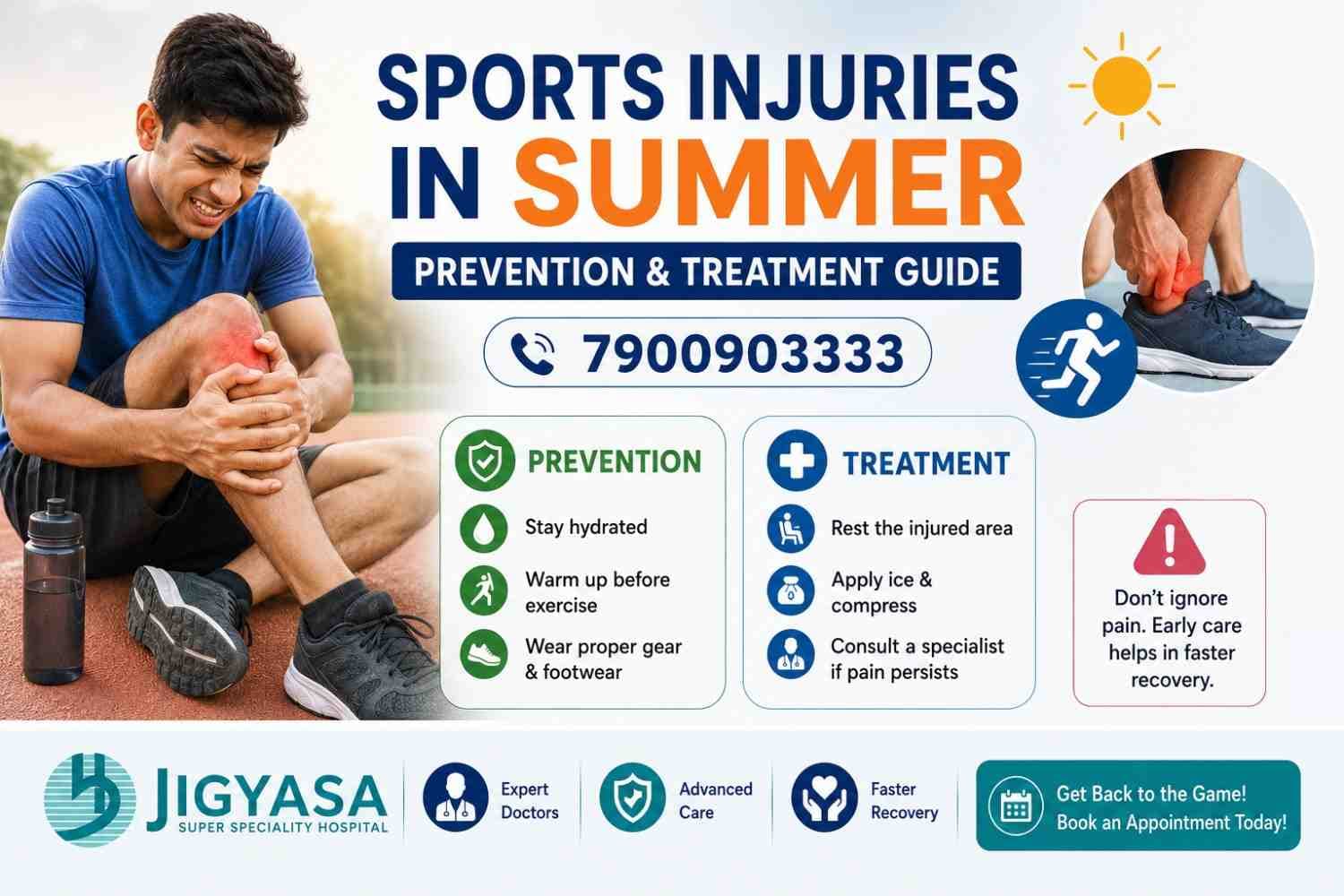
Sports Injuries in Summer — Prevention & Treatment Guide
Muscle Cramps, Ankle Sprains, Heat Stroke & More — How Summer Increases Sports Injury Risk and What to Do About It | Jigyasa Hospital Moradabad (2026)
Summer in Uttar Pradesh is brutal — but it does not stop people from playing. Cricket matches, kabaddi, football, athletics, gym training, morning runs — the sporting calendar in Moradabad and across UP does not pause for the heat. And that is precisely why summer is the season our Orthopaedics and Emergency departments see the highest volume of sports-related injuries every year. The combination of extreme heat, dehydration, fatigue, hard sun-baked ground, and the tendency to skip warm-up creates a perfect environment for injury. Muscles that are dehydrated tear more easily. Joints stressed by heat fatigue give way under sudden load. And heat itself — without proper management — turns a routine training session into a medical emergency. This guide covers every critical sports injury type, why summer makes each one worse, and exactly what to do — at home and at Jigyasa Hospital, Moradabad — to recover fast and prevent the next one.
How Summer Specifically Increases Sports Injury Risk
Dehydration reduces muscle elasticity — dehydrated muscles are stiffer, less pliable, and tear under loads they would normally handle safely. Electrolyte imbalance (loss of sodium, potassium, and magnesium through sweat) causes sudden muscle cramps and coordination failures mid-activity. In extreme heat, the body prioritises cooling over muscular perfusion, reducing oxygen delivery to working muscles.
Heat-related fatigue causes lapses in coordination and reaction time — leading to falls, collisions, and missteps. Hard, dry playing surfaces — sun-baked cricket pitches, concrete courts, and dried grass grounds — absorb less impact and transmit more force to joints and bones. Many players ignore early warning signals like mild pain, cramps, and dizziness in the competitive moment, converting minor issues into serious injuries. And in summer heat, many players assume their body is 'already warm' and skip warm-up and stretching, massively increasing injury risk.
Muscle Cramps — The Most Common Summer Sports Complaint
A muscle cramp is a sudden, involuntary, and extremely painful contraction — most commonly in the calf, hamstring, or foot. It is caused by the combination of dehydration, electrolyte loss (especially sodium and potassium), and muscle fatigue from heat. Even a 2% drop in body hydration significantly increases cramping risk.
Treatment: Stop activity immediately — do not run through a cramp. Gently stretch and massage the cramped muscle, drink a sports electrolyte drink or coconut water, and rest in a cool shaded area until cramping fully resolves. Do not return to activity on the same day if cramps recurred multiple times.
Prevention: Drink 500 ml of water 30 minutes before exercise and hydrate every 15 to 20 minutes during play — do not wait for thirst. Include potassium-rich foods in your daily diet (banana, coconut water, sweet potato) and reduce training intensity during peak heat hours from 11 AM to 4 PM.
Ankle Sprain — Most Common Joint Injury in Summer Sports
An ankle sprain is the stretching or tearing of the ligaments supporting the ankle joint — typically caused by rolling or twisting the foot inward. It is extremely common in cricket, football, kabaddi, badminton, and running. Heat fatigue impairs coordination and proprioception, while hard uneven sun-dried ground creates unpredictable surface conditions that increase risk.
Sprains are graded in three levels. Grade 1 involves mild stretching with minor pain and swelling. Grade 2 is a partial tear with moderate pain, swelling, bruising, and limping. Grade 3 is a complete tear with severe pain, significant swelling, and inability to bear weight.
Treatment follows the PRICE protocol — Protection (stop playing immediately), Rest (avoid weight-bearing for 24 to 48 hours), Ice (apply ice wrapped in cloth for 15 to 20 minutes every 2 to 3 hours for the first 48 hours), Compression (apply a crepe bandage), and Elevation (keep the ankle raised above heart level). Come to Jigyasa Hospital if you cannot bear any weight, if severe swelling develops within minutes suggesting a fracture, if the ankle looks deformed, or if pain does not improve after 3 to 5 days.
Heat Exhaustion and Heat Stroke — A Sports Emergency
Heat exhaustion occurs when the body's cooling system is overwhelmed — the player becomes pale, dizzy, and nauseous with heavy sweating and a rapid but weak pulse. Heat stroke is a life-threatening emergency where the cooling system fails completely and body temperature rises above 40°C.
Warning signs of heat exhaustion include heavy sweating, cold and clammy skin, rapid but weak pulse, nausea or vomiting, muscle cramps, fatigue, weakness, and dizziness or fainting. Heat stroke warning signs are body temperature above 40°C, hot red dry skin where sweating has stopped, rapid and strong pulse, confusion, slurred speech, loss of consciousness, and seizures.
For heat stroke: call 7900903333 and get to Jigyasa Hospital immediately — this is a medical emergency. While waiting, move the person to shade, remove excess clothing, apply cool water or ice packs to the neck, armpits, and groin, and fan aggressively. Do not give water to a confused or unconscious person.
Hamstring Strain — The Runner's and Cricketer's Enemy
A hamstring strain is a tear in one or more of the three muscles at the back of the thigh — ranging from a mild strain to a complete rupture. It is extremely common in sprinters, cricketers, and football players. Dehydrated, insufficiently warmed-up hamstrings are significantly more prone to tearing under explosive movements like sprinting, diving, or sudden acceleration.
Grade 1 involves tightness and minor pain where the player can continue moving. Grade 2 is a partial tear causing sudden sharp pain mid-sprint with visible bruising and limping. Grade 3 is a complete rupture with sudden severe pain, significant swelling, and inability to straighten the knee.
Stop immediately at the first sign of pain — attempting to continue is the most common cause of Grade 1 becoming Grade 3. Apply the PRICE protocol. Grade 1 strains need 1 to 2 weeks of rest plus physiotherapy. Grade 2 and Grade 3 strains must be evaluated by the Orthopaedics team at Jigyasa Hospital.
Stress Fractures — The Slow-Build Summer Injury
A stress fracture is a tiny crack in a bone caused by repetitive impact load — most common in the foot (metatarsals), shin (tibia), and lower back in fast bowlers. Unlike traumatic fractures, stress fractures develop gradually over weeks of overtraining. Dehydrated bone tissue and hard playing surfaces transmit more impact force, and players who increase training intensity rapidly at the start of summer are at highest risk.
Symptoms include dull aching pain that worsens with activity and improves with rest, point tenderness when a specific spot is pressed, and mild swelling without obvious trauma. Stress fractures are often missed on plain X-ray — MRI is the gold-standard diagnostic tool. Treatment involves rest from impact activity for 6 to 8 weeks; the Orthopaedics team at Jigyasa Hospital will determine whether immobilisation is needed.
Shoulder Injuries — Cricket and Badminton Specific
Rotator cuff strains and tears involve damage to the group of four muscles and tendons stabilising the shoulder joint. AC joint injuries (shoulder separation) result from falls onto the shoulder or outstretched hand. These are common in cricketers (bowling and throwing), badminton players, and gym athletes.
Symptoms include pain when lifting the arm above shoulder height, weakness when throwing or serving, night pain (a classic feature of rotator cuff pathology), and a clicking or catching sensation in the shoulder. Treatment involves rest from overhead activity, anti-inflammatory medication, and physiotherapy-guided strengthening. Advanced cases require MRI evaluation and possible surgical repair at Jigyasa Hospital.
Knee Injuries — ACL, Meniscus and Patellar Tendinopathy
An ACL (Anterior Cruciate Ligament) tear typically occurs from sudden pivoting, landing from a jump, or a collision — a pop is felt followed by immediate instability and swelling. A meniscus tear is cartilage damage from twisting on a planted foot, causing a locking or catching sensation. Patellar tendinopathy (Jumper's Knee) is an overuse injury causing pain directly below the kneecap, worse when going downstairs or after prolonged sitting.
Come to Jigyasa Hospital immediately if the knee buckles or gives way when walking, if significant swelling develops within the first 2 hours of injury (indicating blood inside the joint), if the knee is locked and cannot be straightened, or if a pop was heard or felt at the time of injury.
Shin Splints — The Runner's Seasonal Start Injury
Shin splints cause pain along the inner edge of the shinbone (tibia) from overloading the bone and surrounding muscles. They are common in runners who increase mileage too quickly at the start of the summer training season. Treatment involves rest from running for 2 to 4 weeks, ice application for 15 minutes after activity, supportive footwear with adequate cushioning, and a gradual structured return to running with no more than 10% weekly mileage increase.
General First Aid — The PRICE Protocol
Every player and parent should know the PRICE protocol. Protection: stop activity and stabilise the injured area immediately. Rest: no weight-bearing or use of the injured part for at least 24 to 48 hours. Ice: apply an ice pack wrapped in cloth for 15 to 20 minutes every 2 to 3 hours for the first 48 hours. Compression: apply a crepe bandage — firm but not tight enough to cut circulation. Elevation: raise the injured limb above heart level to reduce swelling.
After 48 hours, transition from ice to heat application to promote blood flow and healing.
Summer Sports Injury Prevention — 10 Rules Every Player Must Follow
Hydrate before, during, and after exercise — 500 ml before exercise, 200 to 250 ml every 15 to 20 minutes during activity, and do not wait for thirst. Never skip warm-up regardless of ambient temperature — 10 minutes of dynamic warm-up reduces injury risk by up to 50%. Always cool down with 5 to 10 minutes of gentle stretching after exercise.
Avoid outdoor activity between 11 AM and 4 PM — this is non-negotiable in UP summer; schedule training for early morning before 8 AM or evening after 6 PM. Wear sport-appropriate footwear — worn-out soles are a leading cause of ankle sprains, shin splints, and stress fractures. Increase training load gradually — never increase intensity or distance by more than 10% per week.
Include electrolytes in summer training — for sessions longer than 45 minutes, add a pinch of salt, sugar, and lemon to water or use a sports drink. Listen to your body — pain is a signal, not a challenge. Take rest days seriously — minimum 2 per week in summer. Get a pre-season orthopaedic screening, particularly for competitive athletes, to identify vulnerabilities before injury occurs.
What NOT to Do After a Sports Injury
Do not apply heat in the first 48 hours — it increases blood flow and worsens acute swelling and inflammation. Do not massage an acutely injured joint in the first 24 to 48 hours — it can increase bleeding and inflammation around torn ligaments and muscles. Do not play through significant pain — this single mistake converts minor injuries into season-ending or surgery-requiring ones.
Do not self-diagnose and self-treat for weeks — fractures, ligament tears, and stress fractures require imaging and specialist evaluation. Do not stop rehabilitation too early — the majority of sports injury reinjuries happen because the player returned to activity before full recovery. Do not take painkillers and return to play — painkillers mask the pain signal that protects the injured area from further damage.
Jigyasa Hospital Sports and Orthopaedic Care — What We Offer
Jigyasa Hospital provides 24/7 emergency orthopaedic care including fracture management, dislocation reduction, and acute ligament injury assessment. Advanced imaging — X-ray, MRI, and ultrasound — is available for precise injury diagnosis. Physiotherapy and rehabilitation services offer structured return-to-sport programmes.
Orthopaedic surgery is available for cases requiring intervention, including ACL reconstruction, fracture fixation, and shoulder repair. Sports nutrition counselling covers hydration and electrolyte guidance for summer training. Ayushman Bharat PM-JAY is accepted — sports injury treatment is available under the government scheme for eligible patients.
Final Word — Play Hard, Play Smart
Summer should not stop you from playing the sport you love. The goal is never to avoid activity — it is to prepare for it correctly, respect the heat, and act intelligently when the body signals distress. Train early. Hydrate constantly. Warm up every single time. And when injury happens — because at some point it will — the Orthopaedics and Emergency team at Jigyasa Hospital, Moradabad is ready to get you back on the field as safely and quickly as possible.
The best athletes are not just physically strong — they are medically smart.
Book an Orthopaedic Consultation at Jigyasa Hospital
Reviewed by the Orthopaedics and Sports Medicine Department, Jigyasa Hospital, Near Miglani Cinema, Rampur Road, Moradabad – 244001. 24/7 Emergency. Orthopaedics. MRI and X-ray. Physiotherapy. Ayushman Bharat Accepted.
📞 Phone: 7900903333
📧 Email: info@jigyasahospital.in
🌐 Website: jigyasahospital.com
Frequently Asked Questions
Why are sports injuries more common in summer in India?
Summer significantly increases injury risk because dehydration reduces muscle elasticity, electrolyte loss from sweating causes cramps and coordination failures, heat fatigue slows reaction time, and sun-baked playing surfaces transmit more impact force to joints and bones. Players also tend to skip warm-up in the heat, which dramatically raises injury risk.
What is the PRICE protocol for sports injury first aid?
PRICE stands for Protection (stop activity immediately), Rest (no weight-bearing for 24 to 48 hours), Ice (ice pack wrapped in cloth for 15 to 20 minutes every 2 to 3 hours for the first 48 hours), Compression (crepe bandage), and Elevation (raise the injured limb above heart level). After 48 hours, switch from ice to heat to promote healing.
What is the difference between heat exhaustion and heat stroke in sports?
Heat exhaustion means the body's cooling system is overwhelmed — the player sweats heavily, feels dizzy and nauseous, and has a rapid weak pulse. Heat stroke is a life-threatening emergency where the cooling system fails completely — body temperature exceeds 40°C, sweating stops, and the skin turns hot, red, and dry. Heat stroke requires immediate emergency care at Jigyasa Hospital.
How do I know if my ankle sprain needs an X-ray?
You need an X-ray if you cannot bear any weight on the ankle, if there is severe swelling within minutes of the injury, if the ankle appears deformed or out of alignment, or if pain does not improve after 3 to 5 days of PRICE protocol treatment. Come to Jigyasa Hospital for evaluation — rapid swelling after a sprain can indicate a fracture rather than a ligament injury.
What should I eat and drink before summer sports to prevent cramps?
Drink 500 ml of water 30 minutes before exercise. During activity, take 200 to 250 ml every 15 to 20 minutes. For sessions longer than 45 minutes, include electrolytes — add a pinch of salt, sugar, and lemon to water or use a sports drink. In your daily diet, include potassium-rich foods like bananas, coconut water, and sweet potato to reduce cramp risk.
When is a hamstring strain serious enough to see a doctor?
Any Grade 2 or Grade 3 hamstring strain must be evaluated by an orthopaedic specialist. Signs include a sudden sharp pain mid-sprint, visible bruising or swelling, inability to straighten the knee, or significant difficulty walking. Attempting to continue playing through a hamstring strain is the most common cause of it escalating to a complete tear requiring surgery.
Can stress fractures be missed on an X-ray?
Yes — stress fractures are frequently not visible on plain X-ray, especially in the early stages. MRI is the gold-standard diagnostic tool for stress fractures. If you have dull aching pain in your foot, shin, or lower back that worsens with activity and improves with rest, see the Orthopaedics team at Jigyasa Hospital for an MRI evaluation.
Is it safe to play cricket and other sports in 42°C heat in UP?
It is not safe to play outdoor sports between 11 AM and 4 PM during peak UP summer heat. Schedule training and matches for early morning before 8 AM or evening after 6 PM. Ensure adequate hydration, wear light breathable clothing, and have a plan to respond to heat exhaustion or heat stroke symptoms immediately if they occur.
What does Jigyasa Hospital offer for sports injury treatment?
Jigyasa Hospital provides 24/7 emergency orthopaedic care, advanced imaging (X-ray, MRI, ultrasound), physiotherapy and rehabilitation, orthopaedic surgery (including ACL reconstruction, fracture fixation, and shoulder repair), and sports nutrition counselling. Treatment is available under the Ayushman Bharat PM-JAY scheme for eligible patients.
What should I NOT do immediately after a sports injury?
Do not apply heat in the first 48 hours, do not massage the acutely injured area, do not play through significant pain, do not take painkillers and return to play, and do not stop rehabilitation before full recovery. Also do not self-treat for weeks without medical evaluation — fractures and ligament tears require imaging and specialist diagnosis.