World Thyroid Day — 25th May | Everything You Must Know About Your Thyroid
Hypothyroidism, Hyperthyroidism, TSH Testing & Thyroid-Friendly Living — A Complete Awareness Guide from Jigyasa Hospital Moradabad on World Thyroid Day 2026
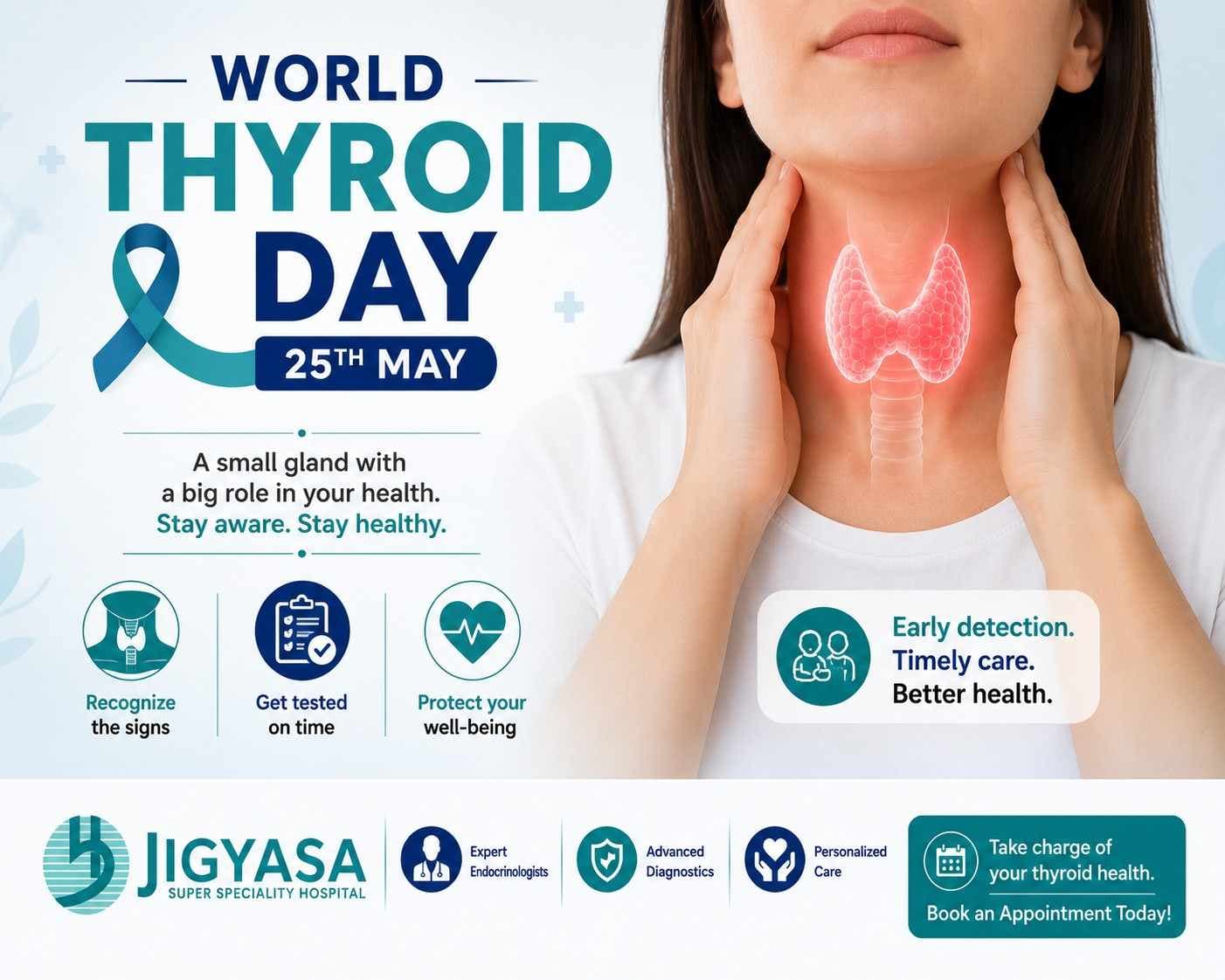
Every year on 25th May, the global medical community observes World Thyroid Day — dedicated to raising awareness about thyroid disorders, promoting early diagnosis, and improving the quality of life of the hundreds of millions of people affected worldwide. The day is led by the European Thyroid Association and supported by thyroid societies across the world, including India. The 2026 theme is: Know Your Thyroid — Early Diagnosis, Better Life. In India, an estimated 42 million people live with some form of thyroid disorder — making it one of the most common endocrine conditions in the country, second only to diabetes. Despite its prevalence, thyroid disease remains massively underdiagnosed — studies suggest that up to 50% of people with thyroid disorders in India are unaware of their condition. At Jigyasa Hospital, Moradabad, this World Thyroid Day we urge every person — particularly women, people over 35, and anyone with a family history of thyroid disease — to get their TSH tested today.
What Is the Thyroid and Why Does It Matter?
The thyroid gland is a small, butterfly-shaped gland located at the front of the neck, just below the Adam's apple. Despite its small size — weighing only 20 to 30 grams — it is one of the most powerful glands in the human body. It produces two critical hormones: T3 (triiodothyronine) and T4 (thyroxine) — which regulate the body's entire metabolic rate.
Thyroid hormones control heart rate, body temperature, energy levels, weight, mood, brain function, digestion, menstrual cycle, fertility, and cholesterol levels. The thyroid is regulated by TSH (Thyroid Stimulating Hormone) produced by the pituitary gland — the most commonly tested marker for thyroid function. The normal TSH range in India is 0.4 to 4.0 mIU/L, though the optimal range for symptom-free function is often considered 1.0 to 2.5 mIU/L. When the thyroid produces too little hormone (hypothyroidism) or too much (hyperthyroidism), virtually every system in the body is affected.
Thyroid Disease in India — The Numbers That Should Alarm Everyone
1 in 8 Indian women will develop a thyroid disorder in her lifetime. Thyroid disorders are 5 to 8 times more common in women than in men. Hypothyroidism (underactive thyroid) affects approximately 11% of the Indian population. Iodine deficiency — still prevalent in several UP districts — remains a leading cause of goitre and hypothyroidism in our region.
Autoimmune thyroid disease (Hashimoto's thyroiditis — the most common cause of hypothyroidism worldwide) is rising rapidly in India, linked to stress, gut health disruption, and environmental factors. UP's Terai belt and hilly regions have historically reported higher rates of iodine deficiency-related thyroid disorders — making thyroid awareness especially critical for patients in and around Moradabad.
Signs of Hypothyroidism (Underactive Thyroid) — Do Not Ignore These
Unexplained weight gain despite no change in diet or activity is one of the most common presentations. Persistent fatigue and weakness — feeling exhausted even after 8 to 9 hours of sleep — is another hallmark sign. Patients also frequently report feeling cold all the time even when others are comfortable, dry skin, dry hair, brittle nails, and hair loss — particularly from the outer third of the eyebrows, which is a classic hypothyroid sign.
Other signs include constipation from sluggish gut motility, depression and brain fog, poor memory, slow heart rate below 60 beats per minute, and puffy or swollen face particularly in the morning. In women of reproductive age, irregular or heavy menstrual periods and difficulty conceiving are very common presentations — hypothyroidism is a leading but under-recognised cause of infertility and recurrent miscarriage in Indian women. High cholesterol that does not respond to dietary changes is also frequently a thyroid-related finding.
Signs of Hyperthyroidism (Overactive Thyroid) — Know These Too
Unexplained weight loss despite normal or increased appetite is the most characteristic feature. Rapid or irregular heartbeat with heart rate consistently above 100 at rest, fine tremors in the hands and fingers, excessive sweating, and intolerance to heat are all common presentations. Patients often describe anxiety, nervousness, and irritability — a feeling of being constantly wired and unable to calm down.
Other signs include difficulty sleeping despite exhaustion, frequent bowel movements or diarrhoea, and muscle weakness particularly in the upper arms and thighs. Bulging eyes (exophthalmos) are characteristic of Graves' disease, the most common cause of hyperthyroidism. A visible swelling at the front of the neck (goitre) indicates an enlarged thyroid and requires prompt evaluation.
Who Should Get a Thyroid Test Today?
On this World Thyroid Day, Jigyasa Hospital strongly recommends thyroid screening for: women of any age — particularly those experiencing irregular periods, difficulty conceiving, or unexplained weight changes; anyone pregnant or planning pregnancy — untreated thyroid disorders during pregnancy cause miscarriage, preterm birth, and developmental problems in the baby, making thyroid testing essential before and during every pregnancy; and anyone above 35 years of age, as thyroid disorders increase sharply with age.
Screening is also recommended for anyone with a family history of thyroid disease, diabetes, or autoimmune conditions; anyone experiencing persistent fatigue, weight changes, hair loss, or mood disorders without a clear cause; anyone with high cholesterol not responding to dietary changes; patients already on thyroid medication who require TSH monitoring every 6 to 12 months; and anyone with a visible neck swelling or lump — which requires immediate evaluation to rule out thyroid nodules or cancer.
Thyroid Treatment — What to Expect
Hypothyroidism is treated with Levothyroxine (T4 replacement) — a once-daily oral tablet taken on an empty stomach, 30 to 60 minutes before breakfast. In most patients this is a lifelong medication. Hyperthyroidism is treated with antithyroid medications (carbimazole, propylthiouracil), radioiodine therapy, or surgical removal of the thyroid gland depending on the cause and severity.
Thyroid nodules require ultrasound evaluation and in some cases FNAC (fine needle aspiration cytology) to rule out malignancy — the vast majority of nodules are benign. Thyroid cancer, while rare, is highly treatable when caught early; survival rates exceed 95% with timely surgery and radioiodine ablation. Treatment of thyroid disease requires regular follow-up — TSH, T3, and T4 levels must be monitored periodically to adjust medication doses as needed.
Thyroid-Friendly Lifestyle Tips — From Our Medical Team
Use iodised salt — the single simplest step to prevent iodine deficiency-related thyroid disorders; ensure your household uses only iodised salt in cooking. Eat selenium-rich foods such as Brazil nuts, sunflower seeds, eggs, and tuna — selenium is essential for thyroid hormone conversion. Limit raw cruciferous vegetables in excess if you have hypothyroidism — raw cabbage, cauliflower, and broccoli contain goitrogens that can mildly interfere with thyroid hormone production; cooking neutralises this effect. Avoid excess soy, which can interfere with thyroid hormone absorption when consumed close to medication.
Take thyroid medication correctly — Levothyroxine must be taken on an empty stomach, and calcium supplements, iron tablets, and antacids must be taken at least 4 hours apart as they block absorption. Manage stress — chronic stress elevates cortisol, which suppresses thyroid function and worsens autoimmune thyroid disease. Sleep 7 to 8 hours — sleep deprivation directly impairs thyroid hormone production. Check for Vitamin D and B12 deficiency — both are commonly depleted in hypothyroid patients and significantly worsen fatigue and mood symptoms.
Jigyasa Hospital's World Thyroid Day Message — 25th May 2026
Thyroid disease is silent, common, and completely manageable — but only when it is diagnosed. A single TSH blood test — affordable, quick, and widely available — is all it takes to know whether your thyroid is functioning normally. Do not normalise fatigue, weight gain, hair loss, or irregular periods — these are your thyroid speaking to you.
Do not wait until symptoms are severe — early diagnosis is the most powerful tool in thyroid health. This World Thyroid Day, Jigyasa Hospital, Moradabad pledges to make thyroid awareness and testing accessible to every patient in our community. Millions of Indians are living with thyroid disorders they do not know they have. A simple blood test today can change the trajectory of your health for the next decade.
Book Your Thyroid Test and Consultation at Jigyasa Hospital
TSH | T3 | T4 | Thyroid Ultrasound | Endocrinology and General Medicine OPD | Ayushman Bharat Accepted. Reviewed by the Internal Medicine and General Physician Department, Jigyasa Hospital, Near Miglani Cinema, Rampur Road, Moradabad – 244001.
📞 Phone: 7900903333
📧 Email: info@jigyasahospital.in
🌐 Website: jigyasahospital.com
Frequently Asked Questions
What is World Thyroid Day and when is it observed?
World Thyroid Day is observed every year on 25th May. It is led by the European Thyroid Association and supported by thyroid medical societies worldwide, including India. The day is dedicated to raising awareness about thyroid disorders, promoting early diagnosis, and improving the quality of life of patients living with thyroid conditions.
What is the normal TSH range in India?
The normal TSH range in India is 0.4 to 4.0 mIU/L. However, many physicians consider 1.0 to 2.5 mIU/L to be the optimal range for symptom-free thyroid function. If your TSH falls outside the normal range, consult the General Medicine or Endocrinology team at Jigyasa Hospital for evaluation and treatment.
What are the early signs of hypothyroidism in women?
Early signs include unexplained weight gain, persistent fatigue even after adequate sleep, feeling cold all the time, dry skin and hair, hair loss especially from the outer eyebrows, constipation, depression, brain fog, and irregular or heavy menstrual periods. Difficulty conceiving is also a common but frequently overlooked presentation of hypothyroidism in Indian women.
How is hypothyroidism treated?
Hypothyroidism is treated with Levothyroxine — a once-daily oral T4 replacement tablet taken on an empty stomach, 30 to 60 minutes before breakfast. For most patients this is a lifelong medication. The dose is adjusted based on regular TSH monitoring every 6 to 12 months. Calcium, iron, and antacids must be taken at least 4 hours apart from Levothyroxine as they block absorption.
Can thyroid disorders cause infertility?
Yes. Hypothyroidism is a leading but frequently under-recognised cause of infertility and recurrent miscarriage in Indian women. Thyroid hormones are essential for ovulation and for maintaining a healthy pregnancy. Any woman experiencing difficulty conceiving should have a TSH test done as part of her initial evaluation. Thyroid testing is also mandatory before and during every pregnancy.
What is the difference between hypothyroidism and hyperthyroidism?
Hypothyroidism means the thyroid is underactive and produces too little hormone — causing weight gain, fatigue, cold intolerance, slow heart rate, and depression. Hyperthyroidism means the thyroid is overactive and produces too much hormone — causing weight loss, rapid heartbeat, anxiety, tremors, heat intolerance, and excessive sweating. Both are diagnosed with a TSH blood test and managed with specific treatments.
Should I avoid any foods if I have thyroid disease?
If you have hypothyroidism, limit raw cruciferous vegetables like cabbage, cauliflower, and broccoli in large quantities — they contain goitrogens that can mildly interfere with thyroid hormone production (cooking neutralises this). Avoid excess soy close to your thyroid medication. Use iodised salt and include selenium-rich foods like eggs and sunflower seeds. If you have hyperthyroidism, your doctor may advise limiting iodine-rich foods — consult the Jigyasa Hospital team for personalised guidance.
What thyroid tests are available at Jigyasa Hospital Moradabad?
Jigyasa Hospital offers TSH, T3, and T4 blood tests for thyroid function assessment, thyroid ultrasound for evaluating thyroid size, nodules, and structural abnormalities, and FNAC (fine needle aspiration cytology) for nodule evaluation when required. Consultations are available through the Endocrinology and General Medicine OPD. Ayushman Bharat PM-JAY is accepted for eligible patients.
Is thyroid cancer serious?
Thyroid cancer is rare and, when caught early, is one of the most treatable cancers with survival rates exceeding 95%. Most thyroid nodules are benign. Any visible neck swelling or lump should be evaluated immediately with an ultrasound and, if needed, FNAC. Do not ignore a neck lump — early evaluation at Jigyasa Hospital can rule out serious pathology quickly.
Who is at highest risk for thyroid disorders in India?
Women are 5 to 8 times more likely than men to develop thyroid disorders. Risk is higher for anyone over 35, those with a family history of thyroid disease or autoimmune conditions, pregnant women or those planning pregnancy, people living in iodine-deficient areas (including parts of UP), and anyone with unexplained fatigue, weight changes, or hair loss. On World Thyroid Day, Jigyasa Hospital urges all of these groups to get a TSH test done today.