
Echocardiography in Moradabad — Dr. Amit Kumar Singh, Jigyasa Hospital
If your doctor has recommended an echo test, or if you have been experiencing chest discomfort, shortness of breath, or irregular heartbeats, getting a reliable echocardiography done at the right centre makes all the difference. At Jigyasa Hospital, Moradabad, we offer state-of-the-art echocardiography services under the expert guidance of Dr. Amit Kumar Singh, a highly experienced cardiologist dedicated to providing precise, patient-centred cardiac care.
Patients from Moradabad, Rampur, Sambhal, Amroha, and surrounding districts of western Uttar Pradesh trust Dr. Amit Kumar Singh for his meticulous approach to cardiac imaging, his ability to explain complex findings in plain language, and his commitment to ensuring every patient leaves with a clear understanding of their heart health and the next steps in their care.
Transthoracic Echocardiography (TTE)
The standard, painless echo test using a probe placed on the chest. No sedation required. First-line investigation for most heart conditions with same-day results at Jigyasa Hospital.
Stress Echocardiography
Evaluates heart performance under physical exertion or pharmacological stress. Essential for diagnosing coronary artery disease and identifying hidden ischaemia not visible at rest.
Doppler & Colour Doppler Echo
Measures blood flow speed and direction through the heart. Vital for quantifying valve stenosis, regurgitation severity, and chamber pressures with visual colour mapping.
2D & M-Mode Echocardiography
Provides real-time cross-sectional images and precise chamber measurements. M-Mode is particularly useful for measuring wall thickness and tracking changes over time.
Foetal Echocardiography
Safe ultrasound assessment of the foetal heart during pregnancy. Recommended when family history of congenital heart disease exists or obstetric scans suggest a cardiac abnormality.
Integrated Cardiac Assessment
Echo findings combined with ECG, blood tests, and clinical history by Dr. Amit Kumar Singh for a complete cardiac evaluation and a personalised treatment plan.
What Is Echocardiography?
Echocardiography, commonly known as an echo test or cardiac ultrasound, is a non-invasive diagnostic procedure that uses high-frequency sound waves to create detailed, real-time images of the heart. It allows the cardiologist to see the heart structure, its chambers, valves, walls, and the blood flow through it with exceptional clarity.
Unlike an ECG, which only records the heart electrical activity, an echocardiogram provides a visual picture of how the heart is physically functioning. It is one of the most important and widely used diagnostic tools in modern cardiology, forming the cornerstone of cardiac assessment at Jigyasa Hospital.
Key information an echocardiogram provides:
- Size and shape of the heart chambers
- Thickness and movement of the heart walls
- Pumping efficiency measured as Ejection Fraction
- Valve function including whether valves are opening and closing properly
- Presence of fluid around the heart known as pericardial effusion
- Blood clots or tumours inside the heart
- Congenital heart defects present from birth
Types of Echocardiography Available at Jigyasa Hospital
At Jigyasa Hospital, we offer a comprehensive range of echocardiography modalities to meet diverse diagnostic needs. Dr. Amit Kumar Singh selects the most appropriate type based on your clinical presentation and the specific information required.
1. Transthoracic Echocardiography (TTE) — Standard Echo
The most commonly performed echo test. A small probe called a transducer is placed on the chest over the skin. It is completely painless, requires no sedation, and is the first-line investigation for most heart conditions. Results are available quickly, making it ideal for routine cardiac assessment and initial evaluation of any cardiac symptom.
2. Stress Echocardiography
Also called a Stress Echo, this test evaluates how the heart performs under physical exertion. Echo images are taken before and immediately after exercise on a treadmill or using medication to simulate exercise. It is particularly useful for diagnosing coronary artery disease and identifying areas of the heart that are not receiving adequate blood supply, even when a resting ECG appears normal.
3. Doppler Echocardiography
Doppler echo measures the speed and direction of blood flow through the heart and its vessels. It is essential for assessing valve problems such as stenosis or regurgitation, detecting abnormal blood flow patterns, and measuring pressures within the heart chambers. Colour Doppler adds a visual colour map to blood flow, making interpretation easier and more precise for clinical decision-making.
4. 2D Echocardiography
This provides two-dimensional cross-sectional images of the heart in real time. It is the standard format used for most clinical evaluations and forms the foundation of every comprehensive echo examination performed at Jigyasa Hospital.
5. M-Mode Echocardiography
An older but still highly useful technique that provides a single-line image of the heart recorded over time. It is particularly helpful for precise measurements of heart wall thickness and chamber dimensions, and is used alongside 2D echo for comprehensive structural assessment.
6. Foetal Echocardiography
Performed during pregnancy to evaluate the structure and function of the foetal heart. This is recommended when there is a family history of congenital heart disease or when routine obstetric scans detect a potential cardiac abnormality in the foetus. It is completely safe for both mother and baby.
Why Is Echocardiography Recommended?
Dr. Amit Kumar Singh at Jigyasa Hospital recommends an echocardiogram for a wide range of symptoms and clinical situations. It is one of the most informative and versatile investigations in cardiology, providing answers that no other single test can offer.
Symptom-based indications:
- Chest pain or pressure, especially on exertion
- Palpitations such as irregular or fast heartbeat
- Unexplained shortness of breath or breathlessness while lying flat
- Persistent fatigue or dizziness without a clear cause
- Swollen legs or feet known as oedema
- Fainting spells or near-fainting episodes
Medical conditions where echo is essential:
- Suspected or confirmed heart failure
- Valvular heart disease including mitral valve prolapse and aortic stenosis
- Coronary artery disease or post-heart attack evaluation
- Cardiomyopathy or diseases of the heart muscle
- Hypertensive heart disease caused by long-standing high blood pressure
- Congenital heart defects
- Infective endocarditis or infection of the heart valves
- Pericardial disease involving the sac surrounding the heart
- Pre-operative cardiac evaluation before major surgeries
Monitoring and follow-up indications:
- Tracking the response to cardiac medications over time
- Post-surgery evaluation after valve replacement or bypass surgery
- Monitoring athletes undergoing high-level physical training
Meet Your Cardiologist: Dr. Amit Kumar Singh
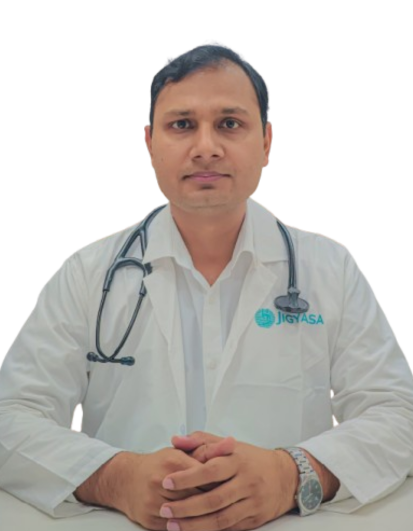
Dr. Amit Kumar Singh is the lead cardiologist at Jigyasa Hospital, Moradabad, bringing years of specialised training and clinical experience in both interventional and non-invasive cardiology. He is the foremost expert in echocardiography and cardiac imaging in Moradabad, personally reviewing and interpreting every echo examination performed at the hospital.
His areas of clinical expertise include echocardiography interpretation and advanced cardiac imaging, management of coronary artery disease, heart failure, and valvular disorders, hypertension and dyslipidaemia management, preventive cardiology and lifestyle counselling, and cardiac risk stratification for high-risk patients.
Dr. Singh believes in a thorough, evidence-based approach to diagnosis. Every patient referred for echocardiography at Jigyasa Hospital receives a detailed consultation, a meticulous echo examination, and a comprehensive written report that is explained in plain language so that patients and their families can make fully informed decisions about their care.
His approach is grounded in empathy and precision. He understands that a cardiac diagnosis can be anxiety-inducing, and he takes genuine time with each patient to address their concerns, explain their echo findings, and guide them clearly through the next steps of their treatment journey.
The Echocardiography Procedure: What to Expect at Jigyasa Hospital
Many patients feel nervous before a diagnostic procedure. Here is exactly what happens during an echo test at Jigyasa Hospital, so you know there is nothing to worry about.
Before the Test
- For a standard TTE, no special preparation is needed. You can eat and drink normally.
- For a stress echo, you may be asked to avoid heavy meals for a few hours beforehand.
- Wear comfortable, loose-fitting clothing for easy access to the chest area.
- Continue your regular medications unless Dr. Singh specifically advises otherwise.
During the Test
- You will be asked to lie on a comfortable examination table, typically on your left side.
- Three small electrode pads are placed on the chest to monitor your heart rhythm throughout the procedure.
- A water-based gel is applied to the chest to ensure good contact between the transducer and skin.
- The cardiologist gently moves the probe across different positions on the chest to capture images of all heart structures from multiple angles.
- You may be asked to breathe in, breathe out, or hold your breath briefly for clearer image capture.
- The entire procedure takes approximately 30 to 45 minutes from start to finish.
After the Test
- There are no side effects. You can resume all normal activities immediately after the test.
- The echo images are personally analysed by Dr. Amit Kumar Singh, not a generic report reader.
- A detailed written report with measurements and clinical interpretation is prepared and discussed with you, usually on the same day or within 24 hours.
Understanding Your Echo Report: Key Parameters Explained
When Dr. Amit Kumar Singh reviews your echocardiogram, the report will include several important measurements. Here is a guide to the key parameters and what they mean for your heart health:
| Parameter | What It Measures | Normal Range |
|---|---|---|
| Ejection Fraction (EF) | Percentage of blood pumped out per beat | 55–70% |
| LVEDD | Size of left ventricle when relaxed | 3.5–5.6 cm |
| IVS Thickness | Thickness of wall between chambers | 0.6–1.1 cm |
| Left Atrial Size | Size of left atrium | < 4.0 cm |
| Diastolic Function | Heart ability to relax and fill | E/A ratio 1–2 |
| TAPSE | Right ventricular function | ≥ 1.7 cm |
A reduced Ejection Fraction, for example, may indicate heart failure with reduced pumping function and directly guides the treatment plan Dr. Singh will recommend for you.
Conditions Diagnosed and Managed at Jigyasa Hospital
Echocardiography is the foundation of cardiac diagnosis at Jigyasa Hospital. Based on echo findings, Dr. Amit Kumar Singh evaluates and manages the full spectrum of cardiac conditions.
Heart Failure
Whether due to a weakened heart muscle (HFrEF) or a stiff heart (HFpEF), echocardiography is the definitive tool for diagnosis and ongoing monitoring. Treatment plans are tailored based on Ejection Fraction measurements and detailed Doppler assessments of filling pressures.
Valvular Heart Disease
Mitral stenosis, aortic regurgitation, mitral valve prolapse, and tricuspid disorders are precisely evaluated using Doppler echo. Colour Doppler quantifies the severity of leakage or obstruction, guiding decisions about medical therapy, balloon valvuloplasty, or surgical valve intervention.
Hypertensive Heart Disease
Long-standing high blood pressure causes the heart muscle to thicken, a condition known as hypertrophy. Echo detects these changes at an early stage, allowing timely intervention to prevent progression to heart failure or dangerous arrhythmias.
Coronary Artery Disease
Wall motion abnormalities visible on echo indicate areas of the heart that have been damaged by a heart attack or are at risk due to blocked arteries. Stress echocardiography further unmasks hidden ischaemia that may be invisible on a resting ECG or standard echo.
Cardiomyopathy
Dilated, hypertrophic, and restrictive cardiomyopathies are diagnosed using detailed echo parameters including chamber dimensions, wall thickness, and tissue Doppler velocities. These conditions affect the heart muscle directly and require long-term specialised management.
Pericardial Effusion
Fluid accumulation around the heart is clearly identified on echocardiography. In emergency situations where the fluid is causing haemodynamic compromise, echo guides drainage procedures such as pericardiocentesis safely and accurately.
Congenital Heart Disease
Echo remains the primary tool for diagnosing and monitoring structural defects present from birth, including atrial septal defect (ASD), ventricular septal defect (VSD), and patent ductus arteriosus (PDA). It is used from foetal life through adulthood for complete congenital cardiac assessment.
Why Choose Jigyasa Hospital for Echocardiography in Moradabad?
Residents of Moradabad and the surrounding regions including Sambhal, Amroha, Rampur, Bijnor, and Hapur trust Jigyasa Hospital for advanced cardiac diagnostics. Here is what sets us apart.
Expert Cardiologist On-Site
Dr. Amit Kumar Singh personally reviews every echocardiogram. You receive a clinical interpretation from a specialist cardiologist who discusses findings directly with you — not a generic radiologist report.
Advanced Echo Equipment
Jigyasa Hospital is equipped with a high-resolution digital echocardiography system with full Doppler and Colour Doppler capability, ensuring image quality that supports accurate and reliable diagnosis.
Same-Day Reports
For most patients, detailed echo reports are available on the same day. This is critical when prompt cardiac diagnosis and rapid clinical decision-making are needed.
Integrated Cardiac Care
Echo findings are integrated with your full clinical history, ECG, blood tests, and other investigations to provide a holistic cardiac assessment and a clear, personalised management plan.
Patient-First Approach
From booking to report discussion, every step is designed to minimise wait times and reduce anxiety. Our team ensures elderly and unwell patients receive full assistance throughout their visit.
Affordable, Transparent Pricing
Quality cardiac care should be accessible. Echo test fees at Jigyasa Hospital are competitively priced with no hidden charges, making advanced cardiac diagnostics available to all patients across the region.
What Patients Say About Dr. Amit Kumar Singh
I was experiencing severe breathlessness and my family was very worried. Dr. Amit Kumar Singh performed a detailed echocardiogram at Jigyasa Hospital and explained every finding patiently. He diagnosed reduced ejection fraction and started the right treatment. Within two months I was feeling significantly better. His clarity and calmness made a difficult diagnosis much easier to accept.
Vikram Sharma
Echocardiography & Heart Failure Management · Moradabad
I had been told by another doctor that I might need valve surgery. I came to Dr. Amit Kumar Singh for a second opinion. His echo was thorough and he explained the Doppler findings in simple Hindi so my family could understand. He reassured us that medical management was sufficient at this stage and gave a clear follow-up plan. We are very grateful for his honest and expert guidance.
Meena Gupta
Valve Disease Assessment · Rampur
I had been getting chest pain during exercise but my ECG was always normal. Dr. Singh recommended a stress echo at Jigyasa Hospital. It identified a problem with blood supply to part of my heart that the ECG had missed. He referred me promptly for further management and the condition was treated in time. I cannot imagine what might have happened without that test.
Farhan Ahmed
Stress Echocardiography · Sambhal
Book Your Echocardiography at Jigyasa Hospital, Moradabad
Do not ignore your heart health. Whether you have been referred by another doctor, are experiencing symptoms that concern you, or want a specialist second opinion on a previous echo report, Dr. Amit Kumar Singh and the Jigyasa Hospital cardiology team are here to help. Expert echocardiography and complete cardiac care are available right here in Moradabad — no need to travel to Delhi or Lucknow.
Jigyasa Hospital is located near Miglani Cinema, Rampur Road, Moradabad 244001 — easily accessible from across the city and from surrounding districts including Rampur, Sambhal, Amroha, and Bijnor. Same-day consultation slots are frequently available for urgent cardiac cases. You can also search Jigyasa Hospital Rampur Road Moradabad on Google Maps for precise directions.
Address
Near Miglani Cinema, Rampur Road, Moradabad 244001
Call Us (24/7)
+91-7900903333Email Us
info@jigyasahospital.inFrequently Asked Questions — Echocardiography in Moradabad
What is an echocardiogram and why is it done?
An echocardiogram is a non-invasive ultrasound test that creates real-time images of the heart. Dr. Amit Kumar Singh at Jigyasa Hospital uses it to assess heart chamber size, valve function, pumping efficiency (Ejection Fraction), and blood flow patterns. It is recommended for chest pain, breathlessness, palpitations, heart failure, valve disease, and pre-operative cardiac evaluation.
Is an echocardiogram the same as an ECG?
No. An ECG records the heart's electrical signals and takes just a few minutes. An echocardiogram uses ultrasound to produce moving images of the heart's structure and function, providing far more detailed anatomical and functional information than an ECG alone.
Is the echo test painful or harmful?
Not at all. Echocardiography is completely non-invasive and painless. There are no needles, no radiation, and no discomfort involved. It is safe for all age groups including newborns, elderly patients, and pregnant women (for foetal echocardiography).
How long does the echo test take at Jigyasa Hospital?
A standard transthoracic echo takes approximately 30 to 45 minutes including preparation. A stress echocardiogram may take 60 to 90 minutes. Reports are typically available on the same day, interpreted personally by Dr. Amit Kumar Singh.
Do I need to fast before my echo test?
For a standard resting echo, fasting is not required and you can eat and drink normally. If you are scheduled for a stress echo or a trans-oesophageal echo (TOE), specific preparation instructions will be provided by the Jigyasa Hospital team in advance.
How do I book an appointment with Dr. Amit Kumar Singh?
Call +91-7900903333, email info@jigyasahospital.in, or visit jigyasahospital.com to book online. You can also walk in to Jigyasa Hospital, Near Miglani Cinema, Rampur Road, Moradabad 244001. Same-day consultation slots are often available for urgent cardiac cases.
Why Patients Choose Us
- 24/7 Emergency & Trauma Care
- Top Specialist Doctors
- Modern ICU & Operation Theatres
- Transparent & Affordable Pricing
- Ayushman Bharat Empanelled
- Cashless Insurance Support
- Multispeciality Under One Roof
Our Location
Near Miglani Cinema,
Rampur Road,
Moradabad 244001