
Heart Attack Treatment in Moradabad – Expert Cardiac Care at Jigyasa Hospital
A heart attack (myocardial infarction) is one of the most life-threatening medical emergencies a person can face. When a coronary artery becomes blocked, heart muscle cells begin to die within minutes — making rapid, expert treatment the difference between life and death. At Jigyasa Hospital, Moradabad, we offer state-of-the-art cardiac emergency care and interventional cardiology services, led by our Senior Cardiologist, Dr Amit Kumar Singh, to give every patient the best possible chance of a full recovery.
Whether you are experiencing a cardiac emergency right now or seeking expert management and prevention of heart disease, our team is available 24 hours a day, 7 days a week. Our cardiac catheterisation laboratory, advanced ICCU, and dedicated rehabilitation programme ensure you receive world-class heart care without needing to travel to Delhi or Lucknow.
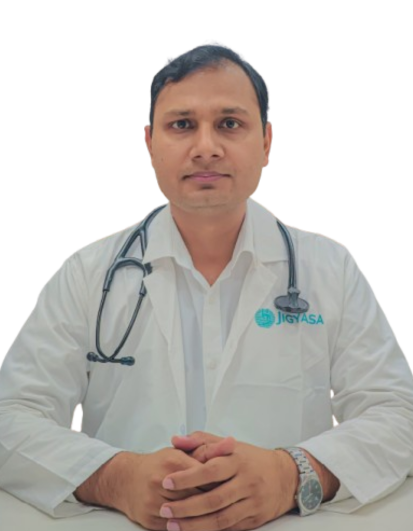
Meet Your Expert – Dr Amit Kumar Singh
Dr Amit Kumar Singh – Senior Cardiologist
Qualifications: MD (BHU), DM Cardiology (KGMU), FSCA
Dr Amit Kumar Singh is a fellowship-trained cardiologist with extensive expertise in acute coronary syndrome management, including heart attacks, unstable angina, arrhythmias, and heart failure. With a DM in Cardiology from King George Medical University (KGMU) — one of India's premier medical institutions — and FSCA fellowship status, Dr Singh brings subspecialty-level precision and evidence-based practice to every patient he treats. He is part of Jigyasa Hospital's multidisciplinary cardiac team, collaborating with interventional radiologists, cardiac surgeons, and rehabilitation specialists for comprehensive patient care.
Primary PCI (Angioplasty & Stenting)
Gold-standard heart attack treatment with over 95% success rate in restoring coronary blood flow using advanced catheter-based intervention.
DM Cardiology from KGMU
Dr Amit Kumar Singh holds MD (BHU) and DM Cardiology (KGMU) with FSCA fellowship, ensuring subspecialty-level expertise in every case.
Door-to-Balloon Under 90 Minutes
Our emergency protocol is designed to minimise time from hospital arrival to coronary intervention, directly improving survival outcomes.
24/7 Cardiac Emergency Response
Round-the-clock emergency cardiac services with dedicated ambulances carrying ECG and advanced life support equipment.
Comprehensive Cardiac Rehabilitation
Three-phase evidence-based rehabilitation programme from in-hospital recovery to long-term cardiovascular health maintenance.
Advanced Cardiac Care in Moradabad
No need to travel to Delhi or Lucknow. World-class interventional cardiology is now available right here in Moradabad.
What Is a Heart Attack?
The heart is a muscular pump that beats approximately 100,000 times per day, continuously supplying oxygen-rich blood to every organ in the body. To sustain this effort, the heart muscle itself requires a constant supply of blood through a network of arteries called the coronary arteries.
A heart attack, medically known as a myocardial infarction (MI), occurs when one or more of these coronary arteries becomes severely narrowed or completely blocked — most commonly due to a blood clot forming on a ruptured cholesterol plaque inside the artery wall. When blood flow stops, the heart muscle supplied by that artery is deprived of oxygen. Without immediate restoration of flow, heart muscle cells begin to die irreversibly within minutes, reducing the heart's pumping capacity and potentially leading to fatal arrhythmias, cardiogenic shock, or cardiac arrest.
In India, cardiovascular disease is the leading cause of mortality, with heart attacks accounting for a significant proportion of all cardiac emergencies. Recognising symptoms early and reaching a hospital equipped for Primary PCI is the most critical factor determining survival and long-term heart function.
Causes of Heart Attacks
- •Atherosclerosis: Gradual build-up of cholesterol plaques narrowing coronary arteries over years
- •Plaque rupture and clot formation: Sudden rupture of a vulnerable plaque triggers an acute blood clot that blocks the artery
- •Coronary artery spasm: Severe temporary spasm of a coronary artery can restrict blood flow even without significant plaque
Key Risk Factors
- • High blood pressure (hypertension)
- • High cholesterol (dyslipidaemia)
- • Diabetes or insulin resistance
- • Smoking and tobacco use
- • Obesity and sedentary lifestyle
- • Strong family history of heart disease
- • Chronic stress and poor sleep
- • Age (men over 45, women over 55)
Recognising Heart Attack Symptoms
Classic Symptoms — Call Emergency Now
- • Severe chest pain, pressure, squeezing, or heaviness
- • Pain radiating to the left arm, jaw, neck, or back
- • Shortness of breath, often with chest discomfort
- • Cold sweats unrelated to physical activity
Atypical Symptoms (Women and Elderly)
- • Unusual fatigue without obvious cause
- • Upper abdominal discomfort or nausea
- • Jaw or tooth pain not explained by dental cause
- • Unusual indigestion or burning sensation
If you or anyone around you experiences these symptoms, call our emergency line immediately. Do not wait and do not drive yourself to the hospital. Our 24/7 cardiac ambulance is equipped with ECG and advanced life support to begin treatment before you even arrive at Jigyasa Hospital.
Our Emergency Cardiac Response Protocol
Dedicated cardiac ambulances with ECG and paramedic-administered advanced life support en route to hospital
12-lead ECG performed within 10 minutes of hospital arrival for immediate diagnosis
Cardiac biomarker testing, echocardiography, and chest X-ray completed in parallel for rapid diagnosis
Catheterisation laboratory activated immediately for confirmed STEMI cases — zero delay to intervention
Door-to-balloon target of under 90 minutes — a benchmark directly linked to reduced heart muscle damage
Immediate ICCU admission with continuous cardiac monitoring, defibrillator readiness, and 24/7 physician presence
Advanced Heart Attack Treatment Options
1. Primary PCI (Angioplasty and Stenting)
- 1Local anaesthesia at wrist or groin; thin catheter inserted into artery
- 2Coronary angiography performed to locate and visualise the blocked vessel
- 3Balloon inflated at blockage site to compress plaque and open the artery
- 4Drug-eluting stent deployed to keep the artery permanently open
- 5Blood flow restored; patient transferred to ICCU for monitoring and recovery
2. Thrombolytic Therapy
Where PCI is not immediately available or is medically contraindicated, fibrinolytic (clot-dissolving) agents are administered intravenously. These are most effective within 12 hours of symptom onset and are often used as a bridge to PCI. Dual antiplatelet therapy is given alongside to reduce re-clotting risk.
Why Primary PCI Wins
- • Over 95% success rate restoring blood flow
- • Lower risk of re-infarction vs thrombolysis
- • Significantly reduced in-hospital mortality
- • Preserves more functioning heart muscle
- • Suitable for most patients including elderly
3. Conservative Medical Management
For NSTEMI or when revascularisation is deferred: dual antiplatelet therapy, beta-blockers, ACE inhibitors, high-intensity statins, and anticoagulation as guided by individual risk assessment.
Intensive Cardiac Care Unit (ICCU) at Jigyasa Hospital
ICCU Capabilities
- • Continuous real-time cardiac monitoring and ECG analysis
- • Haemodynamic support including mechanical assist devices
- • Defibrillators and temporary pacemakers on standby
- • Intra-aortic balloon pump for cardiogenic shock support
- • 24/7 intensivist and cardiac nurse presence
Complication Management
Post-Heart Attack Cardiac Rehabilitation Programme
Phase 1 — In-Hospital (Days 1–5)
- • Supervised bed exercises to prevent deconditioning
- • Controlled ambulation with cardiac monitoring
- • Patient and family education
- • Risk factor assessment and discharge planning
Phase 2 — Early Recovery (Weeks 2–6)
- • Outpatient supervised exercise under ECG monitoring
- • Nutritional counselling for heart-healthy diet
- • Psychological support for anxiety and depression
- • Medication optimisation and adherence review
Phase 3 — Long-Term (Week 6+)
- • Ongoing community exercise programmes
- • Blood pressure, cholesterol, and diabetes control
- • Regular follow-up with Dr Amit Kumar Singh
- • Return-to-work and vocational guidance
Why Choose Dr Amit Kumar Singh at Jigyasa Hospital?
Clinical Excellence
- • DM Cardiology from KGMU, FSCA fellowship
- • Hundreds of successful PCI procedures annually
- • Advanced cardiac catheterisation laboratory
- • Digital angiography and echocardiography suite
- • International standard outcomes and protocols
Patient Experience
Preventing a Heart Attack — Risk Factor Control
Up to 80% of premature heart attacks are preventable through lifestyle modification and targeted management of known risk factors. Dr Amit Kumar Singh offers comprehensive preventive cardiology consultations for patients at elevated cardiovascular risk.
Key prevention pillars include achieving blood pressure below 130/80 mmHg, maintaining LDL cholesterol below 100 mg/dL (or 70 mg/dL for high-risk patients), keeping HbA1c below 7% in diabetics, engaging in at least 150 minutes of moderate aerobic activity per week, complete smoking cessation, adopting a Mediterranean or DASH dietary pattern, and effective stress and sleep management.
Cardiac Emergency or Consultation — We Are Here 24/7
Do not wait if you suspect a heart attack. Every minute counts. If you are seeking preventive cardiology advice, heart failure management, or a second opinion on a cardiac diagnosis, Dr Amit Kumar Singh and the Jigyasa Hospital cardiac team are ready to help. Contact us immediately.
Address
Near Miglani Cinema, Rampur Road, Moradabad 244001
24/7 Cardiac Emergency Helpline
+91-7900903333Frequently Asked Questions About Heart Attack Treatment
How quickly should I seek treatment after heart attack symptoms appear?
Seek emergency care immediately, ideally within 30 minutes of symptom onset. The golden window for optimal outcomes is within 12 hours, but sooner is always better. Do not drive yourself to the hospital. Call our 24/7 emergency line and our cardiac ambulance team will reach you with pre-hospital ECG and life support capabilities. Every minute of delay means more heart muscle damage, so acting fast is the single most important thing you can do.
What is the difference between STEMI and NSTEMI heart attacks?
STEMI (ST-Elevation Myocardial Infarction) shows distinctive changes on the ECG and typically requires urgent Primary PCI intervention within 90 minutes of hospital arrival. NSTEMI (Non-ST Elevation MI) has less dramatic ECG changes but can be equally serious and life-threatening. Dr Amit Kumar Singh and our cardiac team are trained to rapidly classify and treat both types using the most appropriate and evidence-based treatment pathway for each patient.
What is Primary PCI and why is it the preferred treatment?
Primary Percutaneous Coronary Intervention (Primary PCI) is the gold standard treatment for acute heart attacks. A thin catheter is guided through the arteries to the blocked coronary vessel, where a stent is placed to restore blood flow. It is preferred over clot-dissolving medications because it achieves over 95% restoration of blood flow, carries lower risk of re-infarction, and significantly reduces mortality. Dr Amit Kumar Singh performs hundreds of PCI procedures annually with outcomes consistently meeting international standards.
How long will I need to stay in the hospital after a heart attack?
For uncomplicated cases, most patients stay in the Intensive Cardiac Care Unit (ICCU) for 4 to 7 days. During this time, our specialised cardiac nursing team continuously monitors your heart rhythm, blood pressure, and oxygen levels. Discharge planning begins early so that your transition home is smooth, with a clear medication plan, dietary guidance, and scheduled follow-up appointments already arranged before you leave.
Will I be able to return to normal life after a heart attack?
Yes. The vast majority of patients who receive prompt treatment survive and go on to live full, active lives. Our three-phase cardiac rehabilitation programme guides you from supervised in-hospital exercises, through outpatient progressive training, to long-term lifestyle maintenance. Most patients can resume light activities within 2 to 4 weeks, return to work within 4 to 12 weeks depending on job demands, and achieve full physical recovery within 3 to 6 months.
Why Patients Choose Us
- 24/7 Emergency & Trauma Care
- Top Specialist Doctors
- Modern ICU & Operation Theatres
- Transparent & Affordable Pricing
- Ayushman Bharat Empanelled
- Cashless Insurance Support
- Multispeciality Under One Roof
Our Location
Near Miglani Cinema,
Rampur Road,
Moradabad 244001