
Stent Cost in Moradabad: Types of Heart Stents, What Affects the Price and What to Ask
"You need a stent." For most families, the doctor's next sentence is a blur, and the questions pile up. What exactly is a stent? Are there different kinds? Why do some quotes look so different from others? And is the more expensive one really better?
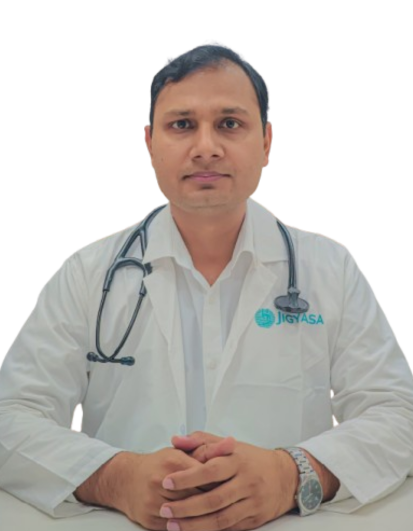
This guide focuses on the stent itself: what it is, the main types, why the price differs, how stent prices are regulated in India, what you should and should not worry about, and the questions worth asking before you agree to a procedure. It is written for patients and families in Moradabad and nearby areas who are considering care with Dr. Amit Kumar Singh, Interventional Cardiologist, at Jigyasa Hospital, a multispeciality hospital on Rampur Road, near Miglani Cinema.
For the cost of the whole procedure, including hospital stay, tests, and medicines, see our page on angioplasty cost in Moradabad. This page is only about the stent.
What Is a Heart Stent?
A coronary stent is a small, expandable mesh tube, usually made of metal alloy, that is placed inside a narrowed or blocked heart artery to keep it open. It is mounted on a tiny balloon and guided through an artery, usually in the wrist, to the blockage. When the balloon inflates, the stent expands and presses against the artery wall. The balloon is then removed, and the stent stays in place permanently.
Over the following weeks and months, the artery's inner lining grows over the stent, which becomes part of the vessel wall. A stent does not cure the underlying disease, but it restores blood flow at the spot where the artery was blocked.
Dr. Amit Kumar Singh performs coronary angiography and angioplasty with stenting at Jigyasa Hospital. Bypass surgery and heart valve replacement are not performed here, and patients who need them are advised clearly and guided on referral.
Main Types of Coronary Stents
Drug-Eluting Stents (DES)
These are the most commonly used stents today. A drug-eluting stent has a thin coating that slowly releases medicine into the artery wall, which reduces the chance of the artery narrowing again at the stent site, a problem called restenosis. Modern drug-eluting stents differ in the metal used, the thickness of the struts, the type of drug, and the coating design.
Most current drug-eluting stents belong to later generations, with thinner struts and more biocompatible coatings, and have lower rates of re-narrowing and clotting than the earliest designs.
Bare-Metal Stents (BMS)
A bare-metal stent has no drug coating. It props the artery open, but the artery is more likely to narrow again over time compared with a drug-eluting stent. Bare-metal stents are used less often, in selected situations, for example when a patient cannot take the prolonged blood-thinning medicines that drug-eluting stents usually require, or has a very high bleeding risk.
Bioresorbable (Dissolvable) Scaffolds
These were designed to support the artery for a period and then dissolve. Early versions faced concerns about higher rates of stent clotting in some studies, and their use has been limited. Availability is restricted, and they are used in very few centres.
Drug-Coated Balloons
These are not stents. A drug-coated balloon delivers medicine to the artery wall without leaving a permanent implant. They are used in selected situations, such as treating re-narrowing inside an old stent or some small vessels, and are sometimes used together with stents. Whether one is suitable depends on your angiogram.
Specialised Stents and Equipment
Some blockages need additional tools or particular stent sizes, for example stents for very large or very small arteries, long blockages, or complex branching points. Additional imaging or devices may be used in difficult cases. These can increase the cost.
The key point: the best stent for you depends on your artery, the blockage, and your health, not on the price tag. Ask your cardiologist which stent is recommended, and why.
Why Stent Prices Differ
If you compare quotes, you may see differences even for the "same" procedure. Common reasons include:
1. Stent type and generation. A newer-generation drug-eluting stent usually costs more than an older design or a bare-metal stent.
2. Brand and manufacturer. Different companies price their stents differently, and technology, coating, and design vary.
3. Number of stents. The total cost rises with each stent. A long blockage may need more than one stent, and some patients have several blockages.
4. Stent size and length. Longer or specially sized stents may be priced differently.
5. Complexity of the lesion. A heavily calcified artery, a branching blockage, or a total blockage may need extra equipment alongside the stent.
6. What the quote includes. Some quotes show the stent price alone, while others bundle the stent with the procedure, cath lab, and hospital charges. Comparing a "stent price" with a "package price" is not a fair comparison.
7. Hospital charges added around the stent. Procedure fees, cath lab charges, room, ICU, medicines, and tests are separate from the device itself.
Stent Price Regulation in India
In India, the government regulates the prices of coronary stents through the National Pharmaceutical Pricing Authority, or NPPA. Stents are placed under price control, with ceiling prices set for different categories, and these ceilings have been revised over time. Hospitals are not supposed to charge more than the permitted ceiling for the stent itself, and are expected to show the stent price separately on the bill.
What this means for you in practice:
• The stent price itself is subject to a regulated ceiling, so it should not be a place where a hospital can charge freely
• A higher total bill usually reflects the number of stents, the hospital stay, ICU care, tests, and medicines, not just the device
• Regulations and ceilings change from time to time, so any figure you read online may be out of date
• Ask for the stent's brand, type, and price to be shown separately on your estimate and bill, and ask the hospital to explain any difference you do not understand
Please call Jigyasa Hospital on 7900903333 to ask about the current position and for a written estimate that applies to you.
What You Are Paying For, Beyond the Stent
When people hear "stent cost," they often think the stent is the main expense. In reality, the total bill for angioplasty includes much more:
• Angiography, the test showing the blockages, unless already done
• Cath lab and procedure charges, including single-use items such as catheters, wires, balloons, and contrast dye
• Doctor and anaesthesia charges
• Hospital stay, including ICU or cardiac care unit and ward days, and room category
• Medicines and injections during the stay
• Tests, such as ECG, echo, and blood tests
• Medicines after discharge, often for months to years
Because these vary from patient to patient, two people who each get "one stent" can have different total bills. Our page on angioplasty cost in Moradabad explains these elements in more detail.
For confirmed details about stent brands and types used, current stent pricing, itemised estimates and bills, and angioplasty package inclusions and exclusions, please call Jigyasa Hospital on 7900903333 and request a written estimate.
Is a More Expensive Stent Always Better?
Not necessarily. This is one of the most common worries families have.
• Modern drug-eluting stents from established manufacturers have good safety and effectiveness records, and the differences between current-generation stents in typical patients are often small
• A particular patient may benefit from a specific stent, for example a very small vessel, a long lesion, or a high-risk situation, and your cardiologist can explain this
• A higher price does not guarantee a better outcome, and a lower price is not automatically inferior
• What matters most for long-term results is taking your medicines, controlling risk factors, and attending follow-up, not only the brand of stent
Ask your cardiologist: Why this stent for me? What are the alternatives? What difference would they make in my case? A good doctor will give a clear, honest answer, and will not pressure you to choose the most expensive option.
After the Stent: Medicines and Daily Life
A stent only works well if you look after what happens next.
Blood-thinning medicines. After a stent, you will take medicines, called antiplatelets, that stop clots forming on the stent. The duration depends on the type of stent, why it was placed, and your bleeding risk, and is decided by your cardiologist, often for months and sometimes longer. Never stop these medicines on your own, even before a dental procedure or minor surgery, without asking your cardiologist. Stopping early can cause a sudden clot in the stent, which can lead to a heart attack.
Other medicines. Cholesterol-lowering medicines, blood pressure medicines, and medicines for diabetes and the heart are commonly continued long-term.
Lifestyle. The stent opened one artery, but the disease that caused the blockage continues. To protect your heart:
• Stop smoking and tobacco completely
• Eat a heart-healthy diet, with less salt, sugar, refined flour, and deep-fried foods, and more vegetables, fruit, pulses, and whole grains
• Walk daily, increasing gradually as advised
• Control blood pressure, blood sugar, and cholesterol
• Maintain a healthy weight, limit alcohol, manage stress, and sleep well
• Attend all follow-up visits
Other practical questions. Most modern stents are considered safe for MRI scans, and a stent does not usually trigger metal detectors, but always tell any doctor, dentist, or radiology team that you have a stent, and carry your stent card or discharge summary. Ask your cardiologist when you can return to work, driving, travel, and exercise, since this varies from patient to patient.
Warning Signs After a Stent
Contact your cardiologist, or go to the hospital, if you have:
• Chest pain or pressure that returns, especially with exertion or at rest
• Sudden breathlessness, or fainting
• A very fast, irregular, or pounding heartbeat
• Swelling, bleeding, a growing lump, or pain at the wrist or groin puncture site, or a cold, numb, or pale hand or leg
• Black stools, vomiting blood, or heavy bleeding while on blood thinners
• Sudden weakness, face drooping, or slurred speech, which may suggest stroke
In an emergency, call 7900903333 or go to the hospital immediately.
Do You Really Need a Stent?
Cost matters, but the first question is whether a stent is needed at all. Not every blockage requires one.
A stent is generally advised when:
• You are having a heart attack, where urgently opening the artery protects heart muscle
• You have angina that is not controlled by medicines, with a significant blockage that explains your symptoms
• A significant blockage restricts blood flow to a large area of the heart
Medicines and lifestyle may be enough when:
• Blockages are mild or moderate, and symptoms are controlled
• The artery supplies only a small area of the heart
• Your doctor judges that medicines and monitoring give you equal or better results
Bypass surgery may be better when there are multiple severe blockages, particularly in people with diabetes, or when the heart's pumping function is weak and the disease is extensive. Bypass surgery is not performed at Jigyasa Hospital, and patients who need it are advised and guided on referral.
If your situation is not an emergency, it is reasonable to ask to see your angiogram, to ask what happens with medicines alone, and to seek a second opinion. In a heart attack, however, do not delay treatment to compare prices. Minutes matter.
Insurance, Cashless and Government Schemes
• Health insurance may cover angioplasty and stenting, but policies differ in waiting periods, pre-existing condition rules, room rent limits, sub-limits, and co-payments
• Cashless treatment involves the hospital billing the insurer directly, subject to approval, and in an emergency the approval can often be requested after admission
• Government health schemes may cover heart procedures at empanelled hospitals, and eligibility and empanelment vary
• Keep ready: your policy document, insurance card, ID, and previous medical records
Please call Jigyasa Hospital on 7900903333 to confirm which insurance, cashless options, and schemes are accepted.
Questions to Ask Before Agreeing to a Stent
• What is my diagnosis, and how many blockages do I have?
• Is a stent necessary now, and what are the alternatives?
• How many stents are likely, and what is the reason?
• Which type and brand of stent do you recommend, and why?
• What is the price of the stent, and will it be shown separately on my bill?
• What does the estimate include, and what could add to it?
• Which medicines will I take afterwards, for how long, and what happens if I need other surgery?
• Is my insurance accepted for cashless admission?
• How will I know the stent is working, and what follow-up is needed?
• Would a second opinion be reasonable?
A good cardiologist welcomes these questions.
Why Consider Jigyasa Hospital and Dr. Amit Kumar Singh?
A cardiologist who diagnoses and treats. Dr. Amit Kumar Singh performs coronary angiography and angioplasty with stenting, so many patients with blocked heart arteries can be assessed and treated in one place.
Honesty about what is and isn't done. Bypass surgery and heart valve replacement are not performed at Jigyasa Hospital, and patients who need them are advised clearly and guided on referral.
A multispeciality hospital. Heart patients often have diabetes, kidney disease, or high blood pressure, and benefit from having other departments under one roof.
Easy-to-find location. On Rampur Road, near Miglani Cinema, Moradabad – 244001, reachable from Moradabad city and nearby areas such as Rampur, Sambhal, Amroha, Bijnor, and Chandausi.
Clear communication. Questions are welcome, including questions about cost, and explanations are given in simple Hindi or English.
For confirmed details about Dr. Amit Kumar Singh's qualifications, experience, OPD timings, cath lab, ICU or CCU, emergency cardiac care, insurers and TPAs accepted, and government schemes, please call Jigyasa Hospital on 7900903333.
How to Prepare for Your Consultation
• Call ahead on 7900903333 to book a consultation, and ask for a written estimate
• Bring all records: ECGs, echo reports, angiograms, blood tests, discharge summaries, and prescriptions
• Bring your insurance documents and ID
• List all medicines, with doses, including blood thinners, and your allergies
• Mention your history: diabetes, blood pressure, kidney or thyroid problems, and previous surgeries
• Bring a family member to help with decisions and paperwork
• Write down your questions, including those about the stent and cost
Clear Explanation of Stent Types
Dr. Amit Kumar Singh explains drug-eluting stents, bare-metal stents, bioresorbable scaffolds, drug-coated balloons, and specialised equipment where relevant.
Transparent Stent Pricing
Ask for the stent brand, type, and price to be shown separately on the estimate and bill, along with the procedure and hospital charges.
Insurance and Cashless Guidance
Insurance coverage, cashless approval, reimbursement, waiting periods, co-payments, and government scheme eligibility should be checked before admission.
Treatment Planning
Not every blockage needs a stent. Dr. Amit Kumar Singh assesses symptoms, angiogram findings, heart function, and alternatives before advising treatment.
Emergency-Focused Cardiac Care
Jigyasa Hospital provides 24/7 emergency and OPD services. In a suspected heart attack, do not delay treatment to compare prices.
Easy-to-Find Location
Jigyasa Hospital is on Rampur Road, near Miglani Cinema, Moradabad, making cardiac care accessible to local and nearby patients.
Discuss Stent Options and Cost with Dr. Amit Kumar Singh
If you or a family member has been advised a stent, ask for a clear explanation of the stent type, number of stents, written estimate, insurance support, and medicines needed after the procedure.
To discuss stent cost and coronary angioplasty with Dr. Amit Kumar Singh at Jigyasa Hospital, Moradabad, call 7900903333. In a suspected heart attack, call the emergency number or an ambulance immediately.
Address
Near Miglani Cinema, Rampur Road, Moradabad 244001
Phone
7900903333Frequently Asked Questions About Stent Cost
How much does a stent cost in Moradabad?
It depends on the type and number of stents and other factors, and stent prices in India are subject to government regulation that changes from time to time. Please call Jigyasa Hospital on 7900903333 for an estimate that applies to your situation, and ask for it in writing.
What is the difference between a drug-eluting stent and a bare-metal stent?
A drug-eluting stent releases medicine to reduce the chance of the artery narrowing again, and is the most commonly used type. A bare-metal stent has no coating and is used in selected situations.
Are stent prices regulated in India?
Yes. Coronary stent prices are subject to price control by the government, with ceilings that are revised from time to time. Ask the hospital to show the stent's brand, type, and price separately on your estimate and bill.
Is the most expensive stent the best?
Not necessarily. Many current-generation stents have good records. The right stent depends on your artery and blockage, and your cardiologist can explain why a particular one is recommended.
How many stents will I need?
It depends on how many blockages you have and how long they are. Your angiogram shows this, and your cardiologist will explain the plan.
Why is my total bill much more than the stent price?
Because the bill also includes angiography, cath lab and procedure charges, doctor fees, hospital stay, ICU or ward days, medicines, and tests.
Do I need medicines after a stent?
Yes. Blood thinners, cholesterol medicines, and others are usually needed, some for a set period and some long-term. Never stop them without your cardiologist's advice.
Can I have an MRI after a stent?
Most modern stents are considered safe for MRI, but always tell the radiology team and carry your stent card or discharge summary.
Why Patients Choose Us
- 24/7 Emergency & Trauma Care
- Top Specialist Doctors
- Modern ICU & Operation Theatres
- Transparent & Affordable Pricing
- Ayushman Bharat Empanelled
- Cashless Insurance Support
- Multispeciality Under One Roof
Our Location
Near Miglani Cinema,
Rampur Road,
Moradabad 244001