
Unstable Angina Treatment in Moradabad: Prompt, Expert Heart Care at Jigyasa Hospital
Chest pain is one of the symptoms people most often delay acting on. Many put it down to gas, acidity, muscle strain or stress. But when chest pain is new, is getting worse, or comes on while you are resting, it can be a sign of unstable angina. This serious heart condition needs urgent medical attention.
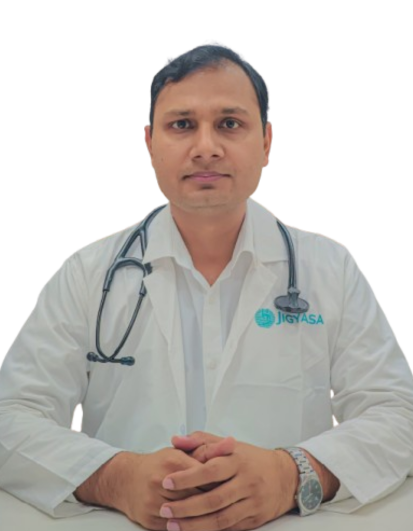
At Jigyasa Hospital, Moradabad, Dr. Amit Kumar Singh, a cardiologist, and the cardiac care team evaluate and treat patients with unstable angina. This page explains what unstable angina is, how it differs from other types of chest pain, what causes it, and how it is diagnosed and treated. It also tells you when to go to the hospital without waiting.
What Is Unstable Angina?
Angina is chest pain or discomfort that occurs when the heart muscle does not get enough oxygen-rich blood. This usually happens because the coronary arteries, which supply blood to the heart, are narrowed by fatty deposits called plaque.
Unstable angina is the more dangerous form. It is part of a group of conditions called acute coronary syndrome, which also includes heart attack. In unstable angina, the chest pain is unpredictable. It may come on at rest, last longer than usual, or become more frequent and more severe over time.
The key point is that unstable angina is a warning sign that a heart attack may be near. It should always be treated as a medical emergency.
Stable Angina vs. Unstable Angina
| Feature | Stable Angina | Unstable Angina |
|---|---|---|
| Pattern | Predictable | Unpredictable |
| Trigger | Usually physical effort or stress | Can occur at rest or with minimal effort |
| Duration | Usually short, a few minutes | May last longer than 15–20 minutes |
| Relief with rest or medicine | Usually relieved | Often not relieved or only partly relieved |
| Trend | Stays the same over time | New, or getting worse and more frequent |
| Urgency | Needs a planned check-up | Needs emergency evaluation |
Why Does Unstable Angina Happen?
In most cases, unstable angina develops when a plaque inside a coronary artery becomes unstable. The surface of the plaque may crack or rupture. The body then forms a blood clot at that spot, which suddenly narrows the artery further and reduces blood flow to the heart muscle.
If the artery is only partly blocked, the result is unstable angina. If the artery gets completely blocked and the heart muscle is damaged, the result is a heart attack. This is why doctors treat unstable angina so seriously.
Risk factors include:
• High blood pressure
• Diabetes
• High cholesterol
• Smoking and tobacco use
• Obesity and inactivity
• Family history of heart disease
• Age, as risk rises with age
• Stress and an unhealthy diet
• Previous heart disease or earlier stent or bypass
Many people in Moradabad and the surrounding region live with several of these risks at once, often without knowing it. This makes regular heart check-ups very important.
Symptoms of Unstable Angina
Symptoms can vary from person to person. Watch for these signs:
• Chest pain, pressure, squeezing, tightness or heaviness
• Pain that occurs at rest or wakes you from sleep
• Pain that is new, more severe or lasts longer than your usual pain
• Pain spreading to the left arm, shoulder, jaw, neck, back or upper abdomen
• Shortness of breath
• Sweating, nausea or vomiting
• Dizziness, light-headedness or unusual weakness
• Sudden, extreme tiredness
Note for diabetics, women and older adults: Symptoms may be mild or unusual, such as breathlessness, indigestion-like discomfort or fatigue, without clear chest pain. Never ignore these signs.
When Should You Go to the Hospital Immediately?
Go to the nearest hospital without delay if you have chest pain at rest, chest pain lasting more than a few minutes, or chest pain with sweating, breathlessness, nausea or fainting. Do not wait to see if it passes. Do not drive yourself. Ask someone to take you or call for emergency transport.
Early treatment can protect your heart muscle and save your life. Delay is the biggest danger in any heart emergency.
How Is Unstable Angina Diagnosed?
When a patient arrives with chest pain, the team works quickly to find out whether the heart is under threat. Tests may include:
• ECG: Records the heart's electrical activity. It is done immediately and may be repeated
• Blood tests: Cardiac markers such as troponin show whether any heart muscle damage has occurred. This helps separate unstable angina from a heart attack
• 2D Echocardiography: An ultrasound of the heart to check how well it is pumping and whether any area is moving poorly
• Chest X-ray and routine blood tests: To check other causes and your overall condition
• Treadmill test or stress testing: Used in selected, stable patients after the acute phase
• Coronary angiography: The key test that shows exactly where the arteries are narrowed or blocked, and how severe the blockage is
Based on these results, Dr. Amit Kumar Singh decides the safest and most effective treatment plan for you.
Treatment of Unstable Angina at Jigyasa Hospital
Treatment has three goals: relieve the pain, prevent a heart attack and treat the underlying blockage. Your plan depends on how severe your condition is and how your heart responds. It may include the following.
1. Immediate Hospital Care and Monitoring
Patients are usually admitted for close monitoring. The heart rhythm, blood pressure and symptoms are watched carefully, and oxygen may be given if needed. Rest is important during this phase.
2. Medicines
Medicines are the foundation of treatment. Your cardiologist may prescribe:
• Antiplatelet medicines to stop clots from growing
• Blood thinners, or anticoagulants, in the early phase
• Nitrates to open the arteries and ease chest pain
• Beta-blockers to slow the heart and lower its workload
• Statins to lower cholesterol and stabilise plaque
• Other medicines for blood pressure, blood sugar or heart rhythm as needed
Each medicine has a purpose, and doses are chosen for your specific condition.
3. Coronary Angiography and Angioplasty (Stenting)
For many patients with unstable angina, angiography is advised, usually early. If a significant blockage is found, the cardiologist may perform angioplasty with a stent during the same procedure or shortly after. A balloon widens the narrowed artery, and a small stent keeps it open. A modern drug-eluting stent is commonly used to lower the chance of the artery narrowing again.
You can read more about this on our page on drug-eluting stent in Moradabad.
4. Bypass Surgery (CABG)
If a patient has multiple or complex blockages, especially in the main artery or in diabetics with widespread disease, coronary artery bypass surgery may be the better option. Your cardiologist will explain the reasons and the choices clearly, so that you and your family can make a confident decision.
5. Long-Term Follow-Up and Cardiac Rehabilitation
Treatment does not end when you leave the hospital. Regular check-ups, medicines and lifestyle changes are essential to prevent the problem from returning.
Why Choose Jigyasa Hospital for Unstable Angina Treatment in Moradabad?
When chest pain strikes, you need a hospital that can act quickly and explain clearly. Families from Moradabad, Rampur, Sambhal, Amroha, Bijnor and nearby areas trust Jigyasa Hospital for several reasons.
1. Experienced Cardiology Care. Dr. Amit Kumar Singh, MD (BHU), DM Cardiology (KGMU), FSCAI, Senior Interventional Cardiologist, focuses on diagnosing and treating heart disease. He takes time to explain your condition and the treatment options in simple language.
2. Prompt Evaluation. In a suspected heart emergency, fast assessment with ECG, blood tests and other investigations is crucial. Our team is focused on timely decisions.
3. Complete Cardiac Services in One Place. From the first consultation and echocardiography to angiography and angioplasty, patients can access major cardiac services without having to travel to another city.
4. Honest, Patient-Centred Advice. Treatment is recommended only when needed, and options are discussed openly. Your questions and your family's concerns are always welcome.
5. Support Throughout Recovery. The team guides you through the hospital stay, discharge, medicines and follow-up, so that you know exactly what to do at every step.
6. Advanced Care Close to Home. You get expert heart care in Moradabad, with your family close by, at a time when their support matters most.
For confirmed details about Dr. Amit Kumar Singh's qualifications, experience, OPD timings, cath lab, ICU or CCU, emergency cardiac care, insurance or cashless support, and government schemes, please call Jigyasa Hospital on 7900903333.
What to Expect During Your Hospital Stay
• On arrival: Quick evaluation, ECG and blood tests
• First hours: Monitoring, medicines and pain relief
• Investigations: Echo, and angiography if advised
• Treatment: Medicines, and angioplasty or other procedures if needed
• Recovery: Gradual return to walking and routine activity
• Discharge: Clear written advice on medicines, diet, activity and follow-up
The length of stay differs from patient to patient depending on the condition and treatment.
Recovery and Life After Unstable Angina
Many patients return to a full and active life after treatment. Recovery needs both medical care and personal commitment.
• Take your medicines regularly. This is especially true of antiplatelet medicines after a stent. Never stop or change medicines without consulting your cardiologist, even if you feel completely well
• Follow a heart-healthy diet. Include vegetables, fruits, whole grains and pulses. Cut down on fried food, excess salt, sugar and packaged snacks
• Stay active. Start with gentle walking and increase gradually as your doctor advises. Avoid heavy exertion until you are cleared
• Quit smoking and tobacco. This is one of the most powerful steps you can take. Avoid second-hand smoke too
• Control your health conditions. Keep blood pressure, blood sugar and cholesterol within the targets your doctor sets
• Manage stress and sleep. Chronic stress and poor sleep strain the heart
• Keep every follow-up appointment. Regular check-ups catch problems early
Can Unstable Angina Be Prevented?
In many cases, the risk can be reduced greatly. You can protect your heart by:
• Going for regular health check-ups, including blood pressure, sugar and cholesterol tests
• Not delaying care when you have chest discomfort
• Eating a balanced diet and keeping a healthy weight
• Exercising regularly
• Avoiding tobacco and limiting alcohol
• Taking prescribed medicines for diabetes, blood pressure and cholesterol as advised
• Knowing your family history and sharing it with your doctor
Common Myths About Chest Pain
Myth: "It is just gas or acidity." Heart pain is often mistaken for acidity. If pain is unusual, severe or comes with sweating or breathlessness, get it checked at once.
Myth: "I am young, so it cannot be my heart." Heart disease is increasingly seen in younger adults, especially with smoking, diabetes and stress.
Myth: "If the pain went away, I am fine." Pain that settles can still signal a serious problem. Unstable angina can progress to a heart attack.
Myth: "A stent cures heart disease forever." A stent opens one blocked spot, but the underlying disease continues. Medicines and lifestyle changes remain essential.
Urgent Chest Pain Assessment
Dr. Amit Kumar Singh assesses chest pain, breathlessness, abnormal ECGs, and suspected unstable angina with prompt evaluation.
Cardiac Diagnosis and Testing
Evaluation may include ECG, troponin blood tests, 2D Echo, chest X-ray, treadmill test, and coronary angiography where appropriate.
Angioplasty and Stenting
Where a significant blockage is found and appropriate, coronary angioplasty with a drug-eluting stent can be performed.
Recovery and Prevention Support
Guidance covers medicines, diet, activity, tobacco cessation, blood pressure, diabetes, cholesterol, and follow-up after treatment.
Emergency-Focused Cardiac Care
Jigyasa Hospital provides 24/7 emergency and OPD services. Chest pain at rest or with sweating and breathlessness needs immediate assessment.
Easy-to-Find Location
Jigyasa Hospital is on Rampur Road, near Miglani Cinema, Moradabad, making cardiac care accessible to local and nearby patients.
Chest Pain at Rest? Seek Emergency Care Immediately
If you have new, worsening, or rest-related chest pain, or chest pain with sweating, breathlessness, nausea, or fainting, do not wait for an appointment. Call 7900903333 or go to the nearest emergency facility immediately.
Dr. Amit Kumar Singh at Jigyasa Hospital, Moradabad, assesses unstable angina and heart attack symptoms, and performs coronary angiography and angioplasty with stenting where appropriate.
Address
Near Miglani Cinema, Rampur Road, Moradabad 244001
Phone
7900903333Frequently Asked Questions About Unstable Angina
Is unstable angina a heart attack?
No, but it is closely related and just as urgent. In unstable angina, heart muscle is usually not permanently damaged, but there is a high risk of a heart attack if it is not treated.
How is unstable angina different from a heart attack?
In a heart attack, blood flow is blocked long enough to damage heart muscle, which shows up in blood tests. In unstable angina, the blockage is severe but heart muscle damage is usually not detected. Only tests can tell the two apart, so every episode needs urgent evaluation.
What should I do if I get chest pain at rest?
Stop activity, sit down and get to the nearest hospital immediately. Do not delay or try to manage it at home.
Can unstable angina be treated with medicines alone?
Some patients respond well to medicines, but many also need angiography and angioplasty or surgery, depending on the blockages found. Your cardiologist will decide after evaluation.
Is angiography safe?
Coronary angiography is a widely performed procedure and is generally safe when done by an experienced team. Your doctor will explain the small risks beforehand.
How long will I stay in the hospital?
This depends on your condition and treatment. Your doctor will advise you after assessing your progress.
Can I live a normal life after treatment?
Yes, most patients can. With proper medicines, lifestyle changes and follow-up, many return to work and everyday activities.
Why Patients Choose Us
- 24/7 Emergency & Trauma Care
- Top Specialist Doctors
- Modern ICU & Operation Theatres
- Transparent & Affordable Pricing
- Ayushman Bharat Empanelled
- Cashless Insurance Support
- Multispeciality Under One Roof
Our Location
Near Miglani Cinema,
Rampur Road,
Moradabad 244001