

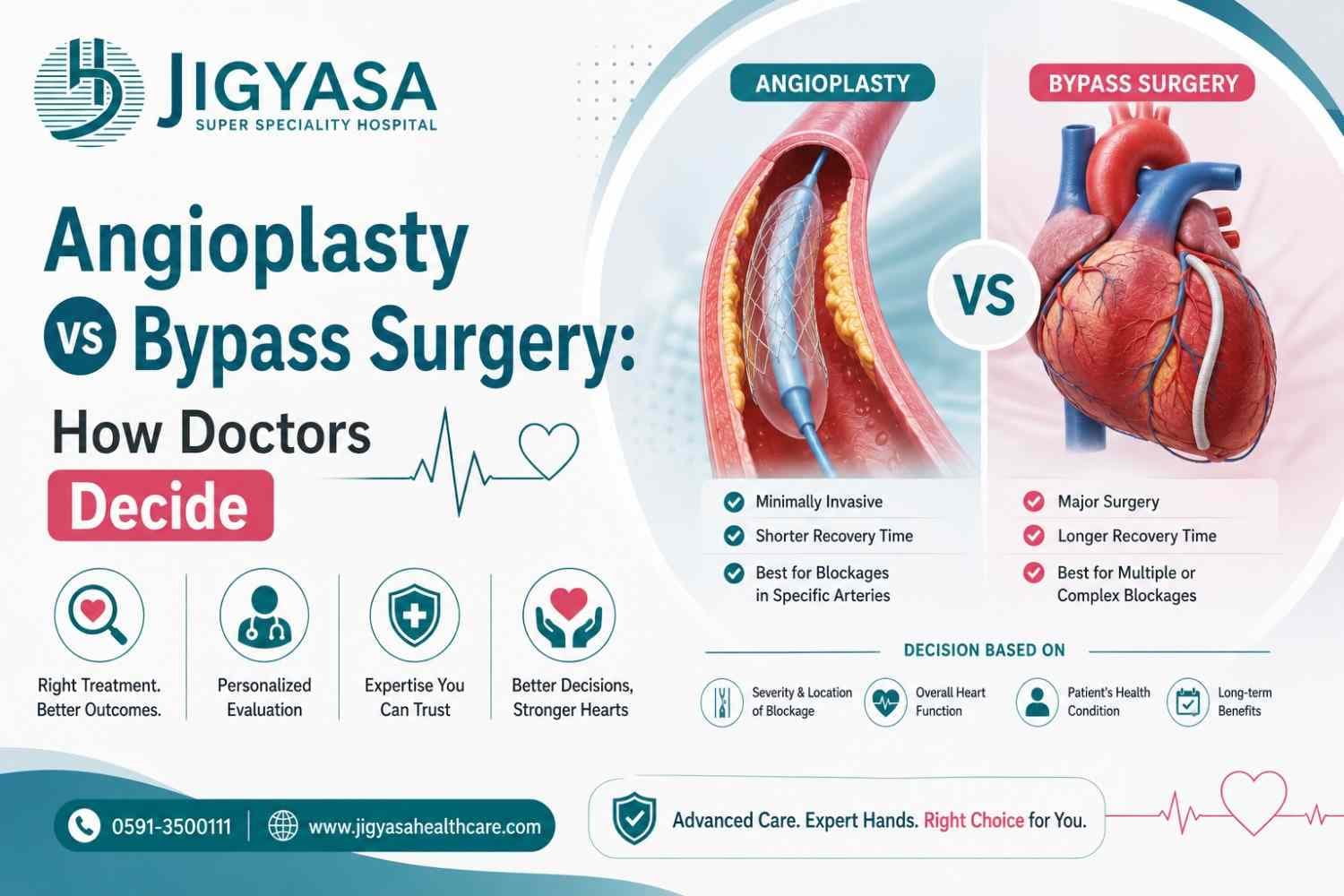
Angioplasty vs Bypass Surgery: How Doctors Decide
Diagnosed with blocked arteries and unsure whether you need angioplasty or bypass surgery? Understand how cardiologists choose between the two.
Being told you have a blocked artery is frightening enough — but the next question often makes things more confusing: should you get angioplasty, or do you need open-heart bypass surgery? Both procedures treat the same underlying problem — restricted blood flow to the heart muscle due to blocked or narrowed coronary arteries — but they work in very different ways, involve different levels of invasiveness, and are suited to different situations. At Jigyasa Hospital, Moradabad, our interventional cardiology team, led by Dr. Amit Kumar Singh, evaluates each patient's specific pattern of blockages, overall health, and heart function to determine which treatment offers the best outcome, rather than defaulting to one option for everyone.
Understanding the Underlying Problem: Coronary Artery Disease
Both angioplasty and bypass surgery exist to treat coronary artery disease (CAD) — a condition where the arteries supplying blood to the heart muscle become narrowed or blocked due to plaque buildup (atherosclerosis). When blood flow is significantly restricted, the heart muscle doesn't get enough oxygen, leading to chest pain (angina), breathlessness, or, if a blockage becomes complete, a heart attack.
The goal of both treatments is the same: restore adequate blood flow to the heart muscle. The difference lies in how each approach achieves that goal.
What Is Angioplasty (PCI)?
Angioplasty, technically known as percutaneous coronary intervention (PCI), is a minimally invasive procedure performed through a small incision, usually in the wrist or groin. A thin catheter is guided through the blood vessels to the site of the blockage in the coronary artery.
How it works:
- •A balloon at the tip of the catheter is inflated at the blockage site, compressing the plaque against the artery wall and widening the passage
- •In the vast majority of cases, a stent — a small mesh tube — is then placed to keep the artery open and reduce the chance of it narrowing again
- •Many modern stents are drug-eluting, meaning they slowly release medication that helps prevent the artery from re-narrowing over time
Key characteristics:
- •Performed under local anesthesia, with the patient awake
- •Typically completed within an hour or two, depending on the complexity of the blockage
- •Recovery is generally quick, often allowing discharge within a day or two
- •No large chest incision is required
Dr. Amit Kumar Singh personally performs coronary angioplasty and stenting procedures at Jigyasa Hospital, addressing blockages directly at the time of diagnostic angiography in many cases.
What Is Bypass Surgery (CABG)?
Coronary artery bypass grafting (CABG), commonly known as bypass surgery, is a more invasive, open-heart surgical procedure. Rather than opening up the blocked artery itself, the surgeon creates an entirely new route for blood to flow around the blockage.
How it works:
- •A healthy blood vessel is taken from elsewhere in the body — commonly from the chest wall (internal mammary artery), leg (saphenous vein), or arm
- •This vessel is then grafted onto the coronary artery, creating a detour that bypasses the blocked segment entirely
- •Multiple bypasses can be performed in a single surgery if several arteries are significantly blocked
Key characteristics:
- •Performed under general anesthesia, typically taking several hours
- •Requires opening the chest, and in many cases, temporarily stopping the heart while a heart-lung machine takes over circulation (though minimally invasive and beating-heart techniques exist for select cases)
- •Recovery is longer, often requiring a hospital stay of about a week, followed by several weeks of at-home recovery
- •Leaves a chest scar and, if a leg vein is used as a graft, an additional scar there as well
How Doctors Decide Between the Two
The choice between angioplasty and bypass surgery isn't based on patient preference alone — it depends on a detailed evaluation of several clinical factors, typically assessed through coronary angiography.
1. Number and Location of Blockages
- •A single blockage, or blockages in one or two arteries that are accessible and favorably located, are often well-suited to angioplasty
- •Extensive disease involving multiple arteries, particularly when the left main coronary artery (which supplies a large portion of the heart) is significantly blocked, often favors bypass surgery, since it provides more complete and durable revascularization in complex disease
2. Complexity of the Blockages
- •Straightforward, discrete blockages are generally easier to treat with a stent
- •Long, heavily calcified, or complexly branched blockages may be technically difficult or less durable to treat with angioplasty alone, making bypass a more reliable option
3. Overall Heart Function
Patients with significantly reduced heart pumping function, especially with multi-vessel disease, often benefit more from bypass surgery, which has been shown to offer better long-term outcomes in this specific group.
4. Diabetes Status
Patients with diabetes and multi-vessel coronary artery disease often have better long-term outcomes with bypass surgery compared to angioplasty, a finding that has been demonstrated in several large studies and is an important consideration in treatment planning.
5. Patient's Overall Health and Surgical Risk
- •Bypass surgery is a bigger physiological undertaking, so a patient's age, kidney function, lung function, and other coexisting conditions are carefully weighed, since some patients may not be suitable candidates for open-heart surgery
- •In such cases, angioplasty may be the safer option even if bypass would otherwise be technically preferred
6. Urgency of the Situation
- •In an emergency setting, such as an acute heart attack, angioplasty is generally the faster and preferred initial approach to quickly restore blood flow
- •Bypass surgery is more commonly planned in a non-emergency setting after a full evaluation, though it can also be performed urgently when necessary
7. Patient Preference and Lifestyle Considerations
Recovery time, occupation, and personal circumstances are also discussed, since angioplasty's shorter recovery may matter for some patients — though this is weighed against long-term outcomes rather than convenience alone.
A Team-Based Decision
In many hospitals, particularly for complex cases involving multiple blockages, the decision between angioplasty and bypass surgery is made through a "Heart Team" approach — a joint discussion between interventional cardiologists and cardiac surgeons, who together weigh the angiographic findings, patient health, and evidence-based guidelines to recommend the most appropriate option. At Jigyasa Hospital, this collaborative, evidence-based evaluation ensures that treatment decisions are tailored to each patient's specific coronary anatomy and overall health, not applied as a one-size-fits-all protocol.
Is One Option "Better" Than the Other?
Neither angioplasty nor bypass surgery is universally superior — each has situations where it is clearly the better choice. Angioplasty offers a less invasive option with quicker recovery, well-suited to simpler blockage patterns and emergency situations. Bypass surgery, while more invasive, often provides more durable, complete treatment for extensive or complex multi-vessel disease, particularly in patients with diabetes or reduced heart function.
Life After Treatment
Regardless of which procedure is performed, long-term success depends heavily on what happens afterward:
- •Strict adherence to prescribed medications, including blood thinners after stenting
- •Aggressive management of risk factors — blood pressure, cholesterol, blood sugar
- •Lifestyle changes including diet modification, regular physical activity, and smoking cessation
- •Regular cardiology follow-up to monitor heart function and detect any new blockages early
- •Cardiac rehabilitation programs, where recommended, to safely rebuild fitness and confidence after the procedure
Heart Care at Jigyasa Hospital, Moradabad
- •Coronary angiography for precise blockage mapping
- •Coronary angioplasty and stenting (PCI) performed by Dr. Amit Kumar Singh
- •Collaborative Heart Team approach for complex cases requiring bypass surgery
- •Comprehensive post-procedure cardiac care and rehabilitation guidance
Book a Cardiac Screening: 7900903333
Address: Near Miglani Cinema, Rampur Road, Moradabad – 244001
Online Appointments: jigyasahospital.com
Coronary Angiography | Angioplasty & Stenting | Bypass Surgery Referral | Preventive Cardiology | Cardiac Rehabilitation | Ayushman Bharat Accepted
Key Takeaways
- •Angioplasty (PCI) is minimally invasive with quick recovery, ideal for single or simple blockages and emergency situations.
- •Bypass surgery (CABG) is more invasive but provides durable results for complex multi-vessel disease, especially in diabetics.
- •The choice depends on blockage number, location, complexity, heart function, diabetes status, and overall health.
- •A Heart Team approach ensures the best treatment decision based on individual coronary anatomy and clinical factors.
- •Long-term success requires strict medication adherence, risk factor management, and lifestyle changes regardless of procedure type.
Frequently Asked Questions
Is angioplasty a permanent fix for blocked arteries?
Angioplasty effectively treats the specific blockage addressed, but it doesn't stop the underlying disease process. New blockages can develop elsewhere over time if risk factors like cholesterol, blood pressure, and diabetes aren't well controlled, making ongoing cardiac care essential.
Does bypass surgery mean I'll never need a stent again?
Not necessarily. While bypass grafts can last many years, coronary artery disease can still progress in other untreated segments, so ongoing monitoring remains important after bypass surgery as well.
Is bypass surgery always more effective than angioplasty for multiple blockages?
Not universally — it depends on the specific pattern of blockages, heart function, and patient health. Some patients with multi-vessel disease still do well with angioplasty, which is why individualized evaluation, not a blanket rule, guides the decision.
How is the decision made in an emergency heart attack situation?
In acute heart attacks, restoring blood flow as quickly as possible is the priority, so angioplasty is generally performed first to open the blocked artery, with bypass surgery considered afterward only if the coronary anatomy specifically requires it.
Can a patient request one procedure over the other?
Patient preference is considered and discussed, but the final recommendation is based on angiographic findings, overall health, and evidence-based clinical guidelines to ensure the safest, most effective long-term outcome.
Related Articles

Heart Attack Warning Signs You Must Never Ignore
Recognizing heart attack symptoms early can save your life. Learn the critical warning signs from Dr. Amit Kumar Singh, Senior Interventional Cardiologist at Jigyasa Hospital, Moradabad. Call 7900903333.

5 Early Morning Habits That Prevent Diabetes Naturally
Discover 5 powerful morning habits that naturally prevent diabetes. Expert advice from Dr. C.P. Singh, Senior Consultant Physician at Jigyasa Hospital, Moradabad. Call 7900903333.

Why Summers in UP Are Dangerous for Your Kidneys
UP summers can silently damage your kidneys. Jigyasa Hospital Moradabad explains the hidden risks, warning signs, and how to protect your kidneys this season. Call 7900903333.