

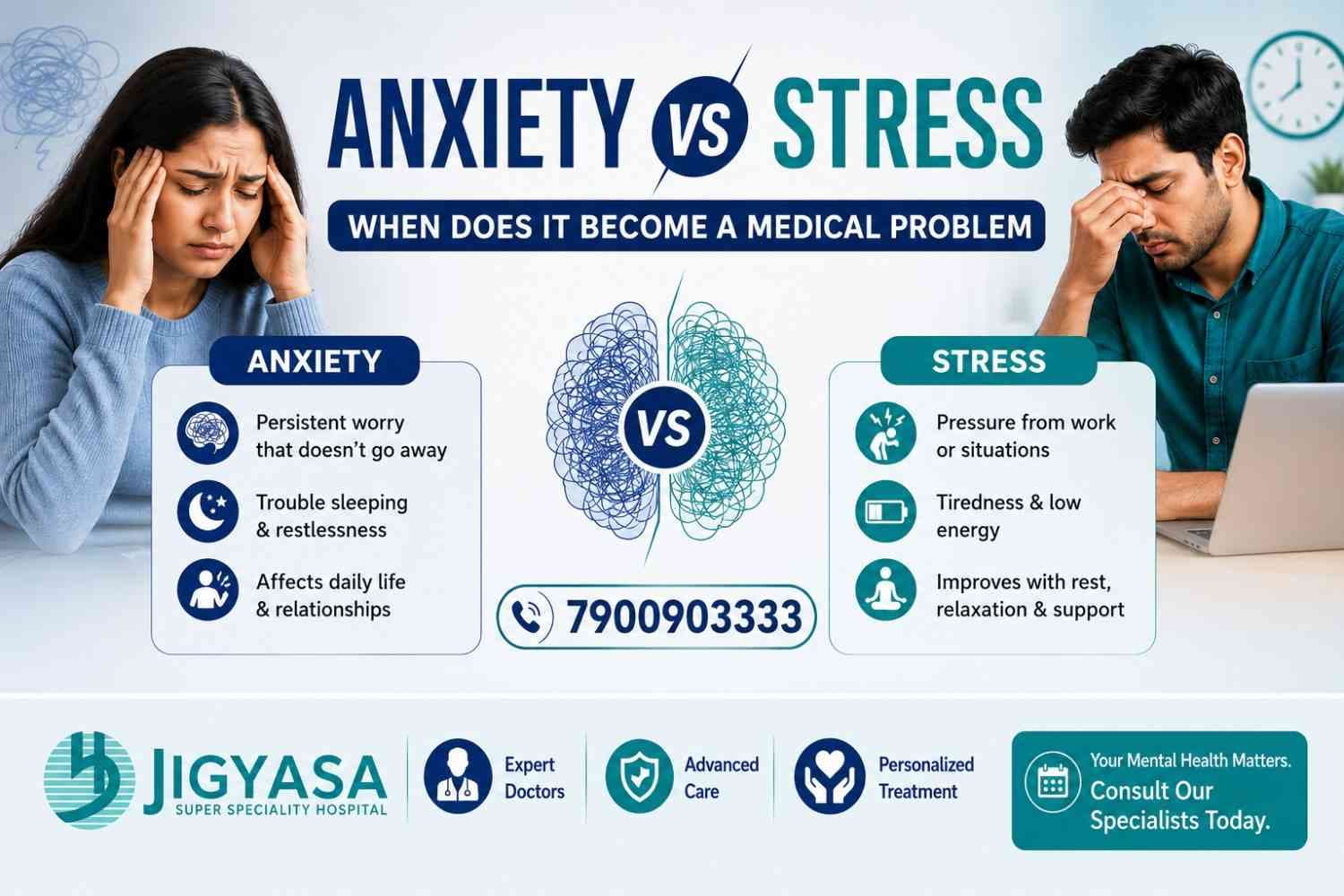
Anxiety vs Stress — When Does It Become a Medical Problem?
Feeling stressed or anxious all the time? Know the exact difference — and when it stops being normal and becomes a condition that needs medical attention.
Everyone feels stressed sometimes. Many people feel anxious. But there is a clinically important difference between the two — and that difference determines whether what you are experiencing is a normal human response or a medical condition that deserves proper treatment. In India, and particularly across UP, anxiety disorders are among the most underdiagnosed conditions in medicine. Patients spend months visiting cardiologists, gastroenterologists, and general physicians for chest pain, palpitations, headaches, and fatigue — without anyone asking whether anxiety is driving the symptoms. This blog gives you a clear framework: what stress is, what anxiety is, where the line between them lies, and exactly when it is time to seek medical help. At Jigyasa Hospital, Moradabad, we treat mental health with the same clinical rigour as any other medical condition — because that is exactly what it is.
What Is Stress?
- •Stress is the body's natural response to an external pressure or threat — a deadline, an argument, financial difficulty, or a health scare
- •It is driven by the fight-or-flight system — cortisol and adrenaline rise, the heart beats faster, and the mind sharpens
- •Stress is tied to a cause. When the cause resolves, the stress typically resolves with it
- •Stress is time-limited and situation-specific — almost everyone experiences it and it is a normal, functional biological response
- •Mild-to-moderate stress can actually improve performance and focus in short bursts
- •Stress becomes a problem when it is chronic, unrelenting, or disproportionate to the situation — but even then, it is still distinguishable from anxiety
What Is Anxiety?
Anxiety is a persistent state of fear, worry, or unease that exists without a clear or proportionate external cause — or continues long after the cause has resolved. It is driven by the same stress-response system, but the system becomes dysregulated — it fires when it should not, and stays on when it should switch off.
Anxiety is internal. Stress is external. Anxiety is a recognised medical condition when it meets clinical diagnostic criteria — not a personality trait, not weakness, not 'overthinking.' Common anxiety disorders include:
- •Generalised Anxiety Disorder (GAD) — persistent worry about multiple areas of life for 6 or more months
- •Panic Disorder — recurrent unexpected panic attacks with fear of future attacks
- •Social Anxiety Disorder — intense fear of social situations and judgement
- •Health Anxiety — excessive preoccupation with having a serious illness
- •Phobias — intense, irrational fear of specific objects or situations
Anxiety disorders are the most common mental health conditions globally — and among the most underdiagnosed in India.
Stress vs Anxiety — Key Differences
Here is how stress and anxiety compare across the factors that matter most for understanding which one you are dealing with:
- •Cause: Stress has a clear external trigger — anxiety is absent, vague, or disproportionate
- •Duration: Stress resolves when the cause resolves — anxiety persists regardless of circumstances
- •Control: Stress is usually manageable with action — anxiety feels uncontrollable despite effort
- •Physical symptoms: Stress symptoms are present but mild — anxiety symptoms are often severe and persistent
- •Worry pattern: Stress worry is focused on a specific problem — anxiety worry is generalised and jumps between topics
- •Sleep impact: Stress causes temporary disruption — anxiety causes chronic insomnia or poor-quality sleep
- •Daily function: Stress reduces but maintains daily function — anxiety significantly impairs it
- •Resolution: Stress resolves with the situation — anxiety requires active treatment
- •Medical diagnosis: Stress is not a disorder in itself — anxiety is a diagnosable clinical condition
Normal Stress vs Anxiety Disorder — Where Is the Line?
Stress crosses into a medical problem — specifically an anxiety disorder — when three or more of the following are present:
- •Worry is excessive and difficult to control — the person knows intellectually that the worry is disproportionate but cannot stop it
- •Duration exceeds 6 months — the anxiety is not linked to a single event or period
- •Physical symptoms are present most days — racing heart, chest tightness, breathlessness, sweating, trembling, headaches, nausea
- •Sleep is chronically disrupted — difficulty falling asleep, staying asleep, or waking with a sense of dread
- •Daily functioning is impaired — the person is avoiding situations, missing work, withdrawing from relationships, or unable to complete routine tasks
- •The anxiety feels impossible to turn off — even in objectively safe and calm situations
- •Panic attacks occur — sudden episodes of intense physical fear with heart pounding, breathlessness, dizziness, and a feeling of impending doom
If you recognise three or more of these in yourself or someone close to you — this is a clinical condition, not a personality type, and it responds very well to treatment.
Physical Symptoms of Anxiety Most People Miss
This is the section most relevant to Indian patients — because anxiety frequently presents physically first, and the medical cause is chased for months before mental health is considered. Commonly missed physical symptoms of anxiety include:
- •Chest pain and tightness — frequently mistaken for a cardiac problem; anxiety is among the most common causes of chest pain in young adults presenting to emergency departments
- •Heart palpitations — a racing, pounding, or irregular heartbeat that sends many patients to cardiologists before anxiety is identified
- •Chronic headaches and migraines — tension headaches from persistent muscle tightness; migraines triggered by anxiety-driven hormonal changes
- •Irritable bowel symptoms — bloating, diarrhoea, constipation, and stomach cramps with no dietary cause; anxiety directly affects gut motility through the gut-brain axis
- •Chronic fatigue — the sustained activation of the stress response is physically exhausting; many anxious patients are genuinely tired, not just mentally drained
- •Breathlessness without physical cause — hyperventilation during anxiety reduces carbon dioxide, producing lightheadedness and tingling in the hands and feet
- •Muscle pain and tension — particularly in the neck, shoulders, jaw, and back; chronic anxiety keeps muscles in a low-grade contracted state
- •Frequent urination — anxiety activates the autonomic nervous system, which increases bladder urgency
- •Dizziness and feeling faint — blood pressure and blood flow changes during anxiety episodes cause genuine lightheadedness
- •Skin symptoms — hives, itching, or eczema flares with no external allergen; the immune-skin axis is directly influenced by chronic cortisol elevation
The result in India: patients with anxiety spend months or years visiting cardiologists, gastroenterologists, neurologists, and general physicians — ruling out physical causes — before the anxiety driving the symptoms is identified and treated. This is not a failure of patients. It is a gap in routine clinical practice.
Who Is Most at Risk in UP and Moradabad?
- •Women — hormonal fluctuations across the menstrual cycle, pregnancy, postpartum period, and perimenopause significantly affect anxiety regulation; women in India are also more likely to suppress symptoms due to social expectations
- •Students and young adults — academic pressure, competitive exams, career uncertainty, and social media comparison drive rising anxiety rates in the 15 to 30 age group across UP
- •People with chronic illness — diabetes, thyroid disease, heart disease, and chronic pain all carry substantially elevated rates of comorbid anxiety; at Jigyasa Hospital, we assess mental health routinely in patients managing long-term conditions
- •People with a family history — genetic and environmental factors make anxiety disorders more likely in first-degree relatives of affected individuals
- •People who experienced childhood adversity — early trauma, instability, or loss significantly increases lifetime anxiety risk
- •People with uncontrolled thyroid disease — hyperthyroidism produces anxiety, palpitations, and panic that are physiologically identical to anxiety disorder; always test thyroid before assuming a psychiatric cause
When to See a Doctor — Specific Triggers
See a physician or mental health professional at Jigyasa Hospital if any of the following apply:
- •Worry, fear, or nervousness has been present most days for more than 4 to 6 weeks
- •You are avoiding situations — social events, work, travel, medical appointments — because of anxiety
- •You have had one or more panic attacks — sudden episodes of intense physical fear lasting minutes, often with chest pain, breathlessness, and a feeling of dying
- •Sleep has been chronically disrupted for more than a month without a clear physical cause
- •You are using alcohol, tobacco, or other substances to manage anxiety — this is a significant red flag
- •Physical symptoms — heart pounding, chest pain, breathlessness — have been investigated and no physical cause found
- •Anxiety is affecting your relationships, work, or ability to care for yourself or your family
- •You are experiencing thoughts of self-harm — this requires urgent medical attention today
What Treatment Actually Looks Like
Anxiety disorders are among the most treatable conditions in medicine. Treatment does not mean being on medication forever — it means getting your nervous system back under regulation.
Psychological Treatment
- •Cognitive Behavioural Therapy (CBT) — the most extensively researched psychological treatment for anxiety; helps identify and restructure thought patterns that drive the anxiety cycle
- •Exposure therapy — for phobias and specific anxiety triggers
- •Mindfulness-Based Stress Reduction (MBSR) — evidence-based; effective for GAD and stress-driven anxiety
- •Available through psychiatrists and clinical psychologists — ask for a referral at Jigyasa Hospital
Medical Treatment
- •SSRIs (Selective Serotonin Reuptake Inhibitors) — first-line medication for anxiety disorders; not addictive; typically take 4 to 6 weeks to reach full effect; examples include escitalopram and sertraline
- •SNRIs — second-line option; also used for anxiety with depression
- •Short-term anxiolytics — used cautiously for acute episodes; not for long-term daily use
- •Beta-blockers — for specific performance anxiety and physical symptoms (palpitations, trembling)
- •Medication decisions are made by a physician after full assessment — never self-medicate for anxiety
Lifestyle Measures That Genuinely Help
- •Regular aerobic exercise — one of the most consistent anxiety-reducing interventions in clinical research; 30 minutes most days
- •Sleep hygiene — a fixed sleep schedule, no screens before bed, no caffeine after 2 pm
- •Caffeine reduction — caffeine directly stimulates the stress response; many anxious patients improve significantly by reducing tea and coffee
- •Avoiding alcohol — alcohol temporarily suppresses anxiety but worsens it significantly the following day through rebound activation
- •Structured daily routine — predictability reduces the unpredictability that anxiety feeds on
Mental Health Care at Jigyasa Hospital, Moradabad
Mental health is physical health. At Jigyasa Hospital, we treat anxiety, depression, and stress-related conditions with the same clinical rigour as any other medical condition. Our physicians screen for anxiety as part of managing diabetes, thyroid disease, heart conditions, and chronic pain — because these conditions consistently coexist. We provide assessment, diagnosis, medication management, and referral to psychological support. You do not need to be in crisis to come to us. If anxiety is affecting your daily life — that is reason enough.
📞 Call: 7900903333
📍 Address: Near Miglani Cinema, Rampur Road, Moradabad – 244001
📧 Email: info@jigyasahospital.in
🌐 Website: jigyasahospital.com
✅ Mental Health OPD | Anxiety & Depression Assessment | Medication Management | Ayushman Bharat Accepted
You do not need to be in crisis to seek help. Come to Jigyasa Hospital — and let us help you feel like yourself again.
Frequently Asked Questions
Can anxiety cause physical pain — or is the pain 'in my head'?
Anxiety causes real, measurable physical pain through several mechanisms — muscle tension, autonomic nervous system activation, inflammation, and altered pain perception. The pain is not imaginary. Chest pain, headaches, back pain, and stomach cramps driven by anxiety are physiologically genuine. 'In your head' is a medically inaccurate and unhelpful framing. The brain and body are not separate — anxiety is a whole-body condition.
Is anxiety a sign of weakness or mental instability?
No. Anxiety disorders are neurobiological conditions involving dysregulation of the brain's threat-response circuits — specifically the amygdala, prefrontal cortex, and HPA axis. They are influenced by genetics, early life experience, hormones, chronic stress, and physical health. High-functioning, resilient people develop anxiety disorders. Seeking treatment is the medically correct and courageous response — equivalent to seeing a cardiologist for a heart condition.
Can anxiety go away on its own without treatment?
Mild, situational anxiety often resolves when circumstances change. Clinical anxiety disorders — particularly GAD, panic disorder, and social anxiety — rarely resolve fully without some form of treatment. They tend to fluctuate in severity rather than disappear. Untreated anxiety often worsens over time and increases the risk of depression, substance use, and chronic physical health conditions. Early treatment produces better outcomes than waiting.
Will I need to take anxiety medication for life?
Not necessarily. Many people complete a course of medication — typically 6 to 12 months — alongside psychological treatment and do not require it indefinitely. The goal of treatment is to restore the nervous system's capacity for regulation, not to create permanent dependence. Some people with severe or recurrent anxiety do benefit from longer-term medication. This is a decision made with your physician based on your specific history and response to treatment — not a default outcome.
Related Articles
Heart Attack Warning Signs You Must Never Ignore
Recognizing heart attack symptoms early can save your life. Learn the critical warning signs from Dr. Amit Kumar Singh, Senior Interventional Cardiologist at Jigyasa Hospital, Moradabad. Call 7900903333.
5 Early Morning Habits That Prevent Diabetes Naturally
Discover 5 powerful morning habits that naturally prevent diabetes. Expert advice from Dr. C.P. Singh, Senior Consultant Physician at Jigyasa Hospital, Moradabad. Call 7900903333.
Why Summers in UP Are Dangerous for Your Kidneys
UP summers can silently damage your kidneys. Jigyasa Hospital Moradabad explains the hidden risks, warning signs, and how to protect your kidneys this season. Call 7900903333.