
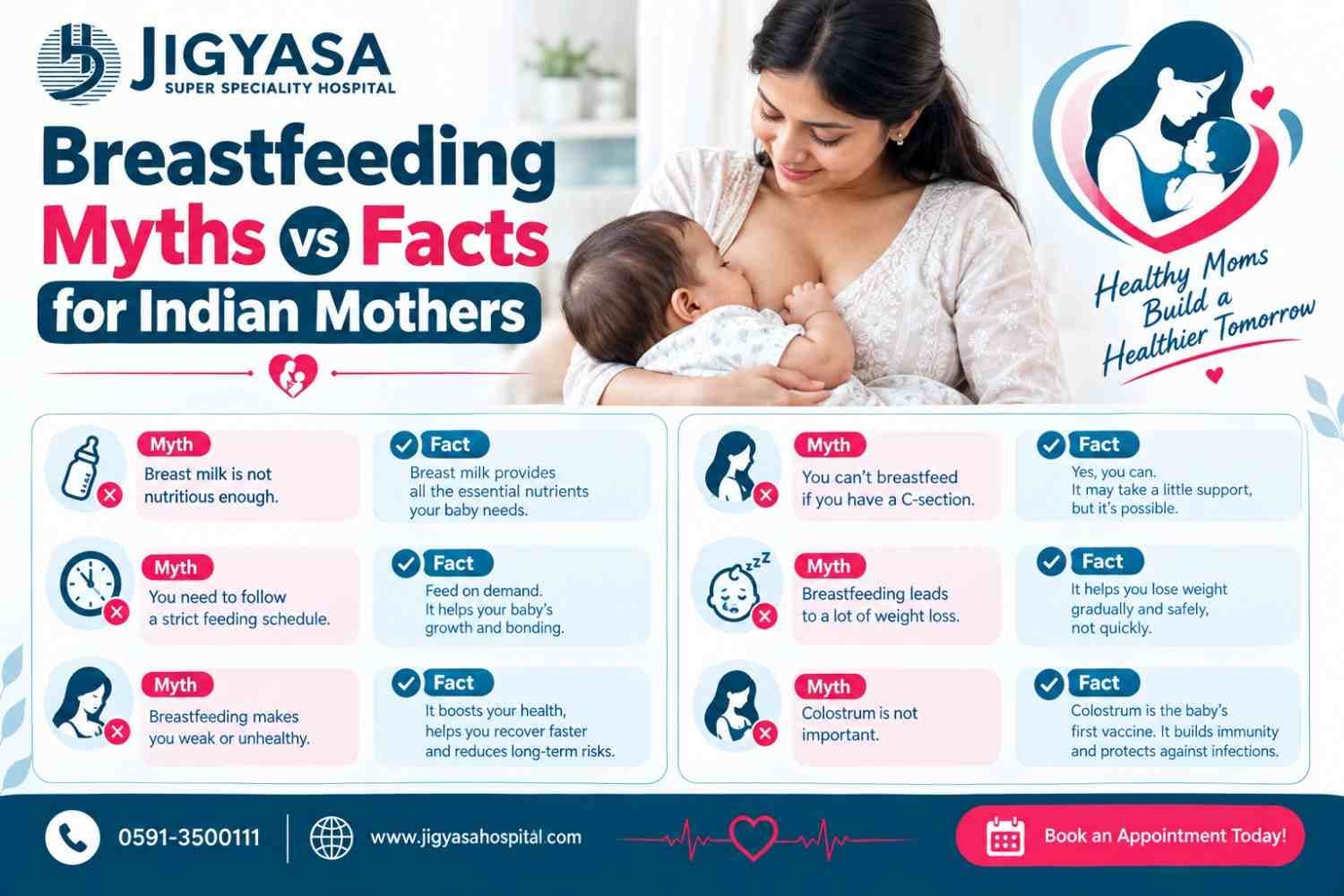
Breastfeeding Myths vs Facts for Indian Mothers
From colostrum to diet restrictions, breastfeeding advice in Indian households is full of myths. Learn what's actually true — guidance from Dr. Karishma Singh, Jigyasa Hospital, Moradabad.
Few topics attract as much unsolicited advice in Indian households as breastfeeding. New mothers are often surrounded by well-meaning relatives, neighbors, and even strangers, each offering guidance passed down through generations — some genuinely helpful, much of it outdated or simply untrue. This flood of conflicting advice can leave new mothers confused, anxious, and sometimes making decisions that aren't actually in their or their baby's best interest. At Jigyasa Hospital, Moradabad, Dr. Karishma Singh, our specialist in Gynecology, Obstetrics, and IVF, regularly helps new mothers separate evidence-based breastfeeding guidance from long-standing myths that continue to circulate in Indian families.
Myth 1: "The First Milk (Colostrum) Should Be Discarded"
The Myth: Many families believe the thick, yellowish first milk produced right after delivery is "dirty," "unclean," or otherwise unsuitable for the baby, and should be expressed and thrown away before "real" breastfeeding begins.
The Fact: Colostrum is actually one of the most valuable substances a newborn can receive. It's packed with antibodies and immune-boosting components that provide the baby's first significant protection against infections, along with being easily digestible and perfectly suited to a newborn's tiny stomach. Far from being discarded, colostrum should be offered to the baby as soon as possible after birth — ideally within the first hour, a practice often referred to as early initiation of breastfeeding.
Myth 2: "Breastfeeding Mothers Must Follow Extremely Restrictive Diets"
The Myth: New mothers are often told to avoid large categories of food — certain vegetables, fruits, spices, or "cooling" and "heating" foods based on traditional classifications — out of concern these will harm the baby or affect milk quality.
The Fact: While a genuinely balanced, nutritious diet supports both maternal health and milk production, extremely restrictive diets aren't necessary for most mothers and can actually lead to nutritional deficiencies at a time when the body needs adequate nutrition to recover from childbirth and support milk supply. Breastfeeding mothers generally need increased calorie intake, adequate protein, calcium, iron, and fluids — rather than elimination of entire food groups without a specific medical reason.
Myth 3: "If the Baby Cries a Lot, the Mother's Milk Isn't Enough"
The Myth: A crying baby is frequently interpreted as a sign of insufficient milk supply, leading families to pressure mothers into supplementing with formula or other foods prematurely.
The Fact: Babies cry for many reasons unrelated to hunger — discomfort, needing a diaper change, wanting comfort, being too warm or cold, or simply going through normal developmental phases. Signs of adequate milk intake are better assessed by tracking wet diapers, appropriate weight gain, and overall growth pattern, rather than crying alone. Frequent crying doesn't automatically mean low milk supply, and unnecessary early supplementation can actually interfere with establishing good breastfeeding.
Myth 4: "Small Breasts Produce Less Milk"
The Myth: Breast size is often assumed to directly correlate with milk-producing capacity, leading some mothers to worry unnecessarily about their ability to breastfeed adequately.
The Fact: Breast size is primarily determined by the amount of fatty tissue, not the amount of milk-producing glandular tissue. Milk production capacity is unrelated to breast size, and mothers with smaller breasts are just as capable of producing sufficient milk for their babies as those with larger breasts.
Myth 5: "Breastfeeding Mothers Should Avoid Drinking Water Immediately After Feeding or Certain Times of Day"
The Myth: Various restrictions around water intake timing are sometimes recommended, based on traditional beliefs rather than medical evidence.
The Fact: Breastfeeding significantly increases a mother's fluid needs, since milk production requires adequate hydration. Restricting water intake unnecessarily can contribute to dehydration, fatigue, and even reduced milk supply. Mothers should drink water regularly throughout the day based on thirst, without arbitrary timing restrictions.
Myth 6: "You Cannot Breastfeed If You're Sick"
The Myth: Many mothers are told to stop breastfeeding entirely if they catch a common cold, fever, or other minor illness, out of fear of passing the illness to the baby through milk.
The Fact: For most common illnesses, such as colds, flu, or mild fever, breastfeeding can and should continue. In fact, breast milk contains antibodies that can help protect the baby from the same illness the mother is experiencing. There are only a small number of specific medical situations where breastfeeding needs to be temporarily paused, and this should be guided by a doctor's advice rather than general precaution.
Myth 7: "Breastfeeding Ruins Breast Shape"
The Myth: Concerns about breastfeeding causing permanent changes to breast appearance sometimes discourage mothers from breastfeeding as long as recommended.
The Fact: Changes in breast appearance after pregnancy are primarily related to the hormonal changes and physical changes of pregnancy itself, along with factors like genetics, age, and number of pregnancies — rather than breastfeeding specifically. Avoiding breastfeeding doesn't prevent these natural changes, so this concern shouldn't be a reason to avoid or shorten breastfeeding duration.
Myth 8: "Formula Milk Is Just as Good as Breast Milk"
The Myth: Some families believe formula feeding is an equally good, convenient alternative to breastfeeding from the very start, without significant differences in benefit.
The Fact: While formula can be an appropriate and necessary option in specific circumstances, breast milk offers unique immune-protective components, easy digestibility, and a composition that naturally adapts to the baby's changing needs — benefits that formula cannot fully replicate. Exclusive breastfeeding for the first six months, where medically possible, is generally recommended due to these advantages, though individual circumstances always play a role in feeding decisions.
Myth 9: "You Should Stop Breastfeeding as Soon as the Baby Starts Eating Solid Food"
The Myth: Introducing solid foods around six months is sometimes seen as a signal to stop breastfeeding altogether.
The Fact: Breastfeeding alongside appropriate solid foods can continue well beyond six months, offering ongoing nutritional and immune benefits as the baby transitions to a more varied diet. The introduction of solids is meant to complement, not replace, continued breastfeeding at this stage.
Myth 10: "Painful Breastfeeding Is Just Something You Have to Endure"
The Myth: Many mothers assume significant pain during breastfeeding is a normal, unavoidable part of the experience that simply has to be tolerated.
The Fact: While some initial tenderness is common as breastfeeding is established, significant or ongoing pain often indicates an issue — such as improper latch, or conditions like blocked ducts or infection — that can and should be addressed rather than endured. Persistent pain is a signal to seek guidance, not something to simply push through.
Myth 11: "Pumped or Expressed Milk Isn't as Nutritious as Direct Breastfeeding"
The Myth: Some believe that milk expressed and stored for later use loses significant nutritional value compared to feeding directly from the breast.
The Fact: When properly expressed and stored, breast milk retains its nutritional and immune-protective properties, making it a valuable option for mothers who need to be away from their baby or want to build a supply for specific situations, without meaningfully compromising the benefits for the baby.
Why Addressing These Myths Matters
Believing these myths isn't just a matter of misinformation — it can have real consequences: unnecessary anxiety for new mothers, premature discontinuation of breastfeeding, nutritional deficiencies from overly restrictive diets, or delayed treatment of genuine breastfeeding difficulties because pain or problems were assumed to be "normal." Providing accurate, evidence-based guidance helps mothers make informed decisions and approach breastfeeding with confidence rather than fear or confusion.
How Jigyasa Hospital Supports Breastfeeding Mothers
At Jigyasa Hospital, Dr. Karishma Singh provides guidance to new mothers on establishing successful breastfeeding, including:
- •Encouraging early initiation of breastfeeding, ideally within the first hour after delivery
- •Providing accurate information about maternal nutrition needs during breastfeeding, correcting unnecessary restrictions
- •Addressing common breastfeeding difficulties, such as latch problems or concerns about milk supply, with practical, evidence-based solutions
- •Supporting mothers in making informed feeding decisions suited to their individual circumstances
- •Offering ongoing guidance through postnatal visits as breastfeeding challenges or questions arise
Gynecology Care at Jigyasa Hospital, Moradabad
- •Comprehensive postnatal care with breastfeeding support and guidance
- •Expert consultation by Dr. Karishma Singh, Gynecologist & IVF Specialist
- •Evidence-based advice on maternal nutrition, milk supply, and common breastfeeding challenges
- •Ongoing support through postnatal visits for new mothers
Book an Appointment: 7900903333
Address: Near Miglani Cinema, Rampur Road, Moradabad – 244001
Online Appointments: jigyasahospital.com
Breastfeeding Support | Postnatal Care | Maternal Nutrition | Newborn Care | Gynecology Services | Ayushman Bharat Accepted
Key Takeaways
- •Colostrum is the baby's first immunization — never discard it; initiate breastfeeding within the first hour.
- •Breastfeeding mothers need balanced nutrition, not restrictive diets — avoid unnecessary food restrictions.
- •Crying doesn't automatically mean low milk supply — track wet diapers and weight gain instead.
- •Breast size doesn't affect milk production; small-breasted mothers can breastfeed successfully.
- •Most illnesses don't require stopping breastfeeding — breast milk provides protective antibodies to the baby.
Frequently Asked Questions
How can I tell if my baby is getting enough milk?
Signs of adequate feeding include regular wet diapers, appropriate weight gain over time, and the baby appearing satisfied after feeds — these are more reliable indicators than crying frequency alone.
Is it true that I need to eat for two while breastfeeding?
Breastfeeding does increase calorie and nutrient needs, but this doesn't mean doubling food intake — rather, focusing on a balanced diet with adequate protein, calcium, and fluids to support milk production and maternal recovery.
Can I breastfeed if I've had a cesarean delivery?
Yes, a cesarean delivery doesn't prevent breastfeeding, though mothers may need some additional support finding comfortable positions during initial recovery.
Is it safe to breastfeed while taking medication for a common illness?
Many medications are safe during breastfeeding, but it's important to check with a doctor before taking any new medication, since safety varies depending on the specific drug.
How long should breastfeeding continue?
Exclusive breastfeeding is generally recommended for the first six months, with continued breastfeeding alongside solid foods recommended well beyond that, based on the mother and baby's circumstances and preferences.
Related Articles

Heart Attack Warning Signs You Must Never Ignore
Recognizing heart attack symptoms early can save your life. Learn the critical warning signs from Dr. Amit Kumar Singh, Senior Interventional Cardiologist at Jigyasa Hospital, Moradabad. Call 7900903333.

5 Early Morning Habits That Prevent Diabetes Naturally
Discover 5 powerful morning habits that naturally prevent diabetes. Expert advice from Dr. C.P. Singh, Senior Consultant Physician at Jigyasa Hospital, Moradabad. Call 7900903333.

Why Summers in UP Are Dangerous for Your Kidneys
UP summers can silently damage your kidneys. Jigyasa Hospital Moradabad explains the hidden risks, warning signs, and how to protect your kidneys this season. Call 7900903333.