

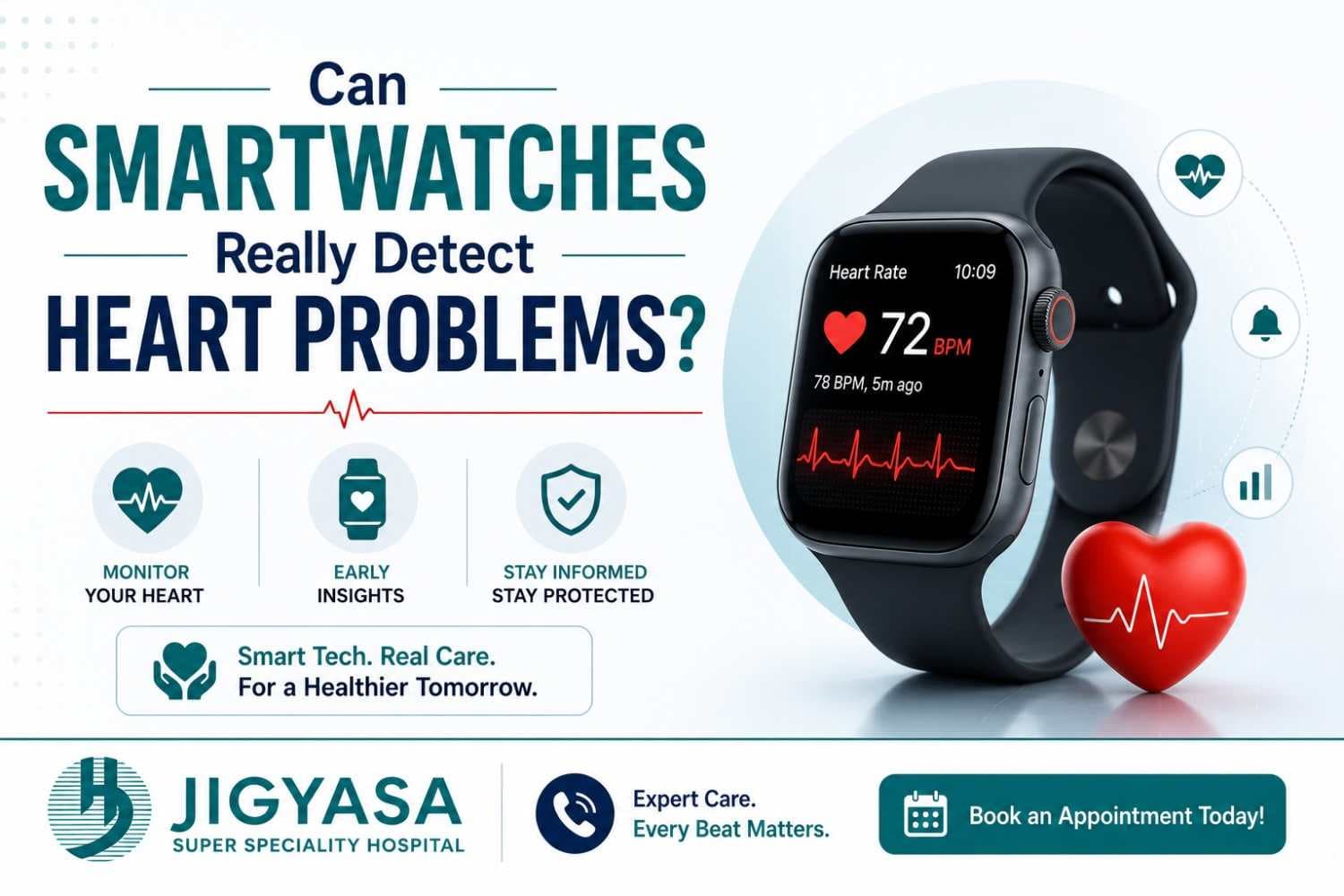
Can Smartwatches Really Detect Heart Problems?
Apple Watch, Galaxy Watch, Fitbit — Can They Truly Detect Heart Disease? Jigyasa Hospital's Cardiologist Explains What Smartwatches Can and Cannot Do for Your Heart Health, and When to See a Real Doctor.
Millions of Indians now wear smartwatches that claim to monitor heart rate, detect irregular rhythms, measure blood oxygen, and even record an ECG. Brands like Apple, Samsung, Garmin, and Fitbit have made bold marketing promises — and wearable health technology is now a ₹10,000+ crore industry in India alone. But when a patient walks into Jigyasa Hospital, Moradabad saying 'my watch told me something is wrong with my heart' — how seriously should we take that? The honest answer: smartwatches can be genuinely useful — but they are not a replacement for medical-grade cardiac diagnostics. This blog gives you the complete, unbiased picture — what smartwatches can detect, where they fall short, and when you must see a cardiologist regardless of what your watch says.
What Heart Features Do Modern Smartwatches Actually Have?
- •Continuous Heart Rate Monitoring (Optical PPG sensor): Uses green LED light to detect blood flow changes in the wrist and calculate beats per minute. Available on virtually all smartwatches — Apple Watch, Samsung Galaxy Watch, Fitbit, Mi Band, Noise, boAt, and more.
- •ECG (Electrocardiogram) Recording: Available on premium devices — Apple Watch Series 4 and above, Samsung Galaxy Watch 4+, Withings ScanWatch. Records a single-lead ECG (versus 12-lead in a hospital) by touching the crown of the watch with your finger to complete an electrical circuit.
- •Blood Oxygen (SpO2) Monitoring: Uses red and infrared light to estimate oxygen saturation in the blood — a proxy for respiratory and cardiac function.
- •Irregular Rhythm Notifications: AI-based algorithms alert the user if the watch detects a possible irregular heartbeat, particularly Atrial Fibrillation (AFib).
- •Stress and HRV (Heart Rate Variability) Tracking: Measures the variation between successive heartbeats — a marker of autonomic nervous system health and cardiac resilience.
What Smartwatches Can Genuinely Help With
Detecting Atrial Fibrillation (AFib) — With Caveats: Multiple peer-reviewed studies, including the landmark Apple Heart Study (Stanford University, 65,000+ participants), have shown that smartwatch AFib notifications have a positive predictive value of around 84%. For a consumer-grade device, this is remarkably good — and has led to real-life diagnoses where users sought medical attention after their watch flagged an irregular rhythm. However, the watch only flags possible AFib — it cannot diagnose it. A confirmed ECG from a cardiologist is always needed before any treatment decision.
Spotting Resting Heart Rate Abnormalities: A resting heart rate consistently above 100 bpm (tachycardia) or below 50 bpm (bradycardia) tracked by a smartwatch is a legitimate reason to consult a doctor. Smartwatches are effective at recording long-term trends — something a one-time hospital ECG cannot capture. If your watch shows that your resting heart rate has suddenly increased by 10–15 bpm over a week without a change in activity, that is a medically meaningful signal.
Monitoring During Exercise: Tracking heart rate during physical activity helps ensure you are not unknowingly overexerting your heart. For patients with known heart disease or hypertension who have been cleared for exercise, this can be a helpful safety tool — but should be used in consultation with a cardiologist.
Encouraging Proactive Health Behaviour: Studies consistently show that smartwatch users are more likely to notice health changes early and seek medical attention sooner. In that sense, even an imperfect detection is valuable — it gets people through the hospital door who might otherwise have ignored symptoms for months.
What Smartwatches Cannot Do — The Critical Limitations
They Cannot Diagnose a Heart Attack: A heart attack is diagnosed using a 12-lead hospital ECG, blood tests (troponin levels), and clinical assessment — none of which a smartwatch can perform. A smartwatch may detect a racing heart during a heart attack, but it cannot tell you whether arteries are blocked or whether muscle damage is occurring. Never rely on your watch to rule out a heart attack. If you have chest pain, breathlessness, or jaw/arm pain — go to the emergency room immediately.
Single-Lead ECG Misses Most Heart Conditions: Hospital ECGs record electrical activity from 12 different angles of the heart simultaneously. Smartwatch ECGs capture only one lead (Lead I) — equivalent to looking at a complex 3D structure through a single keyhole.
Conditions commonly missed by smartwatch ECGs:
- •ST-elevation (sign of heart attack)
- •Bundle branch blocks
- •Most ventricular arrhythmias
- •Structural heart disease signals
- •Ischemia (reduced blood flow to the heart)
High Rate of False Positives and False Negatives: Motion during exercise, loose fit, tattoos, darker skin tones, cold weather, and even slight wrist movement can cause incorrect readings — leading to unnecessary anxiety. Conversely, a person with serious heart disease may receive normal readings on a smartwatch, creating a dangerous false sense of security. Studies show wrist-based PPG sensors have an accuracy rate of only 60–80% during physical activity — far below the 99%+ accuracy of a hospital Holter monitor or ECG.
They Cannot Replace a Holter Monitor: A Holter monitor is a medical-grade device worn for 24–72 hours that records every heartbeat continuously and with clinical precision. If a cardiologist suspects intermittent arrhythmias, a Holter monitor — not a smartwatch — is the only medically valid tool. Smartwatch data, however useful for trends, is not accepted as clinical evidence in cardiology diagnosis or treatment protocols.
Blood Pressure Measurement Is Unreliable: Some smartwatches now claim to measure blood pressure without a cuff. Cardiologists universally agree: cuffless blood pressure readings from wearables are not accurate enough for medical use and should not be used to monitor hypertension.
When Should You See a Cardiologist — Regardless of What Your Watch Says?
- •Your watch shows irregular rhythm notifications repeatedly — even if you feel fine
- •Resting heart rate stays above 100 bpm or below 50 bpm for several days
- •You experience chest pain, dizziness, shortness of breath, or palpitations — do not wait for your watch to confirm it
- •You have a family history of heart disease or known risk factors like diabetes, hypertension, or high cholesterol
- •You are a man over 35 or a woman over 40 and have not had a cardiac checkup in the past 2 years
- •Your SpO2 readings are consistently below 94% at rest
- •You feel your heart skipping beats or fluttering regularly — even briefly
What a Proper Cardiac Checkup at Jigyasa Hospital Includes
Unlike a smartwatch, a clinical cardiac evaluation gives you definitive, actionable answers:
- •12-Lead ECG: Detects arrhythmias, ischemia, conduction disorders, and signs of prior heart attack
- •2D Echocardiography: Visualises heart structure, valves, and pumping function in real time
- •Holter Monitoring (24–72 hours): Catches intermittent arrhythmias that a smartwatch will miss
- •Treadmill Test (TMT / Stress Test): Evaluates heart function under physical stress
- •Blood Panel: Lipid profile, blood sugar, troponin, thyroid, and CRP inflammation markers
All of these services are available at Jigyasa Hospital, Moradabad under the care of Dr. Amit Kumar Singh, Senior Interventional Cardiologist with over a decade of specialised cardiac experience.
The Bottom Line — Smart Device, Smarter Decisions
- •Use your smartwatch as an early warning system, not a diagnostic tool.
- •Trust the trends it shows you over time — not individual readings.
- •If your watch raises a flag, treat it as a reason to see a cardiologist — not a reason to panic or, worse, to dismiss it.
- •Technology is evolving rapidly, but no wearable can replace a trained cardiologist with medical-grade equipment.
- •The smartest thing your watch can do is tell you to visit Jigyasa Hospital.
Book a Cardiac Consultation: 7900903333
Address: Near Miglani Cinema, Rampur Road, Moradabad – 244001
Appointments Online: jigyasahospital.com
12-Lead ECG | 2D Echo | Holter Monitoring | Stress Test | Interventional Cardiology | Ayushman Bharat Accepted
Key Takeaways
- •Smartwatches can be valuable tools for detecting possible AFib, heart rate abnormalities, and long-term trends — but cannot diagnose heart disease.
- •Single-lead smartwatch ECGs miss the majority of serious cardiac conditions that a 12-lead hospital ECG would catch.
- •False positives and false negatives are common — accuracy varies significantly based on device, skin tone, movement, and fit.
- •A smartwatch alert is a reason to see a doctor, not a final diagnosis.
- •Jigyasa Hospital offers complete, affordable cardiac diagnostics — giving you the certainty that no smartwatch ever can.
Frequently Asked Questions
Can a smartwatch detect a heart attack?
No. A smartwatch cannot diagnose a heart attack. Diagnosing a heart attack requires a 12-lead hospital ECG, blood tests measuring troponin levels, and clinical assessment by a cardiologist — none of which a wearable device can perform. A smartwatch may detect an elevated heart rate during a cardiac event, but it cannot identify blocked arteries or muscle damage. If you experience chest pain, breathlessness, or arm or jaw pain, go to the emergency room immediately — do not wait for your watch to confirm anything.
How accurate is a smartwatch ECG compared to a hospital ECG?
Smartwatch ECGs record only a single lead (Lead I), whereas hospital ECGs record 12 leads simultaneously from multiple angles of the heart. This means smartwatch ECGs miss the vast majority of serious cardiac conditions — including ST-elevation (heart attack sign), bundle branch blocks, ventricular arrhythmias, and ischemia. Hospital ECGs provide diagnostic certainty that no smartwatch can match.
Can a smartwatch detect Atrial Fibrillation (AFib)?
Smartwatches with irregular rhythm notification features — such as Apple Watch and Samsung Galaxy Watch — have demonstrated a positive predictive value of around 84% for AFib detection in peer-reviewed studies. This is useful for prompting people to seek medical attention, but a smartwatch notification is not a diagnosis. A confirmed ECG performed by a cardiologist is always required before any AFib treatment is initiated.
When should I see a cardiologist even if my smartwatch shows normal readings?
Immediately if you experience chest pain, palpitations, dizziness, shortness of breath, or jaw and arm pain — regardless of what your watch shows. Smartwatches have a significant false-negative rate, meaning they can show normal readings in people with serious heart disease. Your symptoms and risk factors matter far more than a consumer-grade wearable reading.
Is a smartwatch blood pressure reading reliable?
No. Cardiologists universally consider cuffless blood pressure readings from smartwatches to be insufficiently accurate for medical use. They should not be used to monitor, diagnose, or make treatment decisions about hypertension. A validated upper-arm cuff blood pressure monitor is the standard for home BP monitoring.
What cardiac tests does Jigyasa Hospital offer?
Jigyasa Hospital, Moradabad offers a full range of cardiac diagnostics including 12-lead ECG, 2D Echocardiography, Holter Monitoring (24–72 hours), Treadmill Stress Test (TMT), and comprehensive blood panels including lipid profile, troponin, and inflammatory markers. All services are available under the care of Dr. Amit Kumar Singh, Senior Interventional Cardiologist. Call 7900903333 or visit jigyasahospital.com to book.
Can I use my smartwatch data during a cardiology consultation at Jigyasa Hospital?
Yes — your smartwatch's heart rate trends, irregular rhythm logs, and SpO2 history can provide useful context during a consultation and help your cardiologist understand patterns over time. However, this data supplements — it does not replace — clinical diagnostic tests. Smartwatch data is not accepted as clinical evidence for diagnosis or treatment decisions under standard cardiology protocols.
My smartwatch showed an irregular rhythm — should I be worried?
Treat it as a prompt to see a cardiologist, not a cause for panic. A single irregular rhythm notification may result from movement, a poor fit, or a transient benign event. However, repeated notifications — or any notification accompanied by symptoms such as palpitations, dizziness, or chest discomfort — should be evaluated promptly. Contact Jigyasa Hospital on 7900903333 for a same-day cardiac consultation.
Is a Holter monitor better than a smartwatch for detecting arrhythmias?
Yes — significantly. A Holter monitor is a medical-grade device that records every single heartbeat over 24–72 hours with clinical precision. It captures intermittent arrhythmias that a smartwatch will frequently miss. Holter monitor data is accepted as clinical evidence and forms the basis of arrhythmia diagnosis and treatment decisions. Jigyasa Hospital offers Holter monitoring as part of its cardiac diagnostic services.
At what age should I get a proper cardiac checkup even if I feel healthy?
Men over 35 and women over 40 should have a baseline cardiac evaluation even without symptoms — particularly if they have risk factors such as family history of heart disease, diabetes, hypertension, high cholesterol, obesity, or a history of smoking. Early detection through a proper 12-lead ECG, echo, and blood panel at Jigyasa Hospital gives you a definitive baseline that no smartwatch can provide.
Related Articles
Heart Attack Warning Signs You Must Never Ignore
Recognizing heart attack symptoms early can save your life. Learn the critical warning signs from Dr. Amit Kumar Singh, Senior Interventional Cardiologist at Jigyasa Hospital, Moradabad. Call 7900903333.
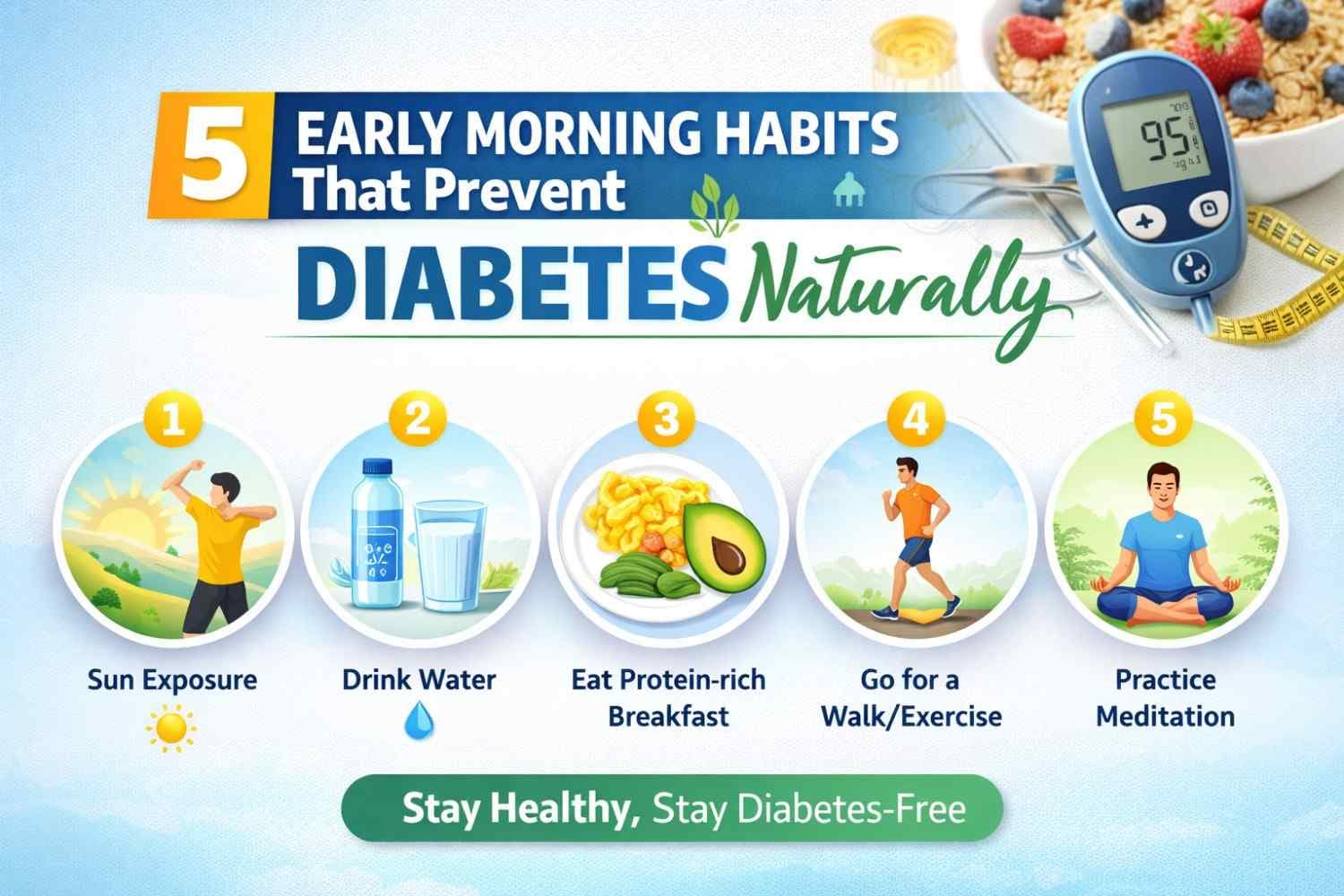
5 Early Morning Habits That Prevent Diabetes Naturally
Discover 5 powerful morning habits that naturally prevent diabetes. Expert advice from Dr. C.P. Singh, Senior Consultant Physician at Jigyasa Hospital, Moradabad. Call 7900903333.

Why Summers in UP Are Dangerous for Your Kidneys
UP summers can silently damage your kidneys. Jigyasa Hospital Moradabad explains the hidden risks, warning signs, and how to protect your kidneys this season. Call 7900903333.