
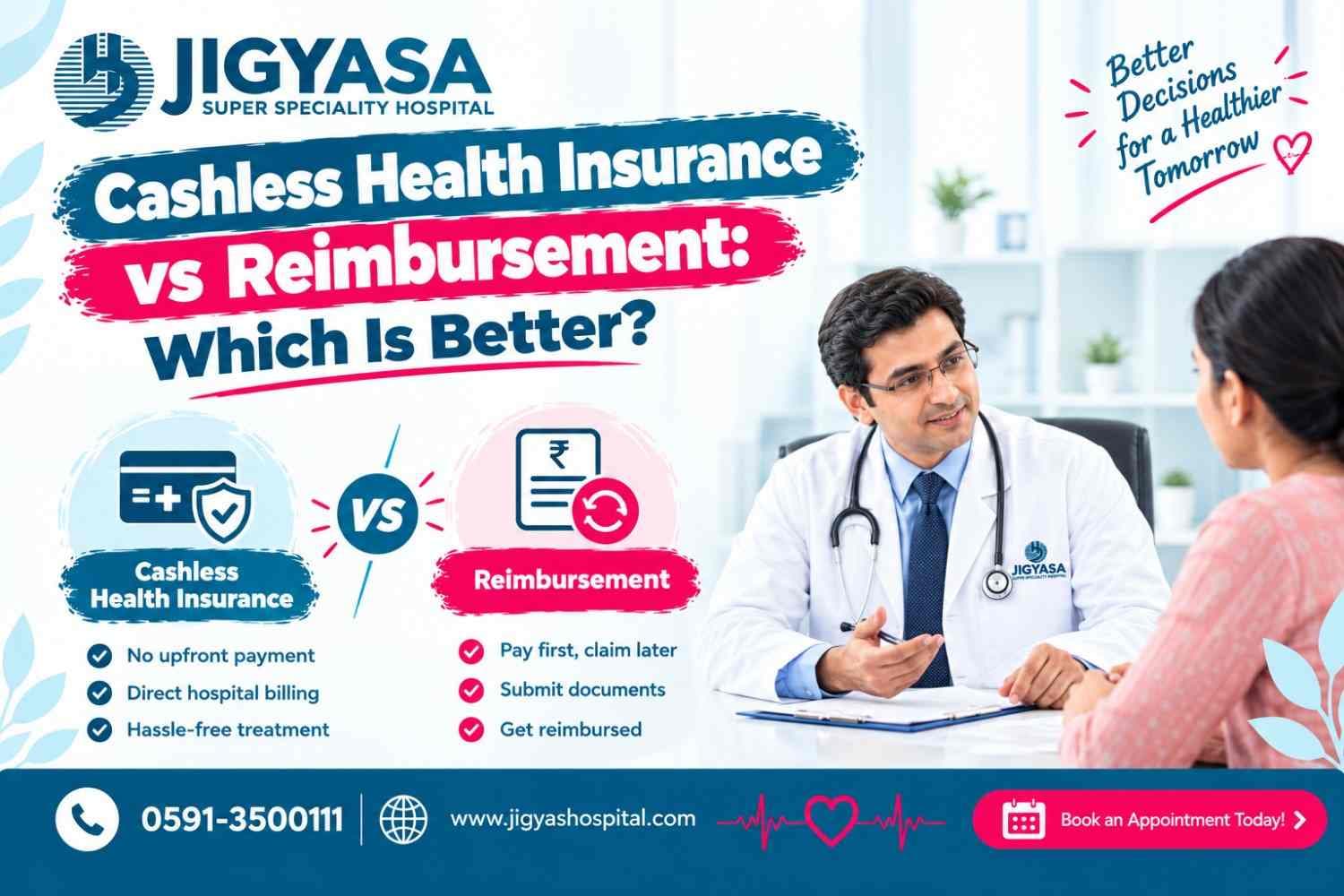
Cashless Health Insurance vs Reimbursement: Which Is Better?
Cashless or reimbursement claim? Learn how each works, the pros and cons, documents needed, and how to avoid claim rejection, from Jigyasa Hospital, Moradabad.
When a family member is admitted to hospital, the first worry is health. The second is almost always money. If you have health insurance, one question comes up quickly: should the claim be cashless, or should you pay and claim the money back later? Both routes can work well, but they feel very different on the ground. The right choice depends on your policy, the hospital, and whether the admission is planned or an emergency. At Jigyasa Hospital, Moradabad, our insurance and billing team helps families with this decision every day. This guide explains both options in plain language so you can plan before you are under pressure.
What Is a Cashless Claim?
In a cashless claim, the insurer (or its TPA, the third-party administrator) pays the hospital directly. You do not pay the covered amount from your pocket.
How it usually works:
- •You get admitted at a hospital that has a tie-up (network arrangement) with your insurer
- •The hospital's insurance desk sends a pre-authorisation request to the insurer with the diagnosis, treatment plan, and estimated cost
- •The insurer reviews and approves the amount, in full or in part
- •During treatment, you pay only for items not covered, such as non-payable consumables, any co-payment, and amounts above your limit
- •At discharge, the insurer settles the approved bill directly with the hospital
Cashless is available only at network hospitals and only for treatments the policy covers. Approval is not automatic. The insurer can ask for more documents, approve a lower amount, or decline.
What Is a Reimbursement Claim?
In a reimbursement claim, you pay the hospital bill yourself, then submit documents to the insurer to get the eligible amount refunded.
How it usually works:
- •You are treated at any hospital, network or non-network
- •You pay the bills at discharge
- •You collect all original documents
- •You submit the claim form and documents to the insurer within the time limit stated in your policy
- •The insurer verifies and pays the admissible amount into your bank account
You need enough funds, or the ability to arrange them, at the time of discharge.
Side-by-Side Comparison
| Feature | Cashless | Reimbursement |
|---|---|---|
| Upfront payment | Minimal, only non-covered items | Full bill paid first |
| Where available | Network hospitals only | Any hospital |
| Paperwork | Mostly handled by hospital desk | Done by you |
| Approval | Before or during treatment | After treatment |
| Stress during admission | Lower | Higher if funds are tight |
| Flexibility of hospital choice | Limited to network | Wide |
| Refund time | Not applicable | Depends on insurer processing |
| Risk of surprise disallowance | Mostly known earlier | Often learned after you have paid |
Advantages of Cashless
- •No large upfront payment, which matters most in emergencies
- •Less paperwork for the family, since the hospital desk coordinates with the insurer
- •Clarity on what is covered before or early in treatment
- •Peace of mind at a stressful time
Limitations of Cashless
- •Only at network hospitals
- •Pre-authorisation can be delayed or partially approved, especially for complex cases
- •Approval can be revised during treatment if the condition changes
- •You may still pay non-payable items, co-payment, and any amount above the sum insured
- •Not suitable if the best-matched hospital or doctor is outside your network
Advantages of Reimbursement
- •Freedom to choose any hospital or doctor
- •Useful when the nearest suitable hospital is not in your network
- •A fallback if a cashless request is declined or the policy does not offer cashless at that hospital
Limitations of Reimbursement
- •You must arrange the full payment up front
- •You manage all documents and deadlines
- •Claim can be reduced or rejected after you have already paid
- •Waiting period for the refund
Which Is Better? It Depends on the Situation
Cashless is usually better when:
- •It is an emergency and funds are not readily available
- •The treating hospital is in your insurer's network
- •The admission is planned and you can get pre-authorisation in advance
- •You want the hospital to handle most paperwork
Reimbursement may make sense when:
- •You prefer a hospital or doctor not in your network
- •Cashless was declined or is not available for that treatment
- •You are comfortable paying first and claiming later
- •You are using an out-of-network facility during travel
Neither is "better" in all cases. The better route is the one that fits your policy, hospital, and finances, and the best preparation is knowing both before you need them.
Government Schemes: Ayushman Bharat PM-JAY
Separate from private insurance, Ayushman Bharat PM-JAY provides cashless hospital cover for eligible families, up to a set annual limit per family, at empanelled hospitals. Jigyasa Hospital is empanelled under PM-JAY. Eligibility, covered packages, and limits are set by the scheme and may change, so confirm your eligibility and card status with the hospital's PM-JAY help desk or the official scheme channels before admission.
Documents You Should Keep Ready
For cashless:
- •Insurance card or policy number
- •Government photo ID
- •Doctor's admission advice or diagnosis note
- •Previous reports relevant to the illness
- •PM-JAY card and ID proof, if using the scheme
For reimbursement, collect and keep originals of:
- •Filled claim form
- •Discharge summary
- •Itemised final bill and payment receipts
- •Doctor's prescriptions, investigation reports, and pharmacy bills
- •Implant stickers or invoices, where applicable
- •Cancelled cheque or bank details
- •Policy copy and ID proof
- •Any other document your insurer lists
Check your own policy for the exact list, since requirements vary.
Common Reasons Claims Get Delayed or Rejected
- •Non-disclosure of existing illnesses when buying the policy
- •Waiting periods not yet completed for specific conditions
- •Excluded treatments, such as certain cosmetic or non-medical procedures
- •Missing or incomplete documents
- •Late intimation or submission beyond policy time limits
- •Admission for tests only, with no medically necessary hospitalisation
- •Exceeding sub-limits, such as room rent caps, which can reduce the whole claim proportionately
- •Non-payable items that policies do not cover
Practical Tips Before Admission
- •Know your policy: sum insured, room rent limit, co-payment, waiting periods, exclusions, and sub-limits
- •Check network status of your preferred hospital before an emergency happens
- •Keep your insurance details in your phone and with a family member
- •For planned admissions, ask the hospital desk to start pre-authorisation early
- •In emergencies, inform the insurer as soon as possible, as most policies require prompt intimation
- •Ask for an estimate and understand what may not be covered
- •Keep every bill and report, even if you plan to go cashless, in case you need to switch to reimbursement
- •Read the final settlement letter, and ask the desk about any deductions you do not understand
What If Cashless Is Denied?
A denial of cashless does not always mean the claim itself is rejected. Often it means the insurer wants more information or wants to review after treatment. Your options:
- •Ask the hospital desk why it was denied and whether more documents can resolve it
- •Proceed with treatment and file a reimbursement claim afterwards, if medically needed treatment cannot wait
- •Contact the insurer's customer care or grievance channel
- •Escalate through the insurer's grievance process, and if unresolved, the insurance ombudsman, as described in your policy
Never delay urgent treatment because of a pending approval. Discuss the situation with your treating doctor and the hospital desk.
How Jigyasa Hospital Can Help
At Jigyasa Hospital, our insurance and billing desk can guide families on:
- •Whether your insurer's cashless facility applies at our hospital, to be confirmed with the desk at the time of admission
- •Starting pre-authorisation for planned admissions
- •Ayushman Bharat PM-JAY eligibility and the admission process for eligible patients
- •The documents to keep for reimbursement claims
- •Understanding the estimate and expected out-of-pocket items
For emergencies, our 24/7 emergency care is available, and the team will help coordinate paperwork alongside treatment.
Insurance & Billing Support at Jigyasa Hospital, Moradabad
- •Insurance desk for cashless pre-authorisation and claim coordination
- •Ayushman Bharat PM-JAY empanelled hospital with dedicated help desk
- •Guidance on reimbursement documents and claim process
- •24/7 emergency care with paperwork support alongside treatment
Book an Appointment: 7900903333
Address: Near Miglani Cinema, Rampur Road, Moradabad – 244001
Online Appointments: jigyasahospital.com
Cashless Insurance | Reimbursement Claims | Ayushman Bharat PM-JAY | Insurance Desk | Ayushman Bharat Accepted
Key Takeaways
- •Cashless = insurer/TPA pays hospital directly (network hospitals only, pre-authorisation needed); Reimbursement = you pay first, claim refund later (any hospital).
- •Cashless advantages: no large upfront payment, less paperwork, clarity on coverage early. Limitations: network-only, approval can be delayed/partial/revised.
- •Reimbursement advantages: any hospital/doctor, fallback when cashless declined. Limitations: full payment upfront, you manage all documents, risk of post-payment disallowance.
- •Know your policy before admission: sum insured, room rent caps, co-payment, waiting periods, exclusions. Keep all bills and reports even for cashless claims.
- •Cashless denial ≠ claim rejection — proceed with treatment, keep documents, and file reimbursement later. Never delay urgent treatment for a pending approval. Jigyasa Hospital is PM-JAY empanelled.
Frequently Asked Questions
Can I switch from cashless to reimbursement during the same hospital stay?
Often yes, if the cashless request is declined or limited. Keep all original documents so you can file a reimbursement claim afterwards, and check your policy terms.
Is cashless available for emergency admissions?
Many insurers allow cashless in emergencies at network hospitals, and approval is usually requested right after admission. Inform the hospital desk and the insurer as early as possible.
Does cashless mean I pay nothing at all?
Not always. You may still pay non-payable items, co-payment, amounts above your sum insured, and any room upgrades beyond your policy limit.
Is reimbursement claim amount the same as cashless?
The covered amount depends on the same policy terms. The difference is who pays first. Reimbursement may expose you to disallowance only after you have already paid.
Should I choose a hospital only because it offers cashless?
Cashless is a convenience, not a substitute for the right hospital and doctor. If the best-suited treatment is out of network, reimbursement is a valid option. Discuss with your doctor first.
Related Articles

Heart Attack Warning Signs You Must Never Ignore
Recognizing heart attack symptoms early can save your life. Learn the critical warning signs from Dr. Amit Kumar Singh, Senior Interventional Cardiologist at Jigyasa Hospital, Moradabad. Call 7900903333.

5 Early Morning Habits That Prevent Diabetes Naturally
Discover 5 powerful morning habits that naturally prevent diabetes. Expert advice from Dr. C.P. Singh, Senior Consultant Physician at Jigyasa Hospital, Moradabad. Call 7900903333.
Why Summers in UP Are Dangerous for Your Kidneys
UP summers can silently damage your kidneys. Jigyasa Hospital Moradabad explains the hidden risks, warning signs, and how to protect your kidneys this season. Call 7900903333.