

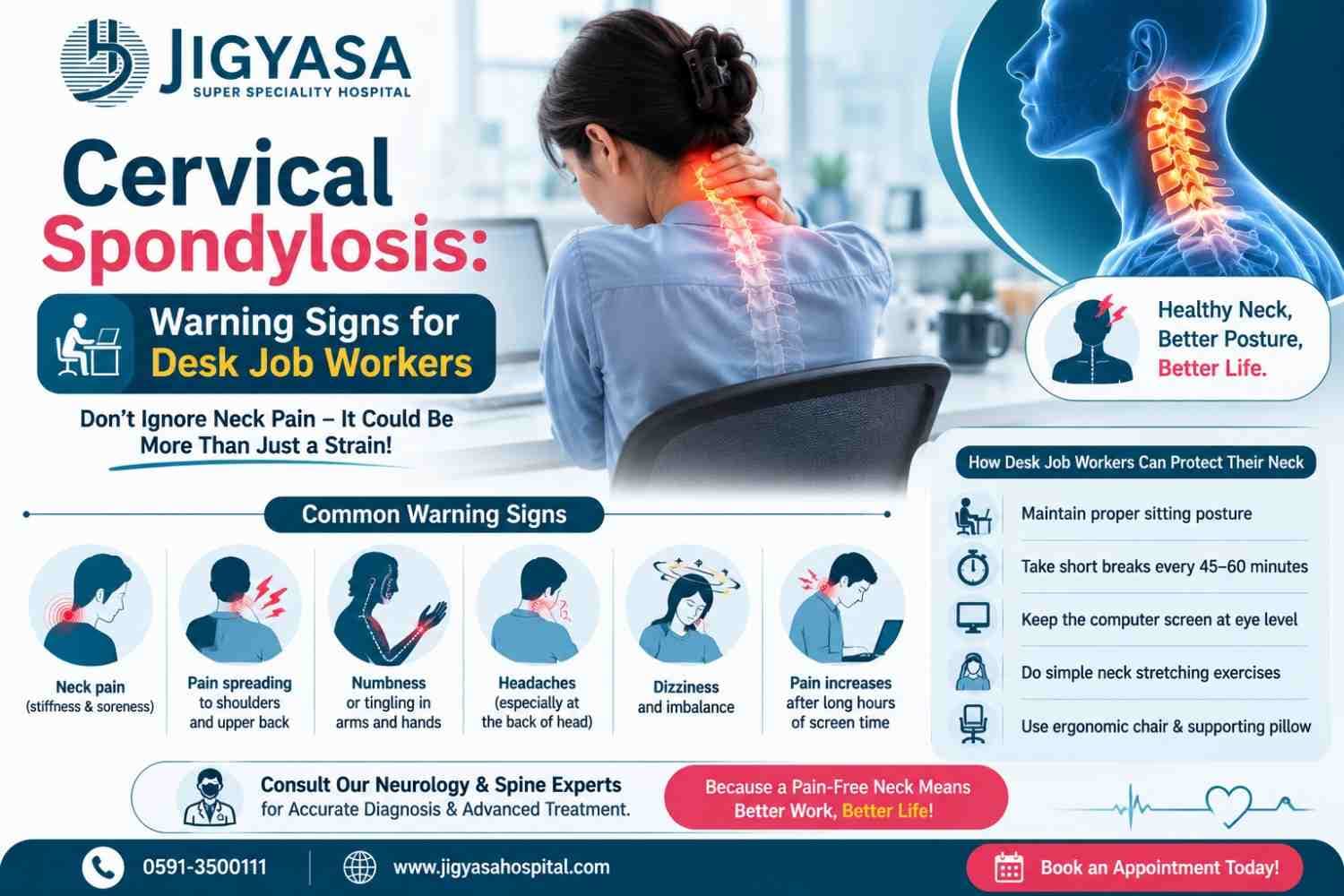
Cervical Spondylosis: Warning Signs for Desk Job Workers
Long hours at a desk can silently damage your neck. Learn the early warning signs of cervical spondylosis and how to protect your spine.
If you spend eight or more hours a day hunched over a laptop, staring down at a phone, or sitting in front of a computer screen with your neck tilted forward, you're part of one of the fastest-growing risk groups for a condition that used to be associated mainly with aging: cervical spondylosis. What was once considered primarily a wear-and-tear condition of older adults is now increasingly diagnosed in people in their late twenties and thirties, largely driven by prolonged desk work, poor posture, and reduced physical activity. At Jigyasa Hospital, Moradabad, Dr. Kriti Kishore, our specialist in Rheumatology, regularly evaluates desk job professionals presenting with neck pain and stiffness, many of whom are surprised to learn how much their daily posture habits are contributing to their symptoms.
What Is Cervical Spondylosis?
Cervical spondylosis refers to age-related or wear-related degeneration of the discs, joints, and bones in the neck (cervical spine). Over time, the cushioning discs between the vertebrae can lose height and elasticity, small bony growths (osteophytes) may develop, and the joints can become stiffer and less flexible. While some degree of these changes is a natural part of aging, prolonged poor posture and repetitive strain — exactly the pattern seen in long hours of desk and screen work — can accelerate this process significantly and bring on symptoms much earlier than expected.
Why Desk Jobs Put the Neck at Risk
The human neck is designed to support the head in a relatively neutral, upright position. However, common desk-work postures place the neck under far more strain than most people realize:
- •Forward head posture: Where the head juts forward relative to the shoulders while looking at a screen, significantly increases the load on the neck muscles and joints — for every inch the head moves forward from its neutral position, the effective weight it places on the neck increases substantially
- •Looking down at phones and laptops: For extended periods, sometimes referred to informally as "tech neck," places sustained strain on the back of the neck
- •Prolonged static positioning: Where the neck remains in the same position for hours without movement, reduces blood flow to the muscles and increases stiffness
- •Poor desk ergonomics: Such as screens positioned too low or too far, or chairs that don't support proper posture
- •Reduced overall physical activity: Weakening the muscles that normally support and stabilize the neck and upper back
Over months and years, this combination of sustained poor posture and reduced movement contributes to accelerated degeneration of the cervical spine structures.
Early Warning Signs Desk Workers Often Ignore
Many people dismiss early neck symptoms as ordinary tiredness or "just how my neck feels after a long day," which often delays evaluation until symptoms become more significant. Watch for:
1. Persistent Neck Stiffness
A general tightness or reduced range of motion in the neck, particularly noticeable first thing in the morning or after long periods at a desk, that doesn't fully resolve with simple stretching.
2. Neck Pain That Worsens Through the Workday
Pain that's mild in the morning but progressively worsens as the day goes on, particularly during long stretches of screen time, is a strong signal of posture-related strain.
3. Pain Radiating to the Shoulders or Upper Back
As the muscles around the neck compensate for poor posture, pain often spreads to the shoulders and upper back, sometimes described as a constant dull ache or tightness.
4. Headaches Originating from the Back of the Head
Tension-type headaches that start at the base of the skull and spread forward are commonly linked to prolonged neck strain and poor posture, a pattern sometimes called cervicogenic headache.
5. A Grinding or Popping Sensation with Neck Movement
Some people notice a crackling, grinding, or popping sound or sensation when turning their head, which can indicate early degenerative changes in the neck joints.
6. Reduced Range of Motion
Difficulty turning the head fully to one side, or noticing that looking over your shoulder while driving or checking surroundings feels more restricted than before.
7. Numbness or Tingling in the Arms or Hands
When degenerative changes begin to affect the nerves exiting the cervical spine, numbness, tingling, or a burning sensation can radiate down the arm into the hand — a sign that should prompt evaluation rather than being dismissed as "sleeping on it wrong."
8. Weakness in the Hands or Arms
In more advanced cases, nerve involvement can cause noticeable weakness, such as difficulty gripping objects firmly or a tendency to drop things unexpectedly.
9. Dizziness or Balance Issues with Neck Movement
Some patients report brief dizziness or unsteadiness when turning or extending the neck, which is thought to be related to how neck position can affect blood flow and nerve signals in certain individuals.
10. Difficulty Sleeping Due to Neck Discomfort
Chronic neck pain that disrupts sleep, or requiring frequent pillow adjustments to find a comfortable position, often indicates the condition has progressed beyond simple, occasional strain.
Who Is Most at Risk?
- •Professionals working long hours on computers — IT, customer support, data entry, content and design work
- •Individuals who spend significant time on smartphones with the head tilted downward
- •People with poor desk ergonomics — screens positioned too low, unsupportive chairs, or improperly placed keyboards
- •Those with minimal physical activity or exercise outside of work hours
- •Individuals with pre-existing postural issues, such as rounded shoulders
- •A family history of early degenerative spine changes
Why Early Recognition Matters
Cervical spondylosis is a progressive condition when the underlying contributing factors — poor posture, prolonged static positioning, weak supporting muscles — aren't addressed. Left unmanaged, the degenerative changes can advance to the point of causing nerve compression (cervical radiculopathy) or, less commonly, spinal cord involvement (cervical myelopathy), both of which are more complex to treat than early-stage postural strain.
Recognizing and addressing symptoms early — before significant structural changes occur — offers far better long-term outcomes than waiting until pain becomes constant or nerve symptoms develop.
How Cervical Spondylosis Is Evaluated at Jigyasa Hospital
At Jigyasa Hospital, Dr. Kriti Kishore's evaluation typically includes:
1. Detailed Clinical History
Understanding symptom onset, work habits, posture patterns, and associated symptoms such as radiating pain, numbness, or headaches provides important initial clues.
2. Physical Examination
Assessing neck range of motion, posture, muscle tenderness, and specific tests to check for nerve involvement in the arms or hands.
3. Imaging Studies
- •X-rays to assess disc space narrowing, bone spurs, and overall alignment of the cervical spine
- •MRI, when nerve or spinal cord involvement is suspected, to get a detailed view of the discs, nerves, and soft tissue structures
4. Nerve Studies
When numbness, tingling, or weakness suggests nerve involvement, nerve conduction studies may be recommended to assess the extent and location of nerve compression.
Treatment Approach
For Early, Posture-Related Symptoms
- •Ergonomic correction — adjusting screen height, chair support, and keyboard position to encourage a neutral neck posture
- •Regular movement breaks during long work sessions to avoid prolonged static positioning
- •Targeted neck and upper back strengthening and stretching exercises
- •Postural awareness training, both at the desk and during phone use
- •Anti-inflammatory medication for symptomatic relief during flare-ups
For More Advanced Cases
- •Physical therapy focused on restoring range of motion and correcting muscle imbalances
- •Cervical traction or supportive measures in select cases
- •Targeted injections for significant nerve-related pain, when appropriate
- •Referral for specialized surgical opinion in cases with significant nerve or spinal cord compression that hasn't responded to conservative treatment
Practical Prevention Tips for Desk Job Workers
- •Position your screen at eye level, so you're not consistently looking down
- •Take a movement break every 30–45 minutes, even briefly standing or stretching
- •Avoid cradling your phone between your ear and shoulder
- •Hold your phone at eye level rather than looking down for extended periods
- •Use a chair with proper back and neck support, adjusted to your desk height
- •Incorporate regular neck and shoulder stretches into your daily routine
- •Strengthen your upper back and core muscles, which help support better overall posture
- •Be mindful of "tech neck" during evening screen time as well, not just work hours
Rheumatology Care at Jigyasa Hospital, Moradabad
- •Comprehensive cervical spondylosis evaluation with physical examination and imaging
- •Expert diagnosis and treatment by Dr. Kriti Kishore, Rheumatologist
- •Ergonomic assessment and posture correction guidance for desk workers
- •Physical therapy, medications, and advanced interventions for neck pain and spine disorders
Book an Appointment: 7900903333
Address: Near Miglani Cinema, Rampur Road, Moradabad – 244001
Online Appointments: jigyasahospital.com
Cervical Spondylosis Treatment | Neck Pain Management | X-Ray & MRI | Rheumatology Services | Physical Therapy | Ayushman Bharat Accepted
Key Takeaways
- •Cervical spondylosis is increasingly common in young desk workers due to poor posture and prolonged screen time.
- •Early warning signs include neck stiffness, worsening pain through the day, headaches, and numbness/tingling in arms.
- •Forward head posture and "tech neck" significantly increase strain on cervical spine structures.
- •Early recognition and ergonomic corrections can prevent progression and nerve complications.
- •Treatment ranges from posture correction and exercises to physical therapy, medications, and targeted interventions.
Frequently Asked Questions
Is cervical spondylosis only a concern for older adults?
No. While it's traditionally associated with aging, it's increasingly seen in younger adults due to prolonged desk work, poor posture, and reduced physical activity, sometimes appearing in people in their late twenties or thirties.
Can cervical spondylosis be reversed?
The degenerative changes themselves generally can't be fully reversed, but symptoms can often be significantly improved and further progression slowed through posture correction, targeted exercise, and appropriate treatment.
Is neck cracking or popping always something to worry about?
Occasional, painless popping isn't necessarily concerning, but if it's accompanied by pain, stiffness, or occurs frequently alongside other symptoms, it's worth having evaluated.
When should numbness or tingling in the arms be taken seriously?
Persistent or recurrent numbness, tingling, or weakness in the arms or hands — especially alongside neck pain — should be evaluated promptly, as it may indicate nerve involvement requiring specific treatment.
Can simple posture correction alone fix cervical spondylosis?
For early, posture-related symptoms, ergonomic and postural changes combined with targeted exercises can make a significant difference. More advanced cases with nerve involvement typically require a more comprehensive treatment approach.
Related Articles

Heart Attack Warning Signs You Must Never Ignore
Recognizing heart attack symptoms early can save your life. Learn the critical warning signs from Dr. Amit Kumar Singh, Senior Interventional Cardiologist at Jigyasa Hospital, Moradabad. Call 7900903333.

5 Early Morning Habits That Prevent Diabetes Naturally
Discover 5 powerful morning habits that naturally prevent diabetes. Expert advice from Dr. C.P. Singh, Senior Consultant Physician at Jigyasa Hospital, Moradabad. Call 7900903333.

Why Summers in UP Are Dangerous for Your Kidneys
UP summers can silently damage your kidneys. Jigyasa Hospital Moradabad explains the hidden risks, warning signs, and how to protect your kidneys this season. Call 7900903333.