

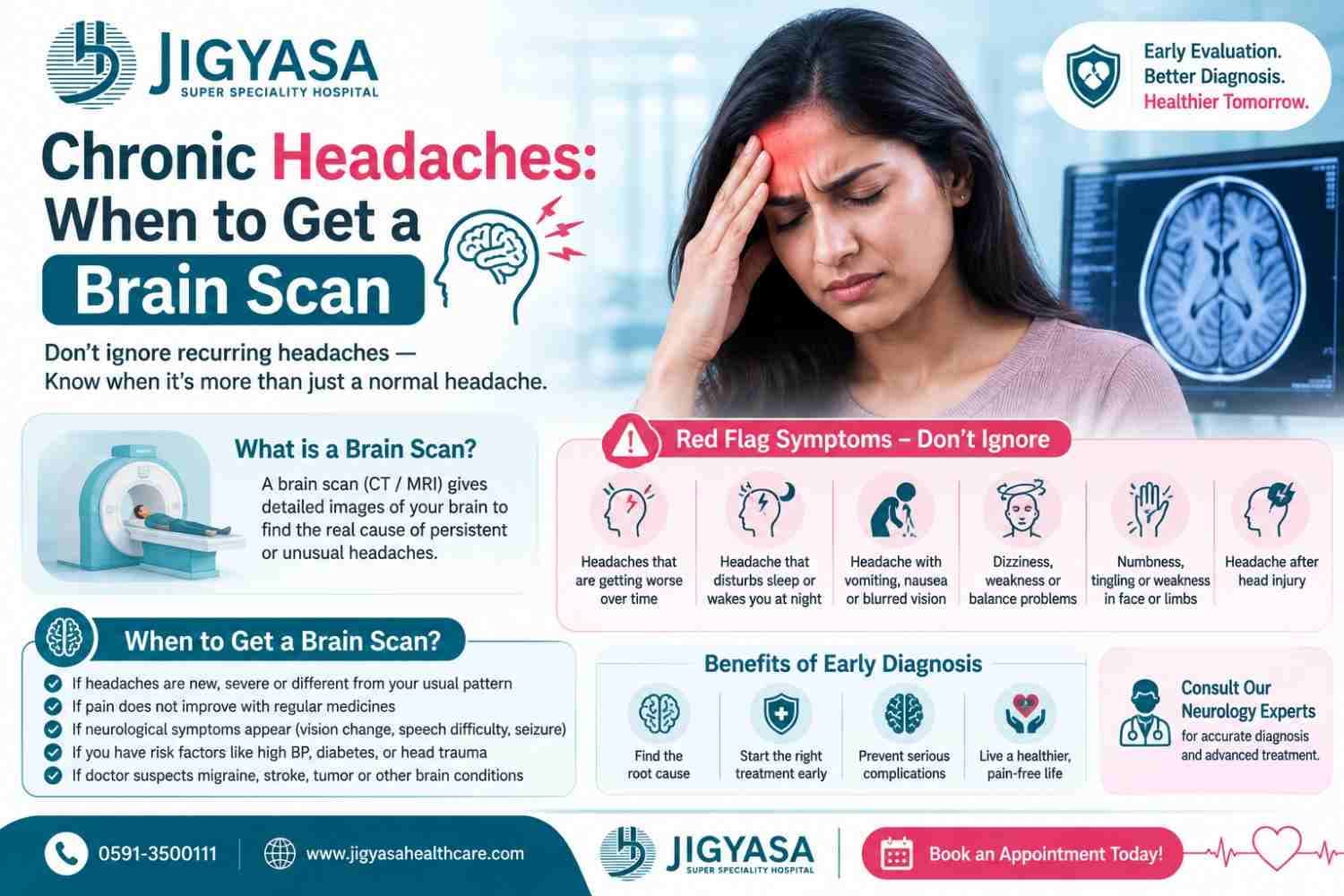
Chronic Headaches: When to Get a Brain Scan
Not every headache needs imaging — but some do. Learn the warning signs that call for a brain scan, from Dr. C.P. Singh, Jigyasa Hospital, Moradabad.
Almost everyone gets a headache from time to time, and the vast majority are harmless — caused by stress, dehydration, poor sleep, or eye strain, and resolving on their own or with simple pain relief. But for people who experience frequent or persistent headaches, a common and understandable question arises: do I need a brain scan? The truth is that most chronic headaches, including migraines and tension-type headaches, don't require imaging at all. However, certain patterns and warning signs do call for further investigation, since a small proportion of headaches can signal an underlying condition that needs prompt attention. At Jigyasa Hospital, Moradabad, Dr. C.P. Singh, Founder and Chairman, evaluates patients with chronic or unusual headaches to determine whether their symptom pattern falls into the "reassurance and management" category or the "further investigation needed" category.
Why Most Headaches Don't Need a Scan
The majority of chronic headaches fall into two broad categories: tension-type headaches and migraines. Both are considered "primary" headaches, meaning the headache itself is the condition, rather than a symptom of something else happening in the brain.
Tension-type headaches typically feel like a constant pressure or tightness, often described as a band around the head, and are usually mild to moderate in intensity.
Migraines often involve throbbing pain, frequently on one side of the head, and may be accompanied by nausea, sensitivity to light and sound, and sometimes visual disturbances (aura) before the headache begins.
For both conditions, the diagnosis is usually made based on the pattern, character, and history of the headaches — not through brain imaging — because these conditions typically don't show any abnormality on a scan. Ordering a scan for every typical migraine or tension headache would expose patients to unnecessary cost, and in the case of CT scans, unnecessary radiation, without meaningfully changing management.
When a Brain Scan Becomes Necessary: Warning Signs ("Red Flags")
While most headaches are benign, certain features suggest the headache could be a symptom of an underlying structural or neurological problem, warranting imaging. Doctors often refer to these as "red flag" symptoms.
1. The "Worst Headache of Your Life"
A sudden, extremely severe headache that reaches maximum intensity within seconds to minutes — sometimes described as a "thunderclap headache" — is a significant warning sign and requires urgent evaluation, as it can indicate bleeding in or around the brain.
2. New Headache Pattern After Age 50
Headaches that begin for the first time in someone over 50 warrant closer evaluation, since new-onset headaches later in life are less commonly due to typical migraine or tension headache and more likely to have an underlying cause.
3. Progressive Worsening Over Time
A headache that steadily worsens in frequency, intensity, or duration over weeks, rather than following the usual on-and-off pattern of migraines, is a signal that further investigation may be needed.
4. Headache with Neurological Symptoms
Any headache accompanied by:
- •Weakness or numbness in an arm, leg, or one side of the body
- •Difficulty speaking or slurred speech
- •Vision changes, double vision, or loss of vision
- •Loss of coordination or balance
- •Confusion or altered mental state
- •Seizures
...should be evaluated urgently, as these symptoms suggest the headache may be linked to a neurological event rather than a typical primary headache.
5. Headache with Fever, Neck Stiffness, or Rash
This combination can indicate a brain or spinal cord infection, such as meningitis, which requires immediate medical attention.
6. Headache That Changes with Position
Headaches that significantly worsen when lying down, standing up, coughing, or straining can indicate changes in pressure within the skull and should be evaluated.
7. Headache Following a Head Injury
Any significant headache after a head injury, particularly if it's severe, worsening, or accompanied by confusion, vomiting, or drowsiness, needs prompt evaluation to rule out bleeding or other injury-related complications.
8. New Headache in Someone with Cancer or Weakened Immunity
In patients with a known history of cancer or a compromised immune system, new or changing headaches are evaluated more cautiously, since these patients have a higher likelihood of an underlying structural cause.
9. Headache Associated with Unexplained Weight Loss or Other Systemic Symptoms
When a headache is accompanied by unexplained weight loss, persistent fatigue, or other systemic symptoms, this combination may prompt further investigation.
10. A Significant Change in a Long-Standing Headache Pattern
For people with a known history of migraines or tension headaches, a notable change in the usual character, frequency, or severity of their headaches — rather than a typical episode — is worth having evaluated rather than assumed to be "just another migraine."
Types of Brain Imaging Used
CT Scan (Computed Tomography)
Often used in urgent situations, as it's quick and effective at detecting bleeding, and is commonly the first imaging test performed when a serious cause is suspected, such as after a thunderclap headache or head injury.
MRI (Magnetic Resonance Imaging)
Provides more detailed images of brain structures and is particularly useful for detecting tumors, structural abnormalities, and issues that CT may not clearly show, and is often used for more thorough or non-urgent evaluation of chronic or atypical headaches.
The choice between CT and MRI — and whether imaging is needed at all — depends on the specific symptom pattern, urgency, and clinical findings on examination.
What a Normal Scan Means (and Doesn't Mean)
It's worth understanding that a normal brain scan doesn't necessarily mean nothing is wrong — it simply rules out the structural causes that imaging can detect, such as tumors, bleeding, or major structural abnormalities. Conditions like migraines and tension headaches typically appear completely normal on imaging, since they're not caused by a visible structural problem.
A normal scan in this context is actually reassuring, confirming that the headaches are very likely a primary headache disorder that can be managed through appropriate medical treatment rather than surgery or other structural intervention.
How Chronic Headaches Are Evaluated at Jigyasa Hospital
At Jigyasa Hospital, Dr. C.P. Singh's evaluation of chronic headache patients typically includes:
1. Detailed Headache History
Understanding the pattern, triggers, duration, associated symptoms, and how the headaches have evolved over time — often the single most valuable diagnostic tool for distinguishing primary from secondary headaches.
2. Physical and Neurological Examination
Checking for any neurological deficits, vision changes, or other findings that might suggest an underlying cause requiring further investigation.
3. Blood Pressure Check
Since very high blood pressure can itself cause headaches and needs to be identified and managed.
4. Imaging, When Indicated
CT or MRI is recommended specifically when red flag features are present, rather than as a routine step for every headache complaint.
5. Referral for Specialized Care
When imaging identifies a structural abnormality, or when the headache pattern suggests a complex neurological condition, coordination with specialized neurology care is arranged as part of comprehensive management.
Managing Primary Headaches (Migraines and Tension Headaches)
For patients whose evaluation points toward a primary headache disorder, management typically includes:
- •Identifying and avoiding personal triggers, such as certain foods, stress, sleep disruption, or dehydration
- •Appropriate use of pain-relief medication, with attention to avoiding overuse, which can paradoxically worsen headache frequency
- •Preventive medication for those with frequent or severe migraines
- •Lifestyle measures — regular sleep schedule, hydration, stress management, and regular meals
- •Keeping a headache diary to identify patterns and triggers over time, which can also help guide treatment adjustments
When to Seek Immediate Emergency Care
- •Sudden, severe "worst headache of your life"
- •Headache with weakness, numbness, slurred speech, or vision loss
- •Headache with confusion, seizures, or loss of consciousness
- •Headache following significant head trauma
- •Headache with fever, neck stiffness, and rash
Neurology Care at Jigyasa Hospital, Moradabad
- •Comprehensive headache evaluation with detailed history and neurological examination
- •CT/MRI brain imaging when red flag symptoms are present
- •Expert diagnosis and management by Dr. C.P. Singh and neurology team
- •Personalized treatment plans for migraines, tension headaches, and chronic headache disorders
Book an Appointment: 7900903333
Address: Near Miglani Cinema, Rampur Road, Moradabad – 244001
Online Appointments: jigyasahospital.com
CT/MRI Brain Imaging | Headache Management | Migraine Treatment | Neurology Services | Emergency Care | Ayushman Bharat Accepted
Key Takeaways
- •Most chronic headaches (migraines, tension-type) don't need brain scans — they're diagnosed based on symptom pattern.
- •Red flag symptoms like sudden severe headache, neurological deficits, fever, or head injury warrant immediate imaging.
- •CT scans are used for urgent evaluation; MRI provides more detailed imaging for non-urgent cases.
- •A normal scan is reassuring — it rules out structural causes but doesn't mean your headaches aren't real.
- •Seek emergency care for thunderclap headaches, headaches with weakness/confusion, or after significant head trauma.
Frequently Asked Questions
If I've had migraines for years, do I ever need a scan?
Not routinely, as long as the pattern remains consistent with your usual migraines. However, a significant change in pattern, severity, or new associated symptoms would warrant re-evaluation.
Is it normal to have headaches almost every day?
Frequent, near-daily headaches aren't something to simply live with — they should be evaluated, both to rule out warning signs and to address the headaches themselves, since untreated frequent headaches can sometimes become harder to manage over time.
Can stress alone cause severe headaches?
Yes, stress is a very common trigger for both tension-type headaches and migraines. However, if a headache described as stress-related has any red flag features, it should still be evaluated rather than assumed to be purely stress-related.
Does a normal brain scan mean my headaches aren't "real"?
Not at all. A normal scan simply rules out structural causes; conditions like migraines are very real and are diagnosed based on symptom pattern rather than imaging findings.
Should children with headaches be evaluated differently?
Headaches in children generally warrant careful evaluation, and warning signs may sometimes present differently than in adults, so any persistent or unusual headache pattern in a child should be discussed with a doctor.
Related Articles

Heart Attack Warning Signs You Must Never Ignore
Recognizing heart attack symptoms early can save your life. Learn the critical warning signs from Dr. Amit Kumar Singh, Senior Interventional Cardiologist at Jigyasa Hospital, Moradabad. Call 7900903333.

5 Early Morning Habits That Prevent Diabetes Naturally
Discover 5 powerful morning habits that naturally prevent diabetes. Expert advice from Dr. C.P. Singh, Senior Consultant Physician at Jigyasa Hospital, Moradabad. Call 7900903333.

Why Summers in UP Are Dangerous for Your Kidneys
UP summers can silently damage your kidneys. Jigyasa Hospital Moradabad explains the hidden risks, warning signs, and how to protect your kidneys this season. Call 7900903333.