
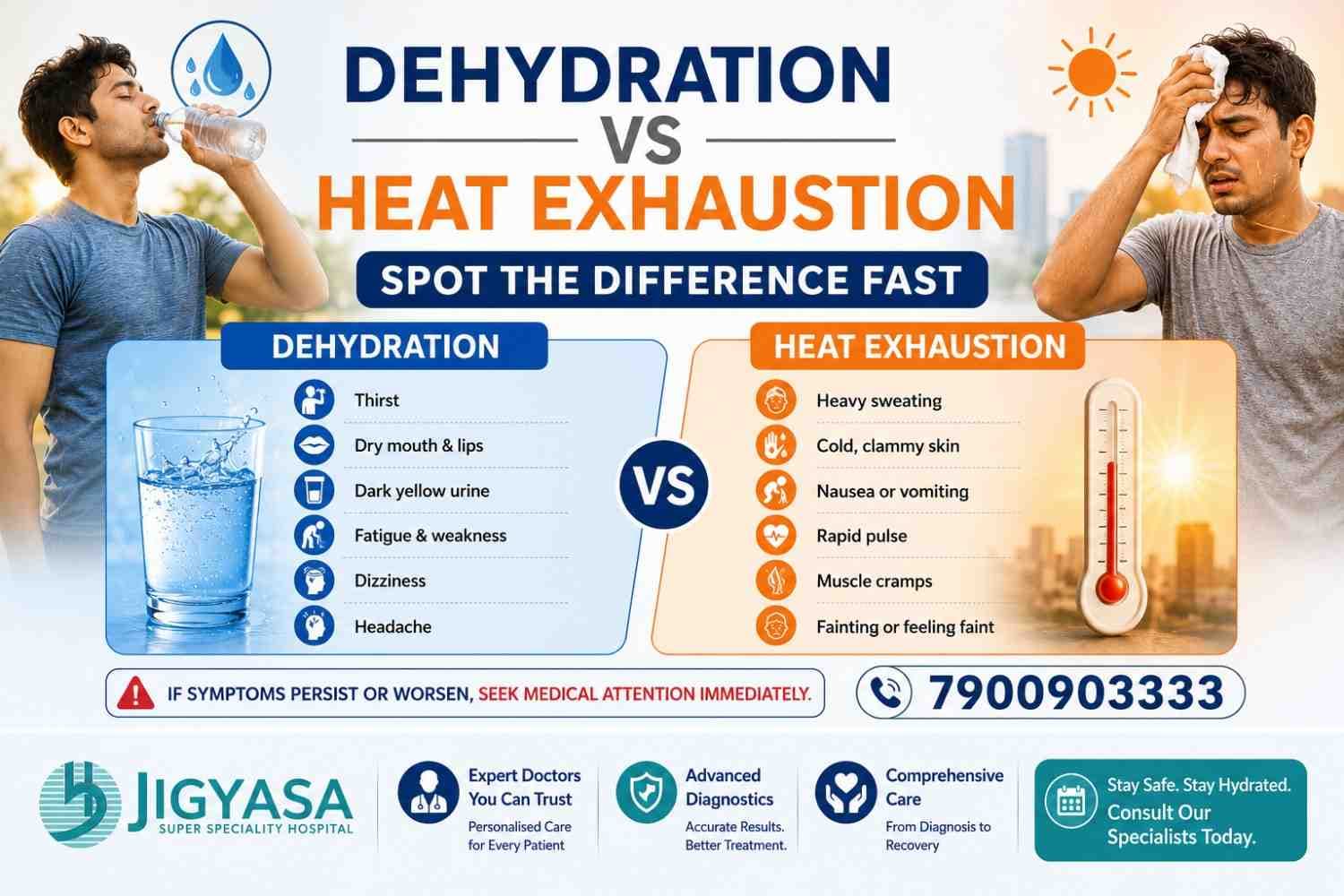
Dehydration vs Heat Exhaustion — Spot the Difference Fast
Dehydration and heat exhaustion look similar but need different action. Jigyasa Hospital Moradabad breaks down the key differences — and tells you exactly when to call emergency.
When temperatures in Moradabad cross 42°C in May and June, two heat-related conditions become a real risk for every family dehydration and heat exhaustion. They share several symptoms, they often occur together, and they are frequently confused with each other. But they are not the same condition, and the difference matters because what you do in the first 20 minutes determines whether someone recovers at home or needs emergency care. This blog gives you a fast, practical guide: what each condition is, how to tell them apart right now, what to do at home, and exactly when to stop and go to hospital. At Jigyasa Hospital, Moradabad, our emergency team manages heat-related cases throughout the summer. This is the guidance we give every family clearly and without delay.
What Is Dehydration?
- •Dehydration occurs when the body loses more fluid and electrolytes than it takes in
- •In summer, the primary cause is sweating without adequate fluid replacement; other causes include vomiting, diarrhoea, fever, and insufficient water intake
- •Affects people of all ages — children and elderly are most vulnerable
- •Can progress from mild to moderate to severe within hours in UP summer heat
- •At the cellular level, dehydration reduces blood volume, impairs circulation, and disrupts electrolyte balance
- •Dehydration is the starting point — heat exhaustion is what happens when dehydration occurs alongside overheating
What Is Heat Exhaustion?
- •Heat exhaustion is a heat-related illness caused by prolonged exposure to high temperatures combined with dehydration
- •It occurs when the body's cooling system — primarily sweating — is overwhelmed or insufficient
- •Body temperature rises above normal but usually stays below 40°C (104°F)
- •Above 40°C with confusion = heatstroke, which is a medical emergency
- •Most common during Moradabad's May–June peak, between 11 am and 4 pm
- •Can develop in minutes when someone is working outdoors, travelling in non-AC vehicles, or standing in direct sun
- •Without treatment, heat exhaustion progresses to heatstroke — which can be fatal
Dehydration vs Heat Exhaustion — Symptoms Side by Side
The table below compares the two conditions symptom by symptom — use it to assess someone right now:
- •Thirst: Strong and persistent in dehydration — may be present but reduced in heat exhaustion
- •Skin: Dry and less elastic in dehydration — pale, cool, and clammy in heat exhaustion
- •Sweating: Reduced or absent in dehydration — heavy and profuse in heat exhaustion
- •Body temperature: Normal or mildly elevated in dehydration — elevated 37.5°C to 40°C in heat exhaustion
- •Urine colour: Dark yellow to no urine in dehydration — dark or reduced in heat exhaustion
- •Headache: Mild to moderate in dehydration — moderate to severe and throbbing in heat exhaustion
- •Dizziness: Present when standing in dehydration — present even when still in heat exhaustion
- •Nausea/vomiting: Mild nausea in dehydration — nausea with possible vomiting in heat exhaustion
- •Muscle cramps: Possible, especially in legs in dehydration — common in legs and abdomen in heat exhaustion
- •Fatigue: Moderate tiredness in dehydration — extreme weakness and near-collapse in heat exhaustion
- •Mental state: Alert, possibly irritable in dehydration — confused, anxious, and disoriented in heat exhaustion
- •Heart rate: Slightly elevated in dehydration — rapid and weak pulse in heat exhaustion
The Fastest Way to Tell the Difference Right Now
Check the Skin First
- •Cold, pale, clammy, sweaty skin → strongly points to heat exhaustion
- •Dry, warm skin with reduced elasticity → points to dehydration
Check Body Temperature
- •Normal or slightly above — dehydration is the primary issue
- •Above 38.5°C — heat exhaustion is active alongside dehydration
- •Above 40°C with confusion or loss of consciousness — this is heatstroke; call emergency immediately
Check Urine
- •Dark yellow or amber → moderate dehydration
- •No urination in 6 or more hours → severe dehydration needing medical care
- •Cannot assess urine because the person is collapsed → go to hospital now
Check Mental State
- •Alert and oriented but tired → dehydration, manageable at home initially
- •Confused, slurring words, disoriented → heat exhaustion advancing, needs medical care
- •Unconscious or unresponsive → heatstroke; call 7900903333 immediately
What to Do at Home — Step by Step
If You Suspect Dehydration (Mild to Moderate)
- •Move the person to a cool, shaded indoor space immediately
- •Begin ORS — small, frequent sips every 1 to 2 minutes; do not gulp
- •If ORS is unavailable, give cool clean water with a small pinch of salt and sugar
- •Remove excess clothing to allow body heat to escape
- •Place a damp cool cloth on the forehead and wrists
- •Monitor urine — improvement means the person is rehydrating
- •Continue ORS for at least 2 to 4 hours
- •Do not give alcohol, caffeinated drinks, or very cold carbonated beverages
If You Suspect Heat Exhaustion
- •Remove the person from heat immediately — move to a cool, shaded indoor space or AC room
- •Lay them down and elevate the legs slightly (if not vomiting) to improve blood flow to the brain
- •Remove all excess or tight clothing
- •Cool the body actively — wet towels on neck, armpits, and groin; fan continuously
- •Give cool ORS or water if the person is conscious and can swallow safely
- •Do not leave the person alone
- •Monitor temperature every 5 to 10 minutes if a thermometer is available
- •If temperature does not drop or condition does not improve within 15 to 20 minutes → go to hospital
When to Stop Home Treatment and Go to Hospital
Go to Jigyasa Hospital or call 7900903333 without further delay if any of the following are present:
- •Body temperature reaches or exceeds 40°C (104°F)
- •The person becomes confused, disoriented, or cannot speak clearly
- •Seizures occur
- •The person loses consciousness even briefly
- •Vomiting prevents any fluid intake for more than 30 minutes
- •Skin becomes hot and dry with no sweating despite high temperature — this is heatstroke
- •A child stops crying, becomes limp, or is unusually unresponsive
- •Symptoms do not improve within 20 to 30 minutes of active cooling and rehydration
- •The person has a history of heart disease, diabetes, or kidney disease, or is elderly — lower threshold for seeking care
Heatstroke — The Emergency Beyond Heat Exhaustion
Heatstroke is the life-threatening stage that follows untreated heat exhaustion. It requires immediate hospital care — it is not manageable at home.
- •Body temperature exceeds 40°C (104°F)
- •The sweating mechanism fails — skin becomes hot and dry
- •Brain function is affected — confusion, aggression, slurred speech, seizures, loss of consciousness
- •Organs begin to fail if body temperature is not rapidly reduced
- •Death or permanent brain damage can occur within minutes to hours without treatment
The one sign that separates heat exhaustion from heatstroke: hot, dry skin with no sweating + body temperature above 40°C + confusion = heatstroke. Call 7900903333 immediately.
Who Is Most at Risk in Moradabad This Summer?
- •Outdoor labourers and daily wage workers with prolonged sun exposure
- •Children travelling to school in non-AC vehicles or playing outdoors during peak hours
- •Elderly individuals with reduced thirst sensation and poor heat tolerance
- •People with diabetes, hypertension, or heart disease — medications like diuretics, beta-blockers, and ACE inhibitors impair the body's heat response
- •People who are overweight — higher metabolic heat production with less efficient cooling
- •Anyone who has had a previous episode of heat exhaustion — risk of recurrence is significantly higher
- •People not acclimatised to sudden extreme heat — early May, when temperatures spike rapidly, is a peak risk period
Prevention — 6 Practical Rules for UP Summer
- •Hydrate ahead of the heat: Drink at least 500 ml of water before going outdoors. Do not wait until you are thirsty.
- •Avoid peak heat hours: Stay indoors between 11 am and 4 pm when air temperature peaks in Moradabad. Schedule outdoor work for early morning or after sunset.
- •Dress for the heat: Loose, lightweight, light-coloured cotton clothing reflects heat and allows sweat to evaporate. Avoid dark colours and synthetic fabrics outdoors.
- •Keep ORS sachets at home: Stock at least 6 sachets through the summer season. Begin rehydration at the first sign of excessive sweating — not after symptoms develop.
- •Check on vulnerable family members: Elderly parents and young children often do not recognise their own dehydration. Ask directly, check urine colour, and ensure they are drinking throughout the day.
- •Never leave a child or elderly person in a parked car: Temperature inside a parked car in Moradabad summer can reach 55 to 60°C within minutes — a life-threatening environment in a very short time.
Get Help at Jigyasa Hospital — 24/7 Emergency Care
If you or a family member shows signs of heat exhaustion, heatstroke, or severe dehydration this summer do not wait. Our team provides IV fluid therapy, rapid cooling protocols, electrolyte correction, and continuous monitoring for all heat-related emergencies.
Call: 7900903333
Address: Near Miglani Cinema, Rampur Road, Moradabad – 244001
Email: info@jigyasahospital.in
Website: jigyasahospital.com
24/7 Emergency Care | IV Fluid Therapy | Rapid Cooling Protocols | Ayushman Bharat Accepted
Emergency unit open 24 hours, 7 days a week. No prior appointment needed.
Frequently Asked Questions
Is heat exhaustion the same as dehydration?
No — they are related but distinct. Dehydration is a fluid and electrolyte deficit that can occur without significant overheating. Heat exhaustion is a specific heat-related illness where the body overheats because its cooling system is overwhelmed, almost always accompanied by dehydration. Dehydration can occur in a cool room if someone is vomiting or not drinking. Heat exhaustion requires exposure to high environmental temperatures.
Can a person have heat exhaustion without feeling thirsty?
Yes — and this is a dangerous feature of heat exhaustion. As the condition progresses, the thirst mechanism can become blunted. Elderly individuals in particular often do not feel appropriately thirsty even when significantly dehydrated or overheated. Never use absence of thirst as reassurance that someone is adequately hydrated in summer heat.
How quickly can heat exhaustion turn into heatstroke?
Without active cooling and rehydration, heat exhaustion can progress to heatstroke within 30 to 60 minutes — sometimes faster in children, elderly individuals, or people with underlying health conditions. The transition is marked by the body temperature crossing 40°C and sweating stopping. At that point, every minute without intervention increases the risk of organ damage. Do not wait to see if it gets better on its own.
Should I give salt tablets for heat exhaustion or dehydration?
No — do not give salt tablets. Concentrated salt without adequate water can worsen sodium imbalance and cause additional complications. ORS sachets dissolved in the correct amount of water provide the right sodium concentration safely. Salt tablets are not recommended for civilian use in heat emergencies.
When is it safe to return to normal activity after heat exhaustion?
Most people need 24 to 48 hours of rest, rehydration, and cool conditions before returning to normal physical activity after a heat exhaustion episode. Returning outdoors or to physical work too quickly significantly increases the risk of a second, more severe episode. If symptoms including weakness, headache, or dizziness persist beyond 48 hours, consult a physician at Jigyasa Hospital before resuming activity.
Related Articles
Heart Attack Warning Signs You Must Never Ignore
Recognizing heart attack symptoms early can save your life. Learn the critical warning signs from Dr. Amit Kumar Singh, Senior Interventional Cardiologist at Jigyasa Hospital, Moradabad. Call 7900903333.
5 Early Morning Habits That Prevent Diabetes Naturally
Discover 5 powerful morning habits that naturally prevent diabetes. Expert advice from Dr. C.P. Singh, Senior Consultant Physician at Jigyasa Hospital, Moradabad. Call 7900903333.
Why Summers in UP Are Dangerous for Your Kidneys
UP summers can silently damage your kidneys. Jigyasa Hospital Moradabad explains the hidden risks, warning signs, and how to protect your kidneys this season. Call 7900903333.