
ECG vs Echo vs TMT: Which Heart Test Do You Actually Need?
Confused between ECG, Echocardiography, and TMT? Understand what each heart test checks, when it's needed, and which one is right for your symptoms.
"Doctor, should I get an ECG or an Echo?" is one of the most common questions cardiologists hear — and understandably so. With so many heart tests available, and doctors often ordering more than one, it's natural to wonder what each test actually shows, why one isn't enough on its own, and which test applies to your specific situation. At Jigyasa Hospital, Moradabad, our cardiology team, led by Dr. Amit Kumar Singh, regularly helps patients understand exactly which test is appropriate for their symptoms — rather than ordering tests indiscriminately. This guide breaks down ECG, Echocardiography, and TMT in simple terms, so you know what to expect and why your doctor may recommend one, two, or all three.
What Is an ECG (Electrocardiogram)?
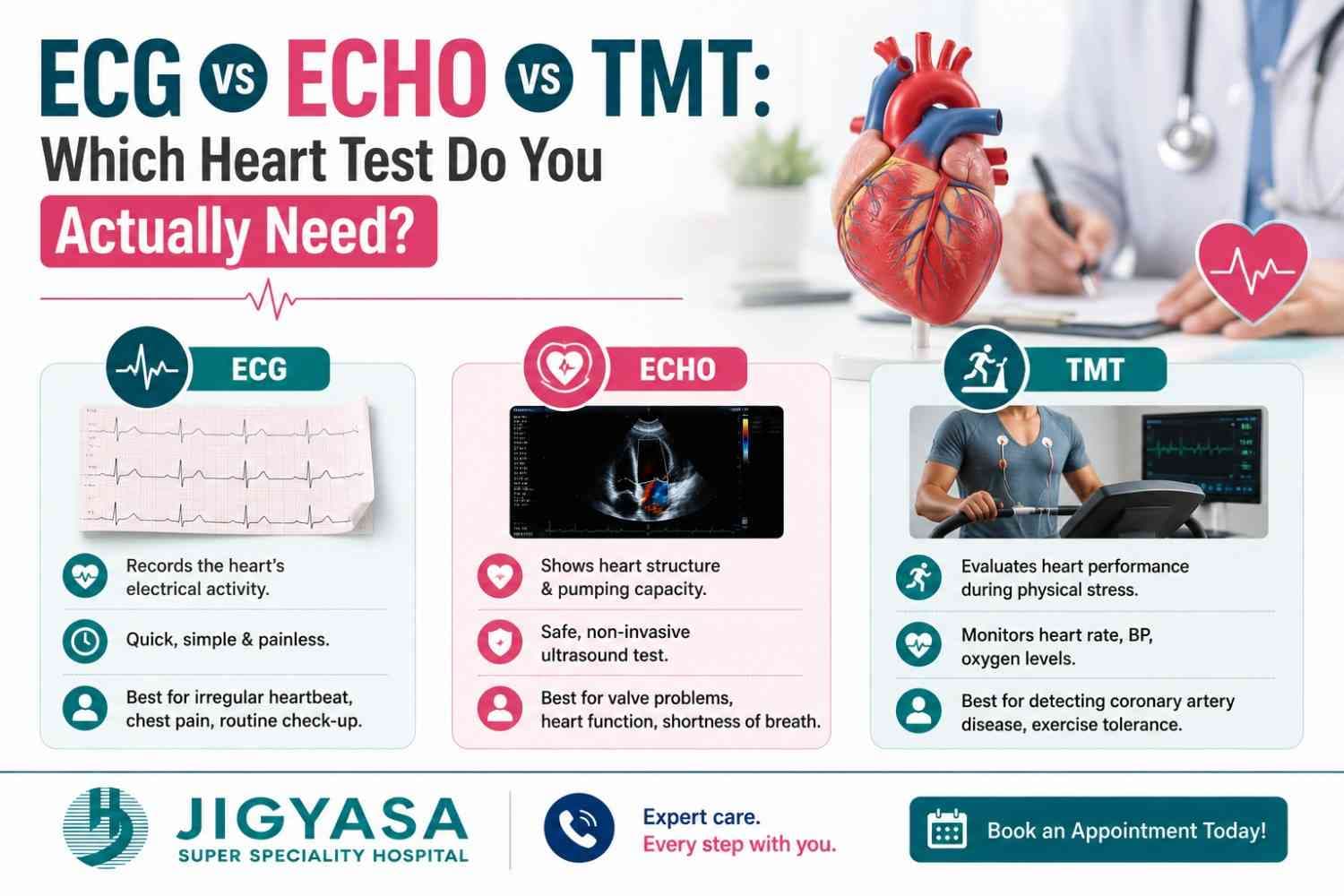
An ECG, sometimes called an EKG, is a quick, painless test that records the electrical activity of your heart. Small electrode patches are placed on your chest, arms, and legs, and the machine traces the pattern of electrical signals that trigger each heartbeat.
What an ECG tells your doctor:
- •Heart rhythm — whether it's regular or irregular (arrhythmia)
- •Heart rate — too fast, too slow, or normal
- •Signs of a current or past heart attack
- •Evidence of reduced blood flow to the heart muscle
- •Certain structural abnormalities, such as chamber enlargement
- •Electrical conduction problems
What an ECG cannot tell you: An ECG only captures a snapshot of electrical activity over a few seconds. It cannot show how well the heart is pumping blood, the condition of the heart valves, or blockages that aren't actively affecting the heart's electrical signal at that moment.
When it's typically used: ECG is usually the first test performed for chest pain, palpitations, dizziness, unexplained fatigue, or as part of a routine health check-up, especially for those with risk factors like diabetes, high blood pressure, or a family history of heart disease.
What Is an Echocardiogram (Echo)?
An echocardiogram uses ultrasound waves to create a real-time, moving image of the heart. Unlike an ECG, which looks at electrical activity, an Echo shows the heart's actual structure and function — essentially giving your cardiologist a live video of your heart at work.
What an Echo tells your doctor:
- •The size and thickness of heart chambers
- •How well the heart muscle is pumping (ejection fraction)
- •The condition and function of the four heart valves — whether they're leaking, narrowed, or working normally
- •Presence of fluid around the heart
- •Blood flow patterns through the heart's chambers
- •Congenital heart abnormalities
- •Signs of heart failure or cardiomyopathy
What Is a TMT (Treadmill Test)?
TMT, or Treadmill Test — also known as a stress test or exercise ECG — evaluates how your heart performs under physical exertion. During the test, you walk on a treadmill at gradually increasing speed and incline while your heart rate, blood pressure, and ECG are continuously monitored.
What a TMT tells your doctor:
- •Whether blood flow to the heart muscle is adequate during physical stress
- •Early signs of coronary artery blockages that may not appear on a resting ECG
- •Exercise capacity and overall cardiovascular fitness
- •How the heart rhythm behaves under exertion
- •Blood pressure response to physical activity
Why exercise matters for diagnosis: Many blockages in the coronary arteries only restrict blood flow significantly when the heart's demand for oxygen increases — such as during exercise. A resting ECG can look completely normal in such cases, which is exactly why TMT is valuable for uncovering problems that wouldn't otherwise be caught.
When it's typically used: TMT is often recommended for patients with exertional chest pain, breathlessness on exertion, or as a screening tool for those with multiple risk factors for coronary artery disease, particularly when a resting ECG is inconclusive.
Side-by-Side Comparison
| Feature | ECG | Echo | TMT |
|---|---|---|---|
| What it measures | Electrical activity | Structure & pumping function | Heart performance under exertion |
| Duration | 2–5 minutes | 20–30 minutes | 15–20 minutes |
| Detects arrhythmias | Yes | Limited | Yes (during exercise) |
| Detects valve problems | No | Yes | No |
| Detects blocked arteries | Indirect signs only | Indirect signs only | Yes (functional evidence) |
| Assesses pumping strength | No | Yes | Indirect |
| Requires physical exertion | No | No | Yes |
Do You Need All Three?
Not always — and this is where individualized clinical judgment matters more than following a fixed checklist. Many patients only need one test, while others benefit from a combination, depending on their symptoms, risk factors, and findings from the initial examination.
A typical pattern might look like:
- •A resting ECG is usually the first step for almost any cardiac symptom, since it's quick and can flag many issues.
- •If the ECG suggests possible reduced blood flow, or the patient has classic exertional symptoms, a TMT may be added to evaluate how the heart performs under stress.
- •If there's a heart murmur, symptoms of heart failure, or a need to assess pumping function or valve health, an Echo becomes essential — since neither ECG nor TMT can adequately evaluate valve structure or pumping strength.
- •In some cases — particularly with ongoing chest pain, an abnormal TMT, or strong risk factors — your cardiologist may recommend further evaluation, such as cardiac catheterization or coronary angiography, to directly visualize the coronary arteries.
When Should You Get a Heart Check-Up?
Consider getting evaluated if you experience:
- •Chest pain, pressure, or discomfort, whether at rest or during activity
- •Breathlessness, especially with exertion or while lying flat
- •Palpitations or a sensation of irregular heartbeat
- •Unexplained fatigue or reduced exercise tolerance
- •Dizziness or fainting spells
- •A family history of heart disease, or existing risk factors like diabetes, hypertension, or smoking
Heart Care at Jigyasa Hospital, Moradabad
- •Comprehensive cardiac testing including ECG, Echocardiography, and TMT
- •Expert interpretation by Dr. Amit Kumar Singh and team
- •Personalized test recommendations based on your symptoms and risk profile
- •Advanced cardiac care including angiography and angioplasty when needed
Book a Cardiac Screening: 7900903333
Address: Near Miglani Cinema, Rampur Road, Moradabad – 244001
Online Appointments: jigyasahospital.com
ECG | Echocardiography | TMT | Coronary Angiography | Angioplasty & Stenting | Preventive Cardiology | Ayushman Bharat Accepted
Key Takeaways
- •ECG measures electrical activity, Echo shows heart structure and function, TMT evaluates heart performance under stress.
- •Each test has unique strengths — ECG for rhythm, Echo for valves and pumping, TMT for hidden blockages.
- •You may not need all three tests; your cardiologist will recommend based on symptoms and risk factors.
- •ECG is typically the first test, with Echo or TMT added as needed for specific concerns.
- •Don't ignore cardiac symptoms — early testing can prevent serious complications.
Frequently Asked Questions
Is TMT painful or risky?
TMT is generally safe and non-invasive, performed under continuous monitoring. Mild fatigue during the test is normal, and it is stopped immediately if any concerning symptoms or ECG changes appear.
Can a normal ECG rule out heart disease?
No. A normal resting ECG does not rule out coronary artery disease, especially blockages that only become apparent during physical exertion — this is precisely why TMT or further testing may still be recommended even with a normal ECG.
Is Echo needed even if ECG and TMT are normal?
It depends on symptoms. If there are signs suggestive of valve disease, heart failure, or a murmur detected on examination, an Echo may still be necessary, since ECG and TMT do not directly assess valve structure or pumping function.
How often should these tests be repeated?
This varies by individual risk profile and existing heart conditions. Your cardiologist will recommend an appropriate follow-up schedule based on your specific situation.
Which test should I start with if I have no specific symptoms but want a routine check?
An ECG is typically the starting point for a general cardiac screening, with further tests added based on findings, risk factors, and clinical judgment.
Related Articles
Heart Attack Warning Signs You Must Never Ignore
Recognizing heart attack symptoms early can save your life. Learn the critical warning signs from Dr. Amit Kumar Singh, Senior Interventional Cardiologist at Jigyasa Hospital, Moradabad. Call 7900903333.

5 Early Morning Habits That Prevent Diabetes Naturally
Discover 5 powerful morning habits that naturally prevent diabetes. Expert advice from Dr. C.P. Singh, Senior Consultant Physician at Jigyasa Hospital, Moradabad. Call 7900903333.

Why Summers in UP Are Dangerous for Your Kidneys
UP summers can silently damage your kidneys. Jigyasa Hospital Moradabad explains the hidden risks, warning signs, and how to protect your kidneys this season. Call 7900903333.