

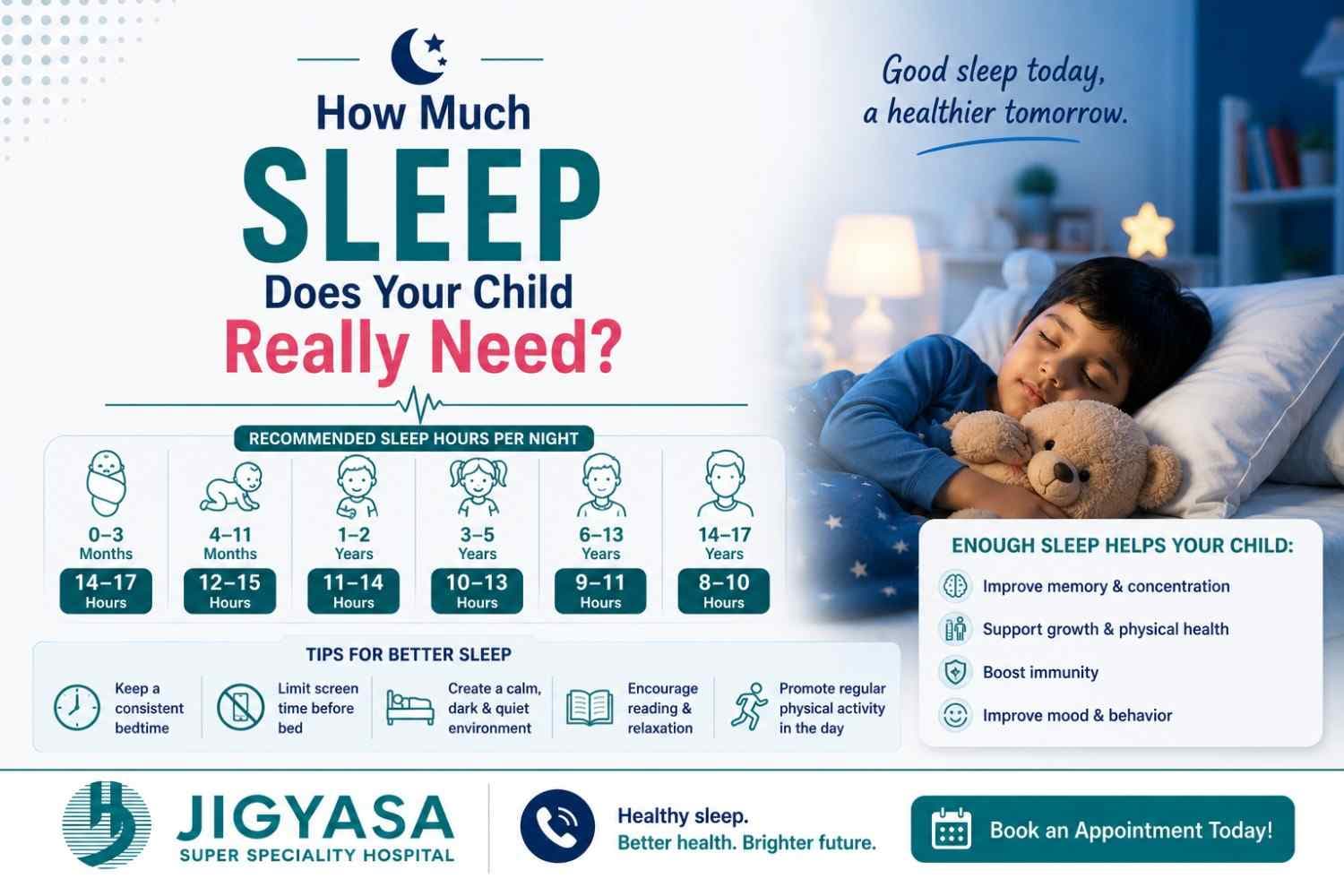
How Much Sleep Does Your Child Really Need?
Is Your Child Getting Enough Sleep? Jigyasa Hospital Moradabad's Paediatrics Team Breaks Down Exactly How Many Hours Children Need at Every Age — and the Warning Signs Parents Must Not Ignore.
Most Indian parents worry about their child's diet, screen time, and academic performance — but sleep is the one health pillar that is consistently underestimated and under-protected. Sleep is not passive rest. During deep sleep, the brain consolidates memory, the body releases growth hormone, the immune system repairs itself, and emotional regulation is reset. A child who is not sleeping enough is not just tired — they are growing more slowly, learning less effectively, getting sick more often, and struggling emotionally more than they need to. Yet across India, children's sleep is being steadily eroded — by late-night TV and mobile screens, early school start times, heavy academic pressure, and households where adults keep late hours that children are expected to match. At Jigyasa Hospital, Moradabad, our paediatrics team regularly sees children presenting with irritability, poor concentration, behavioural issues, and slow growth — where inadequate sleep is a key, overlooked contributor.
Sleep Requirements by Age — The Complete Guide
| Age Group | Total Sleep Needed | Night Sleep | Naps |
|---|---|---|---|
| Newborns (0–3 months) | 14–17 hours | Irregular bursts of 2–4 hours | Multiple throughout day and night |
| Infants (4–11 months) | 12–16 hours | 9–11 hours by 6 months | 2–3 naps per day |
| Toddlers (1–2 years) | 11–14 hours | 10–11 hours | 1 afternoon nap of 1–2 hours |
| Preschoolers (3–5 years) | 10–13 hours | 10–12 hours | 1 afternoon nap (varies by child) |
| School-age (6–12 years) | 9–12 hours | 9–12 hours uninterrupted | None typically needed |
| Teenagers (13–18 years) | 8–10 hours | 8–10 hours | None |
Recommended Sleep Hours by Age
Newborns (0–3 Months): 14–17 Hours per Day
Newborns sleep in short, irregular bursts of 2–4 hours throughout the day and night — their circadian rhythm (internal body clock) has not yet developed. Total sleep of 14–17 hours in 24 hours is normal and necessary — the brain is developing at its fastest rate in human life during this window.
- •There is no 'wrong' time for a newborn to sleep — day/night reversal is normal and temporary.
- •Do not try to keep a newborn awake to 'tire them out' — overtired newborns become harder to settle, not easier.
- •Safe sleep guidelines: always place baby on their back on a firm, flat surface — no pillows, loose bedding, or co-sleeping on soft surfaces.
- •Consult a paediatrician if the baby is sleeping less than 11 hours in 24, or is consistently difficult to settle despite feeding and comfort.
Infants (4–11 Months): 12–16 Hours per Day
By 4–6 months, most babies begin developing a more predictable sleep pattern — with longer night sleep and 2–3 daytime naps. Night sleep of 9–11 hours becomes achievable by 6 months for most healthy infants. By 6 months, many infants can sleep 6+ hour stretches at night without feeding. By 9–12 months, most settle into 2 naps per day (morning and afternoon).
- •Sleep regressions (sudden return to waking frequently) are common at 4 months, 8 months, and 12 months — normal developmental phases, not problems to 'fix' with medication.
- •Establishing a consistent bedtime routine (bath, feed, song, sleep) from 4–6 months onwards significantly improves sleep quality and duration.
- •Iron deficiency — extremely common in Indian infants — is a frequently missed cause of poor infant sleep. If your baby sleeps poorly despite good routines, ask your paediatrician to check haemoglobin levels.
Toddlers (1–2 Years): 11–14 Hours per Day
Toddlers need 11–14 total hours — typically 10–11 hours at night plus one afternoon nap of 1–2 hours. Sleep is critical for language acquisition, motor skill development, and emotional regulation during these years — a toddler's brain nearly doubles in complexity in this period.
- •The shift from 2 naps to 1 nap typically happens between 15–18 months — do not rush this transition; an overtired toddler is harder to manage, not easier.
- •Bedtime should be between 7–8:30 PM for most toddlers — late bedtimes do not result in later wake times; they result in overtired children who wake even earlier.
- •Screen exposure (phones, tablets, TV) within 1 hour of bedtime significantly disrupts melatonin production and delays sleep onset — this applies even at this young age.
- •Night terrors and sleepwalking can begin in toddlerhood — alarming for parents but typically harmless and outgrown.
Preschoolers (3–5 Years): 10–13 Hours per Day
This age group needs 10–13 hours total — most still benefit from a single afternoon nap, though nap needs vary widely by child. Deep sleep during preschool years is when the prefrontal cortex develops most rapidly — the part of the brain responsible for impulse control, decision-making, and social behaviour.
- •A preschooler consistently getting less than 10 hours of total sleep will show it in behaviour — increased tantrums, aggression, difficulty sharing, and inability to follow instructions are all classic signs of sleep deprivation in this age group.
- •Nighttime fears (darkness, monsters) are developmentally normal at this age — respond with reassurance, not dismissal. A consistent, calm bedtime routine is the most effective tool.
- •Children starting nursery or pre-school often experience temporary sleep disruption — new stimulation and social demands increase cortisol levels, making sleep harder for several weeks.
School-Age Children (6–12 Years): 9–12 Hours per Night
School-age children need 9–12 hours of uninterrupted night sleep — yet this is the age group where sleep deprivation is most common and most damaging. Homework, extracurricular activities, tuition classes, and screen time collectively push bedtimes later — while school start times remain fixed and early.
The consequences of chronic sleep deprivation in school-age children:
- •Academic performance: Sleep consolidates memory from the school day overnight — a sleep-deprived child retains significantly less of what they learned.
- •Attention and hyperactivity: Sleep-deprived children are commonly misidentified as having ADHD — their hyperactivity, inattention, and impulsivity are in many cases the direct result of inadequate sleep.
- •Immune function: Children sleeping less than 9 hours fall sick significantly more often — the immune system rebuilds itself during deep sleep.
- •Growth: The majority of growth hormone is released during the first few hours of deep sleep — consistent under-sleeping can measurably affect height and physical development.
- •Emotional health: Anxiety and depression in children and adolescents are strongly correlated with chronically poor sleep — often creating a cycle where poor mental health worsens sleep, which worsens mental health.
- •A child aged 6–12 with a 9 PM bedtime and a 6 AM school wake-up is getting exactly 9 hours — the minimum, not the ideal. Aim for 9:30–10 hours.
- •No screens in the bedroom is the single most impactful rule parents can implement — blue light from screens suppresses melatonin for up to 3 hours after exposure.
- •Physical activity during the day — playing, running, sports — significantly improves sleep quality at night.
Teenagers (13–18 Years): 8–10 Hours per Night
Teenagers need 8–10 hours per night — yet data consistently shows Indian teenagers are among the most sleep-deprived adolescents globally. During puberty, the circadian rhythm genuinely shifts later — teenagers are naturally wired to fall asleep around 11 PM and wake around 8 AM. This is biology, not laziness. Forcing teenagers to sleep at 9 PM and wake at 5 AM for early coaching classes is working against their neurobiology — not a sign of discipline.
Chronic sleep deprivation in teenagers increases risk of:
- •Depression and anxiety — significantly
- •Risk-taking behaviour and poor decision-making
- •Obesity and metabolic dysfunction
- •Road accidents (in older teenagers who drive)
- •Academic underperformance despite effort
Signs Your Child Is Not Getting Enough Sleep
- •Difficulty waking in the morning despite adequate bedtime — a consistent struggle is not normal
- •Falling asleep in the car, bus, or classroom during the day
- •Increased irritability, emotional outbursts, or crying beyond what seems situationally appropriate
- •Hyperactivity in the evenings — counterintuitively, overtired children become hyperactive, not calm
- •Frequent illness — more than 6–8 respiratory infections per year may indicate sleep-related immune suppression
- •Poor concentration and worsening school performance without a clear academic explanation
- •Snoring loudly or gasping during sleep — a key sign of obstructive sleep apnoea, which requires paediatric evaluation
- •Bedwetting beyond age 5 — sleep quality and depth are closely linked to bladder control development
Practical Tips to Improve Your Child's Sleep
- •Set a consistent bedtime and wake time — even on weekends. The body clock responds to consistency; weekend sleep disruption ('social jetlag') significantly impairs the school week.
- •Create a 20–30 minute wind-down routine before bed — bath, story, dimmed lights. Predictability tells the nervous system it is safe to sleep.
- •Ban screens 1 hour before bedtime — non-negotiable for children of all ages. Use blue light filters if compliance is difficult for older children.
- •Keep the bedroom cool, dark, and quiet — Indian summers often mean hot bedrooms; a fan or light AC significantly improves sleep quality.
- •Avoid heavy meals, sugary food, and caffeine (including cola, energy drinks, and tea) in the 2 hours before bedtime.
- •Do not use sleep as punishment — sending a child to bed early as a consequence creates a negative emotional association with sleep that is difficult to undo.
- •Physical activity during the day — children who play outdoors, run, and exercise fall asleep faster and sleep more deeply. Sedentary screen-heavy days produce restless nights.
When to See a Paediatrician About Your Child's Sleep
- •Loud, regular snoring or mouth breathing during sleep — possible adenoid enlargement or sleep apnoea
- •Pauses in breathing during sleep — always requires urgent evaluation
- •Night terrors more than 2–3 times per week beyond age 6
- •Persistent difficulty falling asleep lasting more than 4 weeks despite consistent routines
- •Daytime sleepiness severe enough to affect school or daily function
- •Bedwetting that begins after a dry period of 6+ months — can indicate sleep quality issues or underlying medical causes
- •Sleep concerns in a child with developmental delay, autism, ADHD, or anxiety — sleep problems are significantly more common in these groups and have specific, effective management approaches
At Jigyasa Hospital, Moradabad, our paediatrics team assesses sleep concerns as part of holistic child health evaluation — addressing root causes rather than simply recommending supplements or medication.
Book a Paediatric Consultation: 7900903333
Address: Near Miglani Cinema, Rampur Road, Moradabad – 244001
Appointments Online: jigyasahospital.com
Paediatric Consultation | Child Growth Assessment | Sleep Evaluation | Developmental Assessment | Ayushman Bharat Accepted
Key Takeaways
- •Sleep requirements vary significantly by age — from 14–17 hours for newborns down to 8–10 hours for teenagers — and every hour matters.
- •Sleep is when children grow, learn, build immunity, and regulate their emotions — it is not optional downtime.
- •The most common sleep disruptors in Indian children are screens before bed, inconsistent routines, late family schedules, and academic pressure — all of which are addressable.
- •Warning signs like loud snoring, daytime sleepiness, and persistent bedtime resistance always warrant a paediatric evaluation.
- •Jigyasa Hospital's paediatrics team is here to help you protect one of your child's most important health foundations — sleep.
Frequently Asked Questions
My child sleeps less than the recommended hours but seems fine. Should I be worried?
Children have some individual variation in sleep needs, but consistent under-sleeping — even without obvious symptoms — accumulates as a 'sleep debt' that affects brain development and immunity over time. If your child routinely sleeps significantly less than recommended, a paediatric review is worthwhile.
Is it harmful to let children stay up late on weekends?
Yes — significantly so. Weekend sleep pattern shifts of 2+ hours create 'social jetlag' — mimicking the effects of travelling across time zones every week. Monday morning grogginess, poor concentration early in the school week, and mood disruption are all well-documented consequences.
Can melatonin supplements be given to children for sleep?
Melatonin is used medically for specific sleep disorders — particularly in children with autism or ADHD — under paediatric supervision. It should not be given to healthy children without a doctor's recommendation. Addressing sleep hygiene (routines, screens, environment) is always the first step.
How much screen time is too much before bed?
Any screen exposure within 1 hour of bedtime is problematic for children of all ages. The blue light emitted by phones, tablets, and TVs suppresses melatonin production and delays sleep onset by up to 1–1.5 hours — even at relatively low brightness.
My toddler fights sleep every night. What should I do?
Bedtime resistance in toddlers is almost always driven by one of three things: overtiredness (missed nap or too-late bedtime), undertiredness (too long a nap), or anxiety about separation. A consistent, calming routine started 30 minutes before the target sleep time resolves this in most cases within 2–3 weeks.
Is snoring normal in children?
Occasional, soft snoring during a cold is normal. Loud, regular snoring — present more than 3 nights per week — is not normal in children and may indicate enlarged tonsils, adenoids, or obstructive sleep apnoea. It warrants a paediatric evaluation.
Related Articles

Heart Attack Warning Signs You Must Never Ignore
Recognizing heart attack symptoms early can save your life. Learn the critical warning signs from Dr. Amit Kumar Singh, Senior Interventional Cardiologist at Jigyasa Hospital, Moradabad. Call 7900903333.

5 Early Morning Habits That Prevent Diabetes Naturally
Discover 5 powerful morning habits that naturally prevent diabetes. Expert advice from Dr. C.P. Singh, Senior Consultant Physician at Jigyasa Hospital, Moradabad. Call 7900903333.

Why Summers in UP Are Dangerous for Your Kidneys
UP summers can silently damage your kidneys. Jigyasa Hospital Moradabad explains the hidden risks, warning signs, and how to protect your kidneys this season. Call 7900903333.