

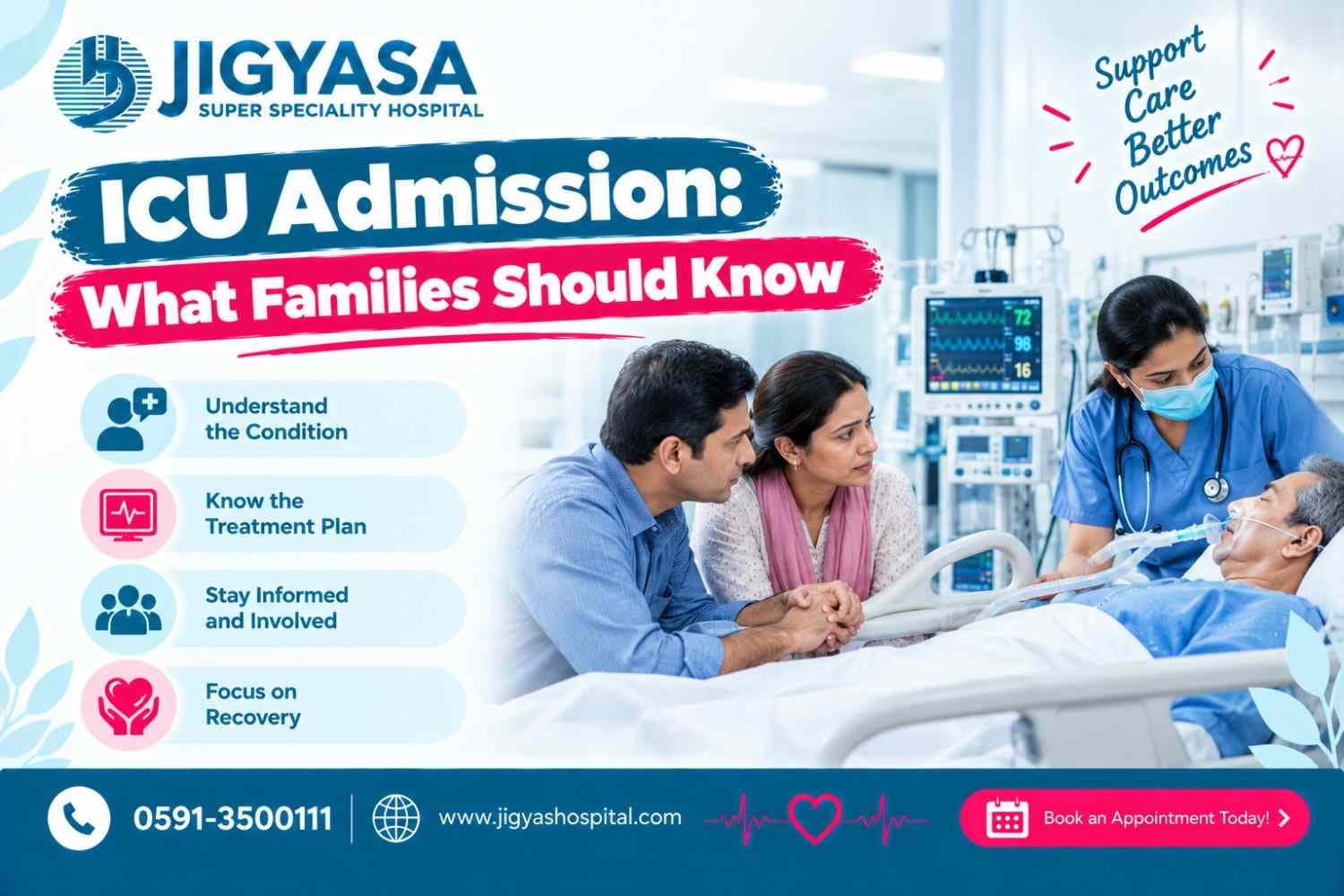
ICU Admission: What Families Should Know
A family member in the ICU? Learn why patients are admitted, what the equipment means, how to communicate with the team, and how to cope, from Jigyasa Hospital, Moradabad.
Hearing that a loved one needs to be moved to the ICU is one of the most frightening moments a family can face. The word itself suggests the worst. In reality, an ICU is simply a place where very sick patients receive close, continuous monitoring and treatment that is not possible in a regular ward. Some patients go there for a short time after major surgery as a precaution. Others are critically ill and need life support. Families often feel confused, helpless, and overwhelmed by unfamiliar machines and medical words. At Jigyasa Hospital, Moradabad, we believe an informed family is a stronger partner in care. This guide explains what to expect, in plain language.
What Is an ICU?
ICU stands for Intensive Care Unit, also called critical care. It is a specialised area staffed by doctors and nurses trained to look after patients whose organs, such as the heart, lungs, kidneys, or brain, are failing or at high risk of failing. Compared with a ward, an ICU offers:
- •Continuous monitoring of heart rate, blood pressure, breathing, and oxygen levels
- •A higher nurse-to-patient ratio, so each patient is observed closely
- •Advanced treatments such as breathing support, medicines delivered through drips, and organ support
- •Rapid response, since changes can be spotted and acted on quickly
Being in the ICU means a patient needs close watching. It does not always mean the situation is hopeless.
Why Patients Are Admitted
Common reasons include:
- •Severe infection or sepsis
- •Heart attack, serious heart rhythm problems, or heart failure
- •Breathing failure, severe pneumonia, or asthma and COPD flare-ups
- •Stroke or serious head injury
- •Major accidents and trauma
- •Recovery after major surgery
- •Serious bleeding, including from the digestive tract
- •Kidney or liver failure
- •Diabetic emergencies
- •Poisoning or overdose
- •Severe complications in pregnancy or after delivery
Understanding the Equipment
The machines can look alarming, but each has a purpose.
- •Monitor: A screen showing heart rhythm, blood pressure, breathing rate, and oxygen levels. Alarms often sound for minor reasons, such as a loose sensor, and do not always mean an emergency.
- •Ventilator: A machine that helps or takes over breathing, usually through a tube in the windpipe. It gives the lungs time to recover and is often temporary.
- •IV lines and infusion pumps: Deliver fluids, medicines, and nutrition at precise rates.
- •Central or arterial lines: Special tubes placed in larger vessels for medicines and accurate blood pressure monitoring.
- •Oxygen masks or nasal support: Provide extra oxygen without a tube.
- •Urinary catheter: Measures urine output, a sign of kidney function.
- •Feeding tube: Gives nutrition when the patient cannot eat.
- •Dialysis machine: Cleans the blood when kidneys cannot, used for selected patients.
- •Sedation and pain medicines: Keep the patient comfortable, especially when on a ventilator. A sleepy or unresponsive patient is often deliberately sedated.
Ask the team to explain any equipment you are unsure about.
Who Is Looking After Your Family Member
An ICU team often includes:
- •Intensivist or treating doctor in charge, who leads the plan
- •Specialist doctors such as cardiologists, surgeons, or others, depending on the illness
- •ICU nurses, who provide round-the-clock care and are often your best source of updates on how the patient is doing hour to hour
- •Physiotherapists, dietitians, and pharmacists, who support recovery
- •Support staff and the hospital desk, who help with paperwork and logistics
Communication: How to Stay Informed
- •Choose one or two family spokespersons who receive and share updates, so the team can speak clearly and consistently
- •Keep your phone reachable and give the team correct contact numbers
- •Ask when the doctor usually updates families, and try to be present then
- •Write down questions before the meeting, and note the answers
- •Ask direct questions such as: What is the diagnosis? What are you treating? What is the expected course? What would improvement look like? What are the risks?
- •Ask for plain language if terms are confusing
- •Bring a relative to the meeting if you are alone, since stress makes it hard to remember details
- •Share relevant information with the team: medicines, allergies, previous illness, and the patient's wishes
Visiting and Family Role
ICUs usually have rules about visiting hours and numbers of visitors, set to protect patients from infection and rest. Follow the instructions given by the hospital, as these can change with the patient's condition.
General expectations include:
- •Washing or sanitising hands before and after entering
- •Wearing masks, gowns, or shoe covers when asked
- •Keeping voices low and visits calm
- •Avoiding food, flowers, and outside items unless allowed
- •Not touching equipment or tubes
- •Leaving when staff ask, especially during procedures or emergencies
- •Keeping children and anyone with cough or fever away, unless permitted
Even when a patient is sedated, gentle presence, a familiar voice, and holding a hand, where permitted, can be comforting.
What the Patient Might Experience
Patients may be drowsy, confused, or unable to speak because of a breathing tube. Some become agitated or see things that are not there, a state called delirium, which is common in ICUs and often temporary. Sleep can be disturbed by lights, alarms, and procedures. Telling the patient where they are, the day and time, and that they are safe helps them stay oriented.
Difficult Decisions
In serious illness, doctors may discuss:
- •Consent for procedures, such as inserting lines, starting dialysis, or surgery
- •Prognosis, meaning the likely outcome
- •Goals of care, including what the patient would want
- •Limits on treatment, in situations where more treatment may not help
These conversations are hard. It helps to ask the doctor to explain the reasoning, take time to think, discuss as a family, and consider what the patient would have wanted. Do not hesitate to ask for another conversation.
Taking Care of Yourself
Families under stress often neglect themselves. Try to:
- •Eat regular meals and drink water
- •Sleep in shifts if possible
- •Share duties among relatives
- •Step outside for fresh air
- •Accept help, and ask for it
- •Talk to someone about your fears
- •Avoid sharing every update on social media, which can lead to rumours and confusion
- •Be patient with each other, since stress can lead to conflict
Costs and Paperwork
ICU care can be expensive, and families worry about this on top of everything else. Ask the hospital desk early about expected costs, insurance or government scheme coverage, and documents needed. Jigyasa Hospital is empanelled under Ayushman Bharat PM-JAY, and the desk can explain eligibility and process for eligible patients. Our guide on cashless health insurance versus reimbursement may also help.
After the ICU
Moving out of the ICU to a ward is a good sign, though recovery continues. Patients may feel weak, tired, forgetful, or low in mood. Physiotherapy, nutrition, and rest help, and family support makes a real difference. Some patients need follow-up care and rehabilitation at home.
How Jigyasa Hospital Supports Families
At Jigyasa Hospital, our team aims to keep families informed, explain the treatment plan in clear language, and support them through difficult decisions. Our 24/7 emergency care ensures that critically ill patients can be assessed and treated at any hour. If you have concerns, ask to speak to the doctor in charge or the hospital desk.
Critical Care at Jigyasa Hospital, Moradabad
- •24/7 emergency care and ICU with continuous monitoring
- •Experienced intensivists, ICU nurses, and specialist support
- •Ventilator support, dialysis, and advanced organ support
- •Family communication, counselling, and PM-JAY insurance desk support
Book an Appointment: 7900903333
Address: Near Miglani Cinema, Rampur Road, Moradabad – 244001
Online Appointments: jigyasahospital.com
Critical Care | ICU | Ventilator Support | 24/7 Emergency | Ayushman Bharat Accepted
Key Takeaways
- •ICU admission ≠ no hope — it means close, continuous monitoring and advanced support that a regular ward can't provide; many patients recover fully.
- •Common reasons: sepsis, heart attack, breathing failure, stroke, trauma, post-major-surgery recovery, kidney/liver failure, diabetic emergencies.
- •Equipment explained: monitors track vitals (alarms often minor), ventilators support breathing temporarily, IV pumps deliver precise medicines, sedation keeps ventilated patients comfortable.
- •Choose 1-2 family spokespersons, ask direct questions (diagnosis, treatment, expected course, risks), and follow visiting/hygiene rules to protect the patient.
- •Take care of yourselves too: eat, sleep in shifts, share duties, and ask the desk early about costs/insurance — Jigyasa Hospital is PM-JAY empanelled with 24/7 emergency care.
Frequently Asked Questions
Does ICU admission mean my family member will not survive?
No. Many ICU patients recover fully. ICU care means the patient needs close monitoring and support, either because they are seriously ill or because it is a precaution after major treatment.
Why is my relative unconscious or sleepy?
It may be because of the illness itself, or because the team is using sedation to keep the patient comfortable, especially on a ventilator. Ask the doctor which applies.
Can I stay with the patient all the time?
Usually not. ICU visiting is limited to protect patients and allow treatment. Follow the hospital's rules, and ask how and when you can be updated.
Is being on a ventilator a bad sign?
It is a sign of serious illness, but it is also a supportive treatment that gives the lungs time to recover. Many patients come off the ventilator and improve.
What should I do if I do not understand what the doctors are saying?
Ask them to explain again in simpler words, and ask the nurse for help. It is your right to understand your family member's condition and treatment.
Related Articles

Heart Attack Warning Signs You Must Never Ignore
Recognizing heart attack symptoms early can save your life. Learn the critical warning signs from Dr. Amit Kumar Singh, Senior Interventional Cardiologist at Jigyasa Hospital, Moradabad. Call 7900903333.

5 Early Morning Habits That Prevent Diabetes Naturally
Discover 5 powerful morning habits that naturally prevent diabetes. Expert advice from Dr. C.P. Singh, Senior Consultant Physician at Jigyasa Hospital, Moradabad. Call 7900903333.

Why Summers in UP Are Dangerous for Your Kidneys
UP summers can silently damage your kidneys. Jigyasa Hospital Moradabad explains the hidden risks, warning signs, and how to protect your kidneys this season. Call 7900903333.