

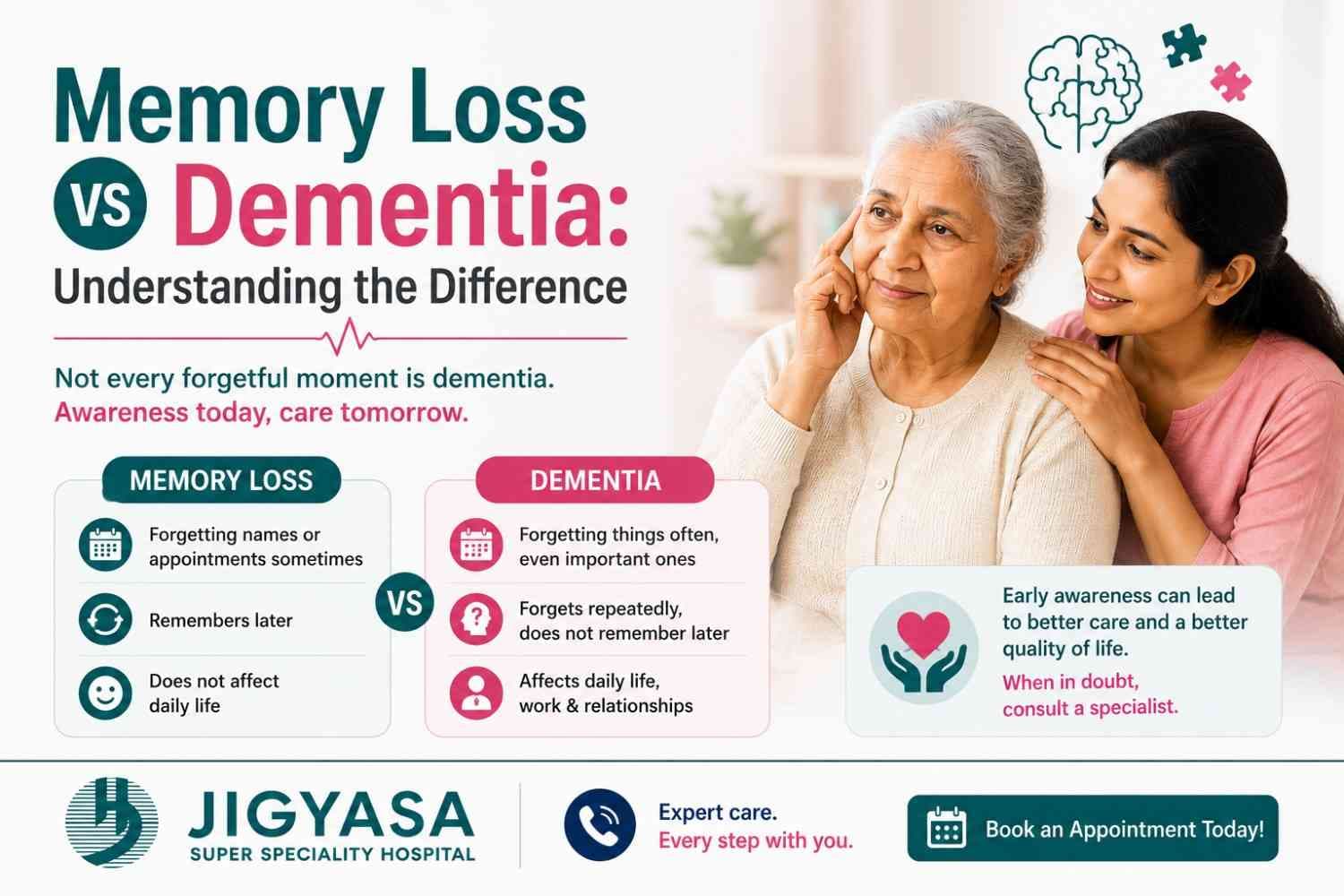
Memory Loss vs Dementia: Understanding the Difference
Is Forgetfulness Normal Ageing — or Something More Serious? Jigyasa Hospital Moradabad's Neurology Team Explains the Key Differences Between Normal Memory Loss and Dementia, and When to Seek Help.
Forgetting where you kept your keys. Walking into a room and blanking on why you went there. Struggling to recall a name that is right on the tip of your tongue. These moments of forgetfulness are familiar to virtually every adult — and for most people, they are entirely normal. But for millions of families across India, there is a quiet, growing anxiety: Is this just normal ageing — or is something wrong with my mother's brain? My father's memory? My own? This anxiety is well-founded. India is home to an estimated 5.3 million people living with dementia — a number projected to more than double by 2050 as the country ages. Yet the vast majority of cases go undiagnosed for years — partly because families dismiss early signs as normal ageing, and partly because the difference between the two is genuinely confusing. At Jigyasa Hospital, Moradabad, our neurology and general medicine teams regularly counsel families on exactly this question — and this blog gives you the clearest, most practical framework to understand when memory concerns deserve medical attention.
What Is Normal Age-Related Memory Change?
The human brain, like every other organ, changes with age. These changes are gradual, predictable, and do not significantly interfere with daily life:
- •Processing speed slows — it may take longer to learn new information or recall a name, but the ability to do so remains intact.
- •Working memory declines slightly — holding multiple pieces of information simultaneously becomes a little harder.
- •Multitasking becomes more effortful — this is normal from the 50s onwards.
- •Occasional word-finding difficulties — 'tip of the tongue' moments increase with age.
The critical distinction in all of these: the information is not lost. Given time, a cue, or a moment of relaxation — it surfaces. The person is aware of the lapse and it does not significantly affect their independence or daily functioning. Normal age-related memory change is slow, stable, and non-progressive — it does not worsen dramatically from month to month or year to year.
What Is Dementia — and How Is It Different?
Dementia is not a single disease — it is an umbrella term for a group of symptoms caused by progressive brain cell damage that severely impairs memory, thinking, behaviour, and the ability to perform daily tasks. The most common types in India are:
- •Alzheimer's Disease (60–70% of cases): Caused by abnormal protein deposits (amyloid plaques and tau tangles) that destroy brain cells from the inside out, starting in memory centres and progressing outward.
- •Vascular Dementia (15–20%): Caused by reduced blood flow to the brain — often following strokes or mini-strokes (TIAs). Common in India given the high prevalence of hypertension and diabetes.
- •Lewy Body Dementia: Characterised by visual hallucinations, fluctuating alertness, and Parkinson's-like movement symptoms alongside memory loss.
- •Frontotemporal Dementia: Affects personality, behaviour, and language before memory — often mistaken for psychiatric illness in its early stages.
The defining feature of dementia is progressive deterioration — not occasional forgetting, but a steadily worsening decline that eventually robs a person of their independence, relationships, and identity.
Normal Memory Loss vs Dementia — Side by Side
| Area | Normal Memory Loss | Dementia |
|---|---|---|
| Forgetting names | Occasionally forgets an acquaintance's name but remembers it later | Forgets names of close family members — spouse, children — or repeatedly asks who someone is despite being told |
| Getting lost | Briefly confused in an unfamiliar new place | Gets lost in familiar neighbourhoods or cannot find their way home from a nearby market |
| Misplacing objects | Puts keys in an unusual place and retraces steps to find them | Puts objects in completely illogical places and has no recollection of doing so — sometimes accuses others of stealing |
| Forgetting dates | Occasionally forgets a non-critical appointment and remembers when reminded | Repeatedly forgets significant events even shortly after being told; loses track of year, month, or season |
| Following conversations | Occasionally loses track in a long, complex conversation | Struggles to follow even simple conversations; repeats the same question within minutes of receiving the answer |
| Managing money | Makes an occasional arithmetic error | Loses the ability to manage finances, pay bills, count change, or understand basic monetary transactions |
| Judgment | Makes an occasional poor decision | Consistently makes poor, unsafe, or out-of-character decisions — giving money to strangers, forgetting to turn off the gas |
| Awareness | Aware of and bothered by memory lapses — self-refers to the doctor | Often has reduced or absent awareness (anosognosia) of their own memory problems — genuinely does not believe anything is wrong |
| Mood and personality | Occasional grumpiness or irritability under stress | Significant personality changes — previously warm person becomes withdrawn, suspicious, or aggressive; paranoia common |
Normal Memory Loss vs Dementia: Key Differences
Early Warning Signs of Dementia — What Families in India Most Commonly Miss
- •Repeating the same story or question within minutes — not occasionally, but consistently and daily
- •Struggling to manage previously routine tasks — cooking a familiar dish, operating the TV remote, taking medication correctly
- •Withdrawal from social activities — stopping attendance at religious gatherings, family functions, or social clubs they previously enjoyed — often because they are hiding cognitive difficulties
- •Increased suspicion or paranoia — accusing family members of stealing, hiding things, or conspiring against them
- •Getting confused about time — not knowing what time of day, day of week, or year it is — beyond the occasional lapse
- •Neglecting personal hygiene — forgetting to bathe, brush teeth, or change clothes, in someone who was previously meticulous
- •Significant word-finding difficulty in the mother tongue — not just English words, but struggling with everyday vocabulary in their primary language
- •Driving errors and getting lost on familiar routes — a critical safety concern that families often minimise
What Causes Memory Loss That Is Not Dementia — And Is Treatable
Many causes of significant memory loss in elderly people are not dementia — and are completely treatable. Before a diagnosis of dementia is considered, the following reversible causes must be ruled out:
- •Hypothyroidism (underactive thyroid): Extremely common in India, particularly in women — causes significant memory impairment, brain fog, and slowed thinking that reverses completely with thyroid medication.
- •Vitamin B12 Deficiency: Endemic in India — particularly in vegetarians. B12 is essential for nerve and brain function; severe deficiency mimics dementia with memory loss, confusion, and personality change — and responds to B12 injections.
- •Vitamin D Deficiency: Increasingly recognised as a contributor to cognitive decline — and highly prevalent in Indian adults, even in a sunny country.
- •Depression: In elderly people, depression frequently presents as apparent memory loss, disinterest, and cognitive slowing — sometimes called 'pseudodementia.' Treating the depression often restores cognitive function significantly.
- •Medication side effects: Many common medications — certain blood pressure drugs, sleeping pills, antihistamines, and psychiatric medications — cause memory impairment and confusion, particularly in the elderly. Medication review by a physician can reverse this entirely.
- •Urinary Tract Infections (UTIs) in the elderly: A UTI in an elderly person frequently presents as sudden confusion, agitation, and apparent memory loss — not the classic burning and frequency seen in younger patients. A urine test can diagnose and antibiotics resolve it.
- •Sleep deprivation and sleep apnoea: Chronically poor sleep — including untreated obstructive sleep apnoea (extremely common in overweight or elderly Indians) — causes significant, reversible cognitive impairment.
- •Uncontrolled diabetes or blood pressure: Chronic dysregulation of either directly damages brain blood vessels and accelerates cognitive decline — controlling these conditions stabilises and sometimes improves cognition.
- •Severe anaemia: Reduced oxygen delivery to the brain from very low haemoglobin causes confusion, lethargy, and apparent memory problems — resolved by treating the anaemia.
How Is Dementia Diagnosed?
Dementia cannot be diagnosed on the basis of a single test or scan. It requires a comprehensive clinical evaluation:
- •Cognitive screening tests: Standardised tools like the MMSE (Mini-Mental State Examination) or MoCA (Montreal Cognitive Assessment) — brief, structured tests that assess memory, attention, language, and visuospatial skills.
- •Blood tests: To rule out all reversible causes — thyroid function, B12, Vitamin D, blood sugar, full blood count, kidney and liver function.
- •Brain imaging: MRI or CT scan of the brain — to identify vascular changes, strokes, brain atrophy patterns, or tumours that may explain cognitive symptoms.
- •Neuropsychological assessment: Detailed cognitive testing by a trained psychologist — maps the specific pattern of cognitive strengths and deficits.
- •Collateral history: Information from a close family member who observes the patient daily — often more diagnostically valuable than the patient's own account.
Early diagnosis matters enormously — not because dementia is currently curable, but because treatable causes can be identified and reversed, medications (cholinesterase inhibitors for Alzheimer's) can slow progression when started early, safety planning (driving, living alone, financial management) can be addressed before a crisis, and family support systems can be built proactively.
Memory and Neurology Care at Jigyasa Hospital, Moradabad
- •Our Neurology and General Medicine departments offer comprehensive cognitive assessment for patients with memory concerns — including cognitive screening, full blood investigation to rule out reversible causes, and brain MRI.
- •We work closely with families to explain findings clearly, address fears, and create realistic, compassionate care plans.
- •If you are concerned about a parent, spouse, or your own memory — the most important thing you can do is seek evaluation early, before symptoms progress and options narrow.
- •Do not normalise significant memory change as 'just old age' — come in and let us assess it properly.
Book a Neurology Consultation: 7900903333
Address: Near Miglani Cinema, Rampur Road, Moradabad – 244001
Online Appointments: jigyasahospital.com
Cognitive Assessment | Memory Screening | Brain MRI | Neurology OPD | Reversible Dementia Workup | Ayushman Bharat Accepted
Key Takeaways
- •Normal age-related memory change is occasional, non-progressive, and does not affect independence — the information is not lost, just harder to retrieve quickly.
- •Dementia is a progressive, disease-driven decline in memory and cognition that eventually destroys the ability to function independently — fundamentally different from normal ageing.
- •Many causes of significant memory loss in elderly patients — thyroid disease, B12 deficiency, depression, medication side effects, UTIs, sleep apnoea — are completely treatable and must be ruled out before any dementia diagnosis.
- •Early warning signs families most commonly miss: repeating questions, getting lost in familiar places, accusing others of stealing, and withdrawing from social life.
- •Early evaluation saves time, dignity, and options — do not wait until a crisis. Jigyasa Hospital's neurology team is here to help.
Frequently Asked Questions
At what age does dementia typically begin?
Most dementia cases are diagnosed after age 65 (late-onset dementia). However, early-onset dementia — before age 65 — does occur and is more common than most people realise, affecting people in their 50s and even 40s. Age alone is not a reliable indicator.
Is dementia hereditary? If my parent has it, will I get it?
For most common forms of dementia (Alzheimer's, vascular dementia), having a parent with the condition modestly increases risk but does not make it inevitable. Genetics is one of many factors — lifestyle, cardiovascular health, and education level are equally important. Rare genetic forms (familial Alzheimer's) carry a much higher hereditary risk but account for a small minority of cases.
Can dementia be prevented?
There is no guaranteed prevention, but strong evidence shows that controlling blood pressure, blood sugar, and cholesterol; regular physical exercise; not smoking; staying socially and mentally active; and treating hearing loss all significantly reduce dementia risk. Many risk factors in India — hypertension, diabetes, low physical activity, social isolation in old age — are modifiable.
What is the difference between Alzheimer's and dementia?
Dementia is the broad umbrella term for a group of symptoms (memory loss, confusion, behavioural change) caused by brain damage. Alzheimer's disease is the most common specific cause of dementia — responsible for 60–70% of cases. All Alzheimer's is dementia, but not all dementia is Alzheimer's.
My elderly parent was recently diagnosed with a UTI and became suddenly confused. Is this dementia?
Almost certainly not. Sudden-onset confusion in an elderly person is a medical emergency — and infection (especially UTI) is the most common reversible cause. This is called acute delirium, not dementia. It resolves with treatment of the underlying infection. However, if cognitive symptoms persist after the infection clears, further evaluation for dementia is warranted.
What should I do if I suspect a family member has dementia?
Start by scheduling an appointment with a general physician or neurologist for a comprehensive evaluation — do not attempt to diagnose at home. In the meantime, document specific examples of concerning behaviour (dates, what happened, how frequently) — this history is enormously valuable to the evaluating doctor. Avoid confronting or arguing with the person about their memory lapses, as this causes distress without benefit.
Related Articles

Heart Attack Warning Signs You Must Never Ignore
Recognizing heart attack symptoms early can save your life. Learn the critical warning signs from Dr. Amit Kumar Singh, Senior Interventional Cardiologist at Jigyasa Hospital, Moradabad. Call 7900903333.

5 Early Morning Habits That Prevent Diabetes Naturally
Discover 5 powerful morning habits that naturally prevent diabetes. Expert advice from Dr. C.P. Singh, Senior Consultant Physician at Jigyasa Hospital, Moradabad. Call 7900903333.

Why Summers in UP Are Dangerous for Your Kidneys
UP summers can silently damage your kidneys. Jigyasa Hospital Moradabad explains the hidden risks, warning signs, and how to protect your kidneys this season. Call 7900903333.