
Normal Delivery vs C-Section — What Every Pregnant Mother Should Know
Confused about normal delivery vs C-section? Expert gynecologist Dr. Karishma at Jigyasa Hospital Moradabad explains everything a pregnant mother needs to know.
One of the most important — and often anxiety-filled — questions a pregnant woman asks is: 'Will I have a normal delivery or a C-section?' For millions of expecting mothers across Uttar Pradesh, this question carries emotional weight, cultural expectations, family pressure, and genuine medical concern all at once. Social media is full of conflicting advice. Relatives have strong opinions. And sometimes, even well-meaning information from the internet adds more confusion than clarity. At Jigyasa Hospital, Moradabad, our expert gynecologist Dr. Karishma — one of the most trusted names in women's healthcare and maternity care in the region — believes that every pregnant mother deserves clear, honest, medically accurate information about both options, free from fear and pressure. This article is that information.
Meet Dr. Karishma — Your Trusted Gynecologist at Jigyasa Hospital, Moradabad
Dr. Karishma is a highly experienced Obstetrician and Gynecologist (OBG) at Jigyasa Hospital, Moradabad, with years of specialized training and clinical practice in women's reproductive health, high-risk pregnancies, normal and operative deliveries, and postpartum care. She completed her MBBS and MS in Obstetrics & Gynecology from a premier medical institution and brings with her a deeply compassionate, patient-first approach that has made her one of the most sought-after gynecologists in Moradabad and the surrounding region — with patients travelling from Rampur, Amroha, Sambhal, Bareilly, and beyond for her consultation and delivery care.
What sets Dr. Karishma apart is not just her clinical expertise — it is how she treats every mother. She takes the time to understand each patient's history, fears, and birth preferences before making any recommendation. She strongly advocates for normal delivery wherever it is medically safe to do so, while never compromising on the safety of both mother and baby when a C-section is the right clinical decision. Under her care, thousands of mothers at Jigyasa Hospital have experienced safe, supported deliveries — and left with healthy babies and their own well-being intact.
"My goal is always the safest possible outcome for both mother and child. Normal delivery is a beautiful, natural process — and whenever it is safe, we do everything we can to support it. But a C-section, when necessary, is not a failure. It is a medical decision that protects lives." — Dr. Karishma, OBG & Gynecologist, Jigyasa Hospital Moradabad
📅 Book a consultation with Dr. Karishma: dr-karishma-singh-jigyasa-hospital-moradabad
📞 Call for appointment: 7900903333
What Is Normal Delivery (Vaginal Birth)?
A normal or vaginal delivery is the natural process through which a baby is born through the birth canal (vagina). It is how human beings have delivered babies for thousands of years, and when conditions are right, it remains the safest, most recommended mode of delivery by medical bodies worldwide — including the World Health Organization (WHO) and the Indian Council of Medical Research (ICMR).
In a normal delivery, labour begins naturally — or is gently induced if necessary — contractions open the cervix progressively, and the baby moves through the birth canal and is born vaginally. The process can take anywhere from a few hours to longer, depending on whether it is a first pregnancy or subsequent pregnancies. Modern maternity care at Jigyasa Hospital ensures that normal deliveries are supported with continuous fetal monitoring, skilled midwifery care, pain relief options (including epidural analgesia where suitable), and immediate access to emergency intervention if anything changes.
What Is a C-Section (Caesarean Delivery)?
A Caesarean section — commonly called a C-section — is a surgical procedure in which the baby is delivered through incisions made in the mother's abdomen and uterus. It is performed under regional anaesthesia (spinal or epidural) in a sterile operation theatre, typically taking 45 to 60 minutes in total.
A C-section may be planned (elective) — scheduled in advance because of known medical reasons — or emergency — performed urgently when unexpected complications arise during labour. At Jigyasa Hospital, all C-sections are performed by skilled surgical teams under the guidance of Dr. Karishma, with full anaesthesia support, neonatal care standby, and post-operative recovery facilities.
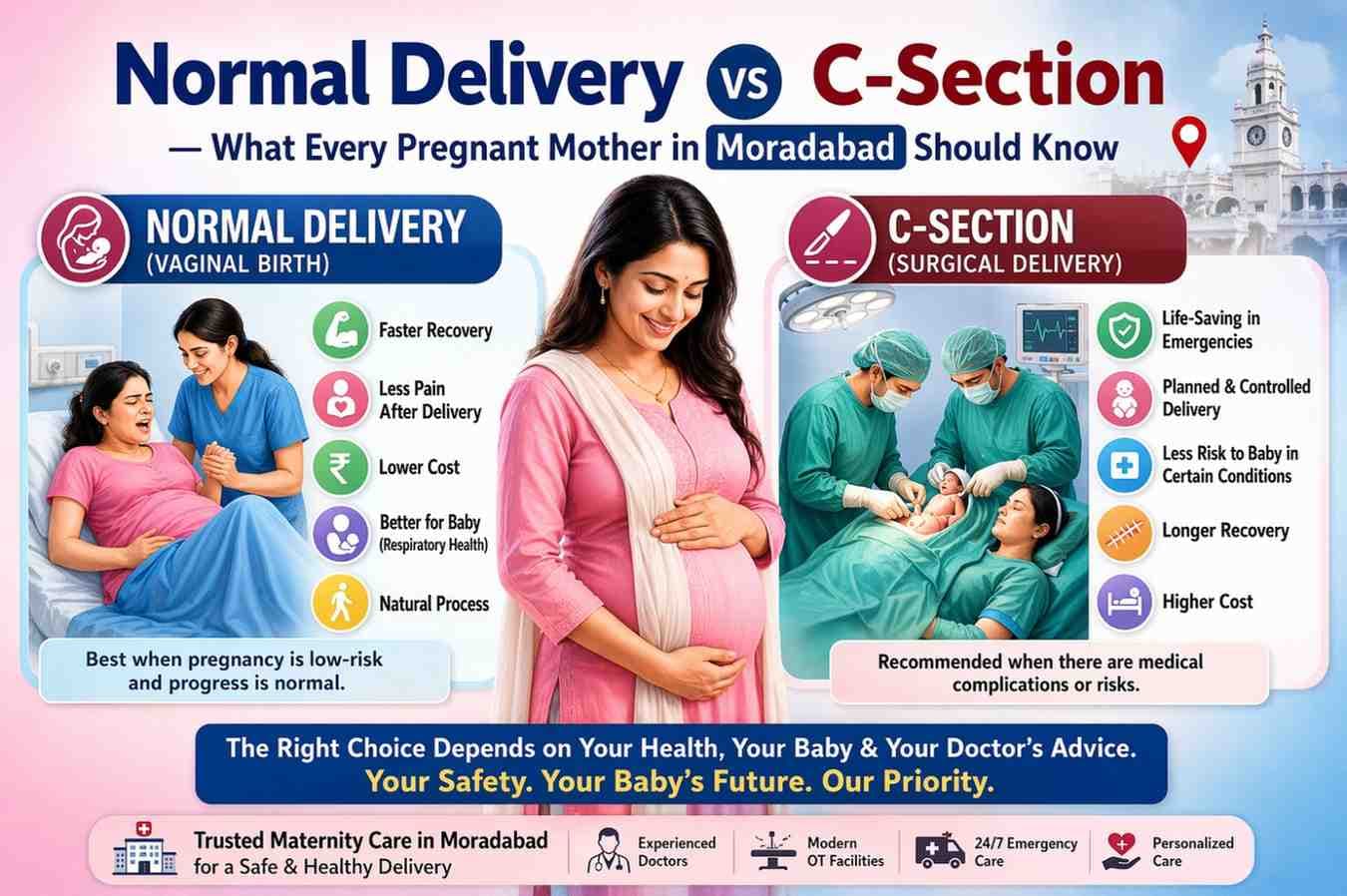
Normal Delivery vs C-Section: A Detailed Comparison
1. Recovery Time
Recovery after a vaginal birth is generally faster. Most mothers are able to walk within a few hours of delivery, begin breastfeeding almost immediately, and are typically discharged within 24 to 48 hours. Full physical recovery takes 4 to 6 weeks. Since a C-section is a major abdominal surgery, recovery takes longer. Hospital stay is typically 3 to 5 days. There will be wound pain and restricted movement for the first week or two. Full recovery takes 6 to 8 weeks, and certain activities — driving, lifting, vigorous exercise — must be avoided during this period. Verdict: Normal delivery offers faster, easier recovery for the mother.
2. Pain During and After Delivery
Labour contractions can be painful — this is a natural part of the process. However, modern pain management options such as epidural analgesia, breathing techniques, and labour support significantly reduce discomfort. Post-delivery pain from perineal tears or episiotomy, if any, typically resolves within a few weeks. The C-section surgery itself is painless (anaesthesia is used), but post-operative pain from the incision site can be significant for several days and requires prescription pain management. Verdict: Normal delivery involves labour pain; C-section involves surgical recovery pain. Both are manageable with appropriate care.
3. Risks to the Mother
Normal delivery risks include perineal tears or need for episiotomy, risk of prolonged or obstructed labour, post-partum haemorrhage, and rarely severe complications if labour is poorly managed. C-section risks include surgical bleeding, infection, injury to bladder or bowel, blood clot formation, reaction to anaesthesia, longer hospital stay, and future pregnancy complications such as uterine rupture risk, placenta previa, and greater risk of hysterectomy in subsequent pregnancies — especially after multiple C-sections. This is why Dr. Karishma and the team at Jigyasa Hospital always carefully evaluate whether a first C-section is truly necessary.
4. Risks to the Baby
In normal delivery, risks include brief oxygen reduction during prolonged labour and rarely shoulder dystocia in large babies. Babies born by C-section may have more respiratory issues initially (wet lung syndrome), as the compression of the chest during vaginal birth helps clear fluid from the lungs — this does not happen in C-sections. They also have slightly lower exposure to beneficial maternal gut bacteria (microbiome), which plays a role in immune development. Verdict: Both modes carry managed risks. A skilled obstetric team minimises risks for mother and baby in both scenarios.
5. Breastfeeding
Normal delivery typically makes early breastfeeding easier — the baby is placed skin-to-skin within minutes of birth, and the hormonal cascade of natural labour supports milk production. C-section mothers can absolutely breastfeed, but the process may take slightly longer to establish due to the effects of anaesthesia and delayed skin-to-skin contact. With proper lactation support — which Jigyasa Hospital provides — breastfeeding success rates are excellent after both delivery modes.
6. Emotional and Mental Health
Many mothers who undergo unplanned or unwanted C-sections report feelings of disappointment, inadequacy, or loss of the birth experience they had hoped for. This is completely normal and valid. It is equally important to affirm: a C-section is not a failure. It is a medical procedure that, when necessary, saves lives. Dr. Karishma and the maternity team at Jigyasa Hospital provide compassionate emotional support to all mothers — irrespective of their delivery mode.
When Is a C-Section Medically Necessary?
A C-section is not a lifestyle choice — it is a clinical decision made when vaginal birth poses unacceptable risk to mother or baby. Medically justified indications include:
- •Cephalopelvic disproportion (CPD): The baby's head is too large to pass safely through the mother's pelvis
- •Abnormal fetal position: Breech (feet-first) or transverse (sideways) presentation
- •Placenta previa: Placenta is blocking the cervix
- •Placental abruption: Placenta separates prematurely from the uterine wall
- •Umbilical cord prolapse: Cord drops into the birth canal ahead of the baby
- •Fetal distress: Baby shows signs of oxygen deprivation during labour
- •Severe pre-eclampsia or eclampsia: Dangerously high blood pressure threatening the mother
- •Active genital herpes infection at the time of delivery
- •Failed induction of labour
- •Previous uterine surgery that makes vaginal delivery unsafe
- •Multiple pregnancy (twins, triplets) in certain presentations
Dr. Karishma carefully evaluates every patient's individual circumstances before recommending delivery mode. No C-section is recommended at Jigyasa Hospital without genuine medical justification.
What Is VBAC? Can You Have a Normal Delivery After a C-Section?
VBAC stands for Vaginal Birth After Caesarean — and yes, it is possible for many women. Not all previous C-sections mean future C-sections are inevitable. If the uterine incision from the previous surgery was a low transverse incision (the most common type), the uterus has healed well, and there are no other complications, a VBAC can be attempted in an appropriately equipped hospital like Jigyasa Hospital.
However, VBAC carries a small risk of uterine rupture and must only be attempted with continuous fetal monitoring and immediate surgical backup. Dr. Karishma will discuss VBAC eligibility individually with each mother based on her history.
The Truth About Rising C-Section Rates in India
India has one of the fastest-growing C-section rates in the world. According to national health data, C-section rates in private hospitals across India now exceed 40% — far above the WHO's recommended benchmark of 10–15%. Many of these surgeries are medically unnecessary. They are driven by convenience scheduling, fear of malpractice, patient demand for painless birth, and in some settings, financial incentives.
At Jigyasa Hospital, Moradabad, we stand firmly against unnecessary C-sections. Our philosophy — championed by Dr. Karishma — is to support every mother's right to a natural, vaginal birth wherever it is medically safe, and to reserve C-sections strictly for when they are clinically indicated. We are proud of our normal delivery rate — because we believe that when a mother and baby are healthy and conditions are right, nature should be allowed to take its course.
What to Expect at Jigyasa Hospital's Maternity Unit
When you choose Jigyasa Hospital for your delivery, you choose:
- •Expert obstetric care under Dr. Karishma, with regular antenatal check-ups throughout your pregnancy
- •Modern labour rooms equipped with fetal monitors and pain management support
- •Skilled nursing and midwifery team trained in normal delivery support
- •Fully equipped operation theatre for emergency or planned C-sections
- •Neonatal care unit for newborn health monitoring
- •Lactation support and breastfeeding counselling
- •24/7 maternity emergency services
- •Post-delivery recovery wards with attentive care
- •Affordable, transparent pricing for both normal and C-section deliveries
We serve mothers from across Moradabad, Rampur, Amroha, Sambhal, Bareilly, and the surrounding region.
Questions to Ask Your Gynecologist Before Delivery
Before your delivery, make sure to discuss the following with Dr. Karishma:
- •What is my baby's current position in the womb?
- •Is my pelvis size adequate for normal delivery?
- •Do I have any conditions that make C-section more likely?
- •What pain relief options are available to me during labour?
- •What is the hospital's protocol if labour stalls?
- •What is the plan if an emergency arises during normal delivery?
- •If I have had a previous C-section, am I eligible for VBAC?
A good doctor will answer all of these questions openly and honestly. At Jigyasa Hospital, we encourage every mother to be an active, informed participant in her own birth plan.
Your Birth, Your Body, Your Choice — Guided by Expert Care
Normal delivery and C-section are not opposites or rivals. They are two pathways to the same destination — a safe, healthy outcome for you and your baby. The right choice is not about which one is 'better' in general; it is about which one is right for you, based on your body, your pregnancy, your baby's health, and your unique circumstances.
What matters most is that you are cared for by a doctor who listens to you, respects your birth preferences, and has the skill and integrity to guide you through one of the most profound experiences of your life. At Jigyasa Hospital, Moradabad, Dr. Karishma and our entire maternity team are here to walk that journey with you — from your first antenatal visit to the moment you hold your baby for the first time.
📅 Book your consultation with Dr. Karishma today
📞 Call: 7900903333
📍 Address: Near Miglani Cinema, Rampur Road, Moradabad – 244001
Every mother deserves the best start. So does every baby.
Frequently Asked Questions
Which is safer — normal delivery or C-section?
Both are safe when performed by skilled professionals in the right circumstances. Normal delivery is preferred as the first choice wherever medically possible, as it carries lower surgical risk, faster recovery, and better long-term outcomes for most mothers. C-section is the safest option when specific medical conditions make vaginal delivery dangerous. The decision should always be made by a qualified gynecologist based on the individual mother's case.
Can I request a C-section if I am afraid of labour pain?
Fear of labour pain is completely understandable, and it is important to discuss it openly with your gynecologist. At Jigyasa Hospital, Dr. Karishma takes pain management seriously — modern options including epidural analgesia, breathing techniques, and continuous labour support can make normal delivery a manageable, positive experience. A C-section should not be chosen primarily to avoid labour pain, as the surgical recovery involves its own significant pain and risks.
Will I be able to have a normal delivery if my first baby was delivered by C-section?
It depends on the type of incision used, the reason for the first C-section, and the current pregnancy. Many mothers are eligible for VBAC (Vaginal Birth After Caesarean). Dr. Karishma at Jigyasa Hospital will evaluate your individual case and advise accordingly during your antenatal visits.
How many C-sections can a woman safely have?
There is no universal fixed number, but risks increase significantly after two or three C-sections — including placenta accreta, uterine rupture, and haemorrhage. Women considering a fourth or subsequent C-section require especially careful evaluation. This is one reason why avoiding an unnecessary first C-section is so medically important.
Where is the best maternity hospital in Moradabad for normal delivery?
Jigyasa Hospital, Moradabad, is well-equipped for both normal and C-section deliveries, with a dedicated maternity unit, modern labour rooms, a skilled OBG team led by Dr. Karishma, and 24/7 emergency maternity services. For appointments, call 7900903333 or visit us at Near Miglani Cinema, Rampur Road, Moradabad – 244001.
Related Articles

Heart Attack Warning Signs You Must Never Ignore
Recognizing heart attack symptoms early can save your life. Learn the critical warning signs from Dr. Amit Kumar Singh, Senior Interventional Cardiologist at Jigyasa Hospital, Moradabad. Call 7900903333.

5 Early Morning Habits That Prevent Diabetes Naturally
Discover 5 powerful morning habits that naturally prevent diabetes. Expert advice from Dr. C.P. Singh, Senior Consultant Physician at Jigyasa Hospital, Moradabad. Call 7900903333.

Why Summers in UP Are Dangerous for Your Kidneys
UP summers can silently damage your kidneys. Jigyasa Hospital Moradabad explains the hidden risks, warning signs, and how to protect your kidneys this season. Call 7900903333.