

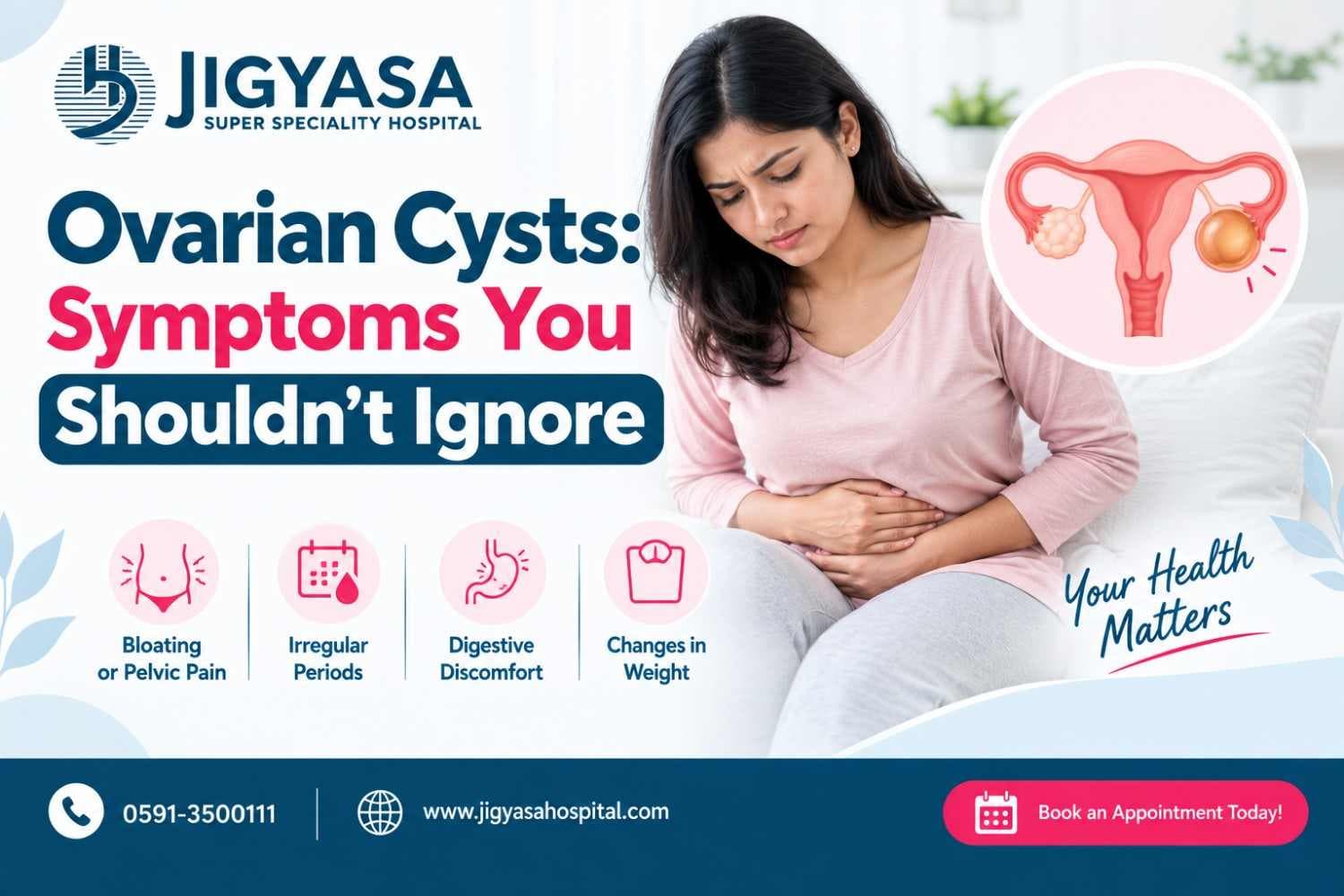
Ovarian Cysts: Symptoms You Shouldn't Ignore
Most ovarian cysts are harmless, but some symptoms need urgent attention. Learn the warning signs — guidance from Dr. Karishma Singh, Gynecologist, Jigyasa Hospital, Moradabad.
Hearing the words "you have a cyst on your ovary" can be alarming, especially when the mind immediately jumps to worst-case scenarios. In reality, ovarian cysts are extremely common, and the vast majority are completely harmless, often resolving on their own without any treatment at all. However, this general reassurance doesn't mean every ovarian cyst can simply be ignored — certain symptoms and specific types of cysts do require prompt medical attention. At Jigyasa Hospital, Moradabad, Dr. Karishma Singh, our specialist in Gynecology, Obstetrics, and IVF, regularly evaluates women with ovarian cysts to determine which fall into the "watch and wait" category and which need more active management.
What Is an Ovarian Cyst?
An ovarian cyst is a fluid-filled sac that develops in or on an ovary. Many cysts form as a normal part of the menstrual cycle, related to the process of egg release (ovulation), and these are generally referred to as functional cysts. Other types of cysts can develop for different reasons and may behave quite differently, which is why understanding the type of cyst matters for determining the right approach.
Common Types of Ovarian Cysts
Functional Cysts (Most Common, Usually Harmless)
- •Follicular cysts — form when the sac that normally releases an egg during ovulation doesn't rupture or release its fluid, and instead continues to grow
- •Corpus luteum cysts — form after an egg has been released, when the structure that remains (corpus luteum) fills with fluid instead of breaking down normally
Both types typically resolve on their own within a few menstrual cycles without requiring treatment.
Other Types of Cysts
- •Dermoid cysts — contain a variety of tissue types and are typically present from birth, though they may not be discovered until later in life
- •Endometriomas — associated with endometriosis, where tissue similar to the uterine lining grows within the ovary
- •Cystadenomas — develop from ovarian surface tissue and can sometimes grow quite large
- •Polycystic ovaries — associated with PCOS, involving multiple small cysts along with a broader hormonal pattern, rather than a single significant cyst
Why Most Ovarian Cysts Don't Cause Alarm
The majority of ovarian cysts, particularly functional cysts, are discovered incidentally during routine pelvic examinations or ultrasounds performed for unrelated reasons, without the woman experiencing any symptoms at all. Most of these resolve spontaneously within one to three menstrual cycles, and require nothing more than periodic monitoring to confirm resolution.
Symptoms That Warrant Attention
While many cysts cause no symptoms, certain signs suggest a cyst may need closer evaluation or more active management:
1. Persistent Pelvic Pain
A dull ache or heaviness in the lower abdomen or pelvis, particularly on one side, that persists over time rather than resolving within a cycle or two, warrants evaluation.
2. Pain During Intercourse
Discomfort or pain during sexual intercourse, particularly if it's a new or worsening symptom, can sometimes be related to an ovarian cyst.
3. Bloating or Abdominal Fullness
A persistent sense of bloating, fullness, or increased abdominal girth that doesn't resolve can occur with larger cysts.
4. Changes in Menstrual Pattern
Irregular periods, unusually heavy or light bleeding, or bleeding between periods can sometimes be associated with certain types of ovarian cysts, particularly those affecting hormone production.
5. Frequent Urination or Difficulty Emptying the Bladder
A larger cyst can press on the bladder, leading to increased urinary frequency or a sense of incomplete emptying.
6. Difficulty with Bowel Movements
Similarly, pressure on the bowel from a larger cyst can cause changes in bowel habits or a feeling of pressure during bowel movements.
7. Unexplained Weight Gain or Abdominal Swelling
Gradual, unexplained abdominal swelling or weight gain, particularly localized to the abdomen, should be evaluated rather than attributed to general weight changes.
Warning Signs That Need Urgent, Same-Day Medical Attention
Certain symptoms suggest a potential complication of an ovarian cyst — such as rupture or twisting of the ovary (torsion) — and require immediate evaluation:
- •Sudden, severe abdominal or pelvic pain, often described as sharp and intense, unlike typical menstrual cramping
- •Pain accompanied by fever, which may suggest infection or complication
- •Pain with nausea and vomiting, particularly if severe and sudden in onset
- •Dizziness, lightheadedness, or fainting, especially alongside sudden pain, which can indicate internal bleeding from a ruptured cyst
- •Rapid breathing or a racing heart accompanying severe pain
- •Pain that suddenly worsens or comes in severe waves alongside other concerning symptoms
These symptoms can indicate ovarian torsion (where the ovary twists on itself, cutting off its blood supply) or a ruptured cyst causing internal bleeding — both of which are medical emergencies requiring prompt treatment to preserve ovarian function and prevent serious complications.
Who Is at Higher Risk of Complications?
- •Larger cysts, which are more prone to torsion or rupture
- •Cysts that have grown rapidly over a short period
- •Women with a history of previous ovarian cysts or torsion
- •Pregnant women, since hormonal changes can sometimes affect cyst behavior
- •Women undergoing fertility treatments, where ovarian stimulation can occasionally lead to larger, more numerous cysts
When Should a Cyst Raise Concern for Something More Serious?
While the vast majority of ovarian cysts are benign, certain features prompt more thorough evaluation to rule out less common but more serious causes:
- •Cysts that persist or grow despite a period of monitoring
- •Cysts with complex features on ultrasound, rather than simple fluid-filled characteristics
- •Cysts occurring after menopause, since these are evaluated more cautiously than those in women of reproductive age
- •Rapidly growing cysts
- •Cysts associated with other concerning symptoms, such as unexplained weight loss or persistent bloating that doesn't improve
How Ovarian Cysts Are Evaluated at Jigyasa Hospital
At Jigyasa Hospital, Dr. Karishma Singh's approach to evaluating ovarian cysts typically includes:
1. Detailed History and Symptom Review
Understanding the nature, timing, and pattern of symptoms, along with menstrual history and any relevant risk factors.
2. Pelvic Examination
A physical examination to assess for tenderness, cyst size, and other relevant findings.
3. Ultrasound Imaging
This is the primary tool for evaluating ovarian cysts, helping determine size, characteristics (simple versus complex), and guiding whether monitoring or further action is needed.
4. Blood Tests, When Indicated
In certain situations, specific blood tests may be used to help assess the nature of a cyst, particularly if there's any concern about its characteristics on imaging.
5. Follow-Up Monitoring
For cysts likely to resolve on their own, a follow-up ultrasound after one or more menstrual cycles helps confirm resolution or track any changes requiring further attention.
Treatment Approaches
Watchful Waiting
For simple, functional cysts without concerning features, monitoring with a follow-up ultrasound is often the appropriate first approach, since most resolve spontaneously without intervention.
Medication
In certain cases, hormonal treatment may be used to help regulate the menstrual cycle and, in some situations, reduce the likelihood of new functional cysts forming, though this doesn't treat an already-existing cyst.
Surgical Management
Surgery may be recommended for cysts that are large, growing, persistent beyond expected resolution time, have concerning features on imaging, or are causing significant symptoms. In emergency situations such as suspected torsion or a ruptured cyst causing significant bleeding, prompt surgical intervention is necessary to preserve ovarian function and address the complication.
Gynecology Care at Jigyasa Hospital, Moradabad
- •Comprehensive ovarian cyst evaluation with pelvic examination and ultrasound
- •Expert diagnosis and treatment by Dr. Karishma Singh, Gynecologist & IVF Specialist
- •Watchful waiting for functional cysts, surgical management when needed
- •Emergency care for ovarian torsion and ruptured cysts
Book an Appointment: 7900903333
Address: Near Miglani Cinema, Rampur Road, Moradabad – 244001
Online Appointments: jigyasahospital.com
Ovarian Cyst Treatment | Pelvic Ultrasound | Gynecology Services | Emergency Care | Ayushman Bharat Accepted
Key Takeaways
- •Most ovarian cysts are functional and harmless — they resolve on their own within 1-3 menstrual cycles.
- •Warning symptoms include persistent pelvic pain, bloating, menstrual changes, and pain during intercourse.
- •Emergency signs: sudden severe pain, fever, nausea/vomiting, dizziness — could indicate torsion or rupture.
- •Evaluation includes pelvic exam, ultrasound, and sometimes blood tests to determine cyst type and treatment.
- •Treatment ranges from watchful waiting to surgery, depending on cyst size, type, and symptoms.
Frequently Asked Questions
Do all ovarian cysts need surgery?
No, the majority of ovarian cysts, particularly functional ones, resolve on their own without any treatment and are simply monitored with follow-up ultrasounds.
Can ovarian cysts affect fertility?
Most simple functional cysts don't affect fertility. However, certain types, such as endometriomas or cysts related to PCOS, can be associated with fertility challenges and may need more focused management, particularly for women trying to conceive.
Is pain during ovulation always a sign of a cyst?
Not necessarily — some women experience normal, mild discomfort around ovulation (sometimes called mittelschmerz) without any underlying cyst. However, if pain is severe, persistent, or a new symptom, it's worth having evaluated.
Can ovarian cysts turn into cancer?
The large majority of ovarian cysts are benign, particularly in women of reproductive age. However, certain features on imaging, larger size, complex characteristics, or occurrence after menopause prompt more careful evaluation to rule out less common but more serious causes.
How urgently should I seek care if I suddenly have severe pelvic pain?
Sudden, severe pelvic pain — especially with nausea, dizziness, or fever — should be treated as an emergency, since it could indicate ovarian torsion or a ruptured cyst with bleeding, both of which require prompt evaluation and treatment.
Related Articles

Heart Attack Warning Signs You Must Never Ignore
Recognizing heart attack symptoms early can save your life. Learn the critical warning signs from Dr. Amit Kumar Singh, Senior Interventional Cardiologist at Jigyasa Hospital, Moradabad. Call 7900903333.

5 Early Morning Habits That Prevent Diabetes Naturally
Discover 5 powerful morning habits that naturally prevent diabetes. Expert advice from Dr. C.P. Singh, Senior Consultant Physician at Jigyasa Hospital, Moradabad. Call 7900903333.

Why Summers in UP Are Dangerous for Your Kidneys
UP summers can silently damage your kidneys. Jigyasa Hospital Moradabad explains the hidden risks, warning signs, and how to protect your kidneys this season. Call 7900903333.