
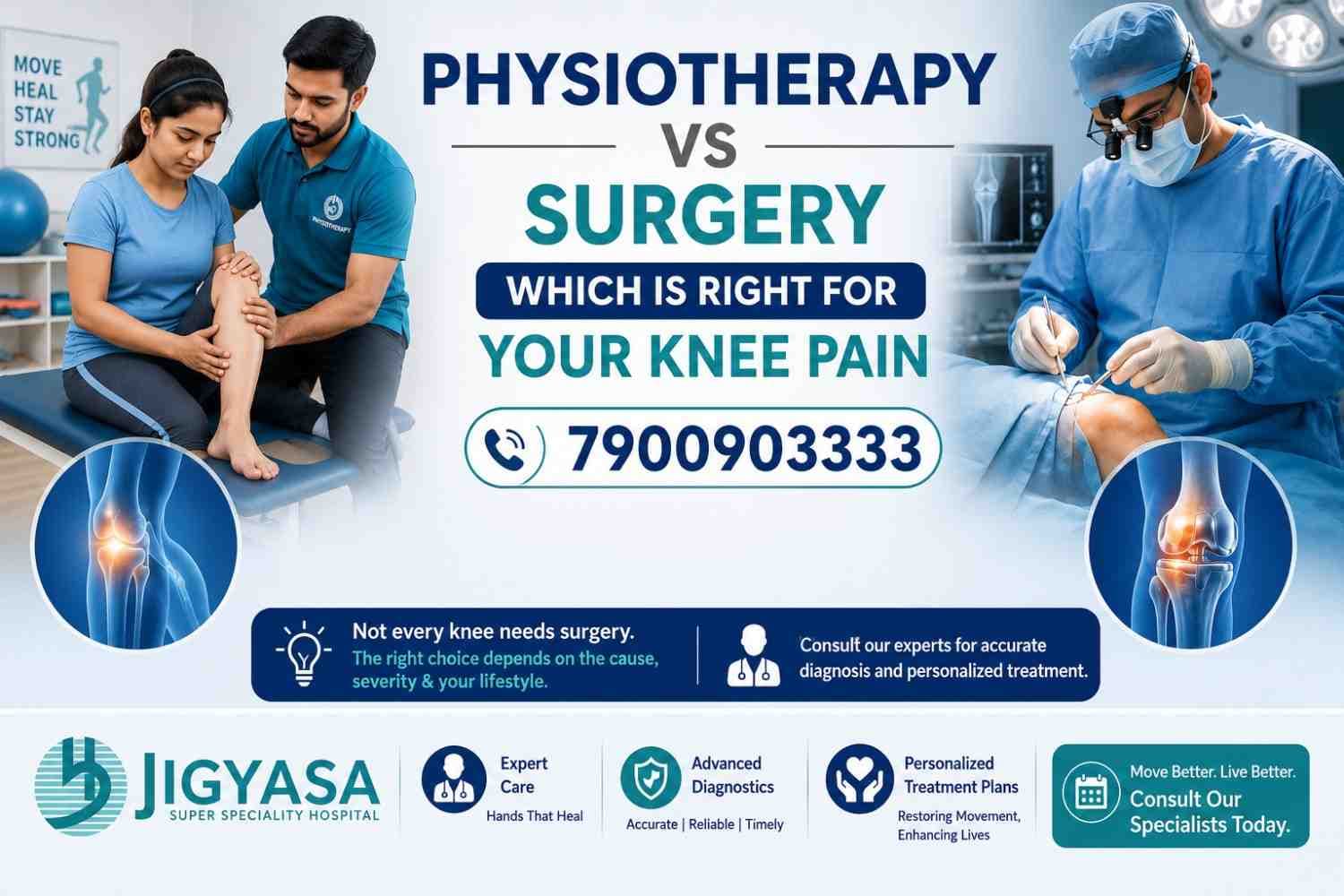
Physiotherapy vs Surgery — Which Is Right for Your Knee Pain?
Knee pain keeping you from daily life? Find out whether physiotherapy or surgery is the right answer — expert guidance from Jigyasa Hospital Moradabad.
Knee pain affects crores of Indians — from young athletes to elderly adults managing osteoarthritis. In Moradabad and across UP, the most common question orthopaedic physicians hear is: 'Doctor, do I need surgery or will physiotherapy work?' It is the right question — but the answer is not the same for everyone. It depends on a specific set of clinical factors, not on how severe the pain feels alone. This blog gives you a clear, evidence-based framework to understand your options before walking into a consultation. At Jigyasa Hospital, Moradabad, our orthopaedic and physiotherapy team helps patients make the right decision — not the most expensive one.
Understanding What Is Actually Causing Your Knee Pain
Before comparing treatments, the cause of pain determines everything. A diagnosis — confirmed by clinical examination and imaging (X-ray, MRI where needed) — must come before any treatment decision. Common causes include:
- •Osteoarthritis (OA) — gradual cartilage wear, most common in adults above 45; India has one of the highest OA burdens globally
- •Ligament injuries — ACL, PCL, or collateral ligament tears from accidents or sports
- •Meniscus tears — damage to the cartilage pads inside the knee from twisting injuries or degeneration
- •Patellofemoral pain syndrome — pain around the kneecap, common in younger active individuals
- •Tendinitis and bursitis — inflammation around the knee joint from overuse
- •Post-fracture stiffness or malalignment — following an injury or previous surgery
What Physiotherapy Can Do for the Knee
Physiotherapy is not 'just exercise.' It is a structured clinical intervention that addresses the root mechanical and muscular causes of knee pain.
How Physiotherapy Works
- •Strengthening the quadriceps, hamstrings, and hip muscles that support and stabilise the knee joint
- •Reducing abnormal load distribution across the joint through gait correction and movement retraining
- •Decreasing inflammation and swelling through manual therapy, ultrasound, and TENS (transcutaneous electrical nerve stimulation)
- •Improving range of motion in stiff or post-injury knees
- •Correcting posture and body mechanics that cause repetitive strain on the knee
Conditions Where Physiotherapy Is the First-Line Treatment
- •Mild to moderate knee osteoarthritis (Grade 1 and 2 on X-ray)
- •Patellofemoral pain syndrome
- •Tendinitis and bursitis
- •Post-surgery rehabilitation (after any knee procedure)
- •Partial meniscus tears in older, less active individuals
- •General knee weakness and instability without structural damage
What Research Shows
- •Multiple large clinical trials — including the landmark METEOR and KANON studies — found that supervised physiotherapy produced outcomes equivalent to surgery for many meniscus tears and early-to-moderate osteoarthritis
- •The American Academy of Orthopaedic Surgeons recommends physiotherapy as first-line management for knee osteoarthritis before surgical options are considered
- •Patients who complete a 6 to 12 week structured physiotherapy programme report significant reduction in pain and improvement in function — often avoiding surgery entirely
What Surgery Can Do for the Knee
Surgery becomes the right option when structural damage is beyond what conservative management can address, or when physiotherapy has been genuinely attempted and has not produced sufficient improvement.
Types of Knee Surgery Relevant in India
- •Arthroscopic surgery — minimally invasive; used for meniscus repair or removal, ligament reconstruction, removal of loose bodies, and cartilage procedures. Recovery: 4 to 12 weeks depending on procedure.
- •ACL reconstruction — for complete ACL tears, particularly in younger, active patients who want to return to sport or heavy physical work. Physiotherapy is essential before and after.
- •Partial knee replacement (unicompartmental) — replaces one section of the knee joint; suitable when only one compartment is severely damaged.
- •Total knee replacement (TKR) — replaces the entire joint surface; reserved for severe, end-stage osteoarthritis where pain and disability are significant and conservative treatment has failed.
- •Osteotomy — reshapes the bone around the knee to redistribute load; used in younger patients with specific alignment issues to delay the need for replacement.
Conditions Where Surgery Is Typically Required
- •Complete ACL or PCL rupture in an active individual
- •Severe meniscus tear causing mechanical locking of the knee
- •Grade 3–4 osteoarthritis with bone-on-bone contact causing debilitating pain and loss of function
- •Significant knee instability after ligament injury that physiotherapy cannot stabilise
- •Fractures around the knee requiring internal fixation
- •Failed conservative management after a genuine, supervised physiotherapy trial
Physiotherapy vs Surgery — Direct Comparison
Here is how the two options compare across the factors that matter most to patients in India:
- •Best for: Physiotherapy — early to moderate damage, inflammation, muscle weakness | Surgery — severe structural damage, complete tears, end-stage OA
- •Invasiveness: Physiotherapy — non-invasive | Surgery — invasive, carries anaesthetic and surgical risks
- •Recovery time: Physiotherapy — 6 to 12 weeks of active rehabilitation | Surgery — 3 to 12 months depending on procedure
- •Cost in India: Physiotherapy — ₹500 to ₹2,000 per session; full course ₹15,000 to ₹50,000 | Surgery — ₹1.5 lakh to ₹4 lakh (arthroscopy to TKR)
- •Risks: Physiotherapy — minimal, possible temporary soreness | Surgery — infection, DVT, anaesthetic complications, implant failure
- •Long-term outcome: Physiotherapy — excellent for right indications; may not stop OA progression | Surgery — excellent for right indications; TKR lasts 15 to 20+ years
- •Reversibility: Physiotherapy — fully reversible | Surgery — generally not reversible
- •Required after surgery: Physiotherapy is always required after any knee surgery — a technically perfect surgery without rehabilitation produces poor results
When to Choose Physiotherapy First
Choose physiotherapy as your starting point if any of the following apply:
- •Your pain is moderate and you can still perform daily activities
- •Your X-ray or MRI shows early-to-moderate changes (Grade 1–2 OA, partial tears)
- •You have not yet tried a structured, supervised physiotherapy programme — home exercises alone do not count
- •You are above 60 with osteoarthritis — muscles around the knee can compensate significantly for cartilage loss when properly strengthened
- •You want to avoid surgery or are medically unfit for anaesthesia
- •Your doctor has not found a mechanical block (locking, inability to straighten the knee) that requires structural correction
Important: physiotherapy must be prescribed and supervised by a qualified physiotherapist or orthopaedic physician. An informal exercise routine from YouTube is not equivalent to clinical physiotherapy and does not count as a failed conservative trial.
When Surgery Is the Right Answer
Consider surgery if any of the following are true:
- •You have a complete ACL or PCL tear and are under 50 with an active lifestyle or physical job
- •Your knee locks, gives way unpredictably, or cannot be fully straightened — indicating a mechanical block
- •MRI confirms a significant meniscus tear causing functional impairment
- •You have Grade 3–4 osteoarthritis with severe, constant pain that disrupts sleep and basic activities
- •You have completed 3 to 6 months of proper supervised physiotherapy without meaningful improvement
- •Imaging shows bone-on-bone contact — no cartilage remaining to protect the joint
- •A fracture requires stabilisation
Age is not a barrier to surgery. Many patients in their 70s and 80s benefit enormously from knee replacement. Equally, surgery is not automatically the answer for someone in their 40s with moderate OA — physiotherapy often works very well in this group.
The Most Important Point Most Patients Miss
- •Physiotherapy and surgery are not mutually exclusive — they are sequential for most patients
- •For moderate conditions: physiotherapy first, surgery only if physiotherapy fails
- •For surgical conditions: physiotherapy before surgery (prehabilitation) improves surgical outcomes significantly
- •For all surgical patients: physiotherapy after surgery is non-negotiable — a technically perfect surgery without rehabilitation produces poor results
- •The question is rarely 'one or the other' — it is 'which comes first, and which will be needed'
Red Flags — See a Doctor Immediately
Go for urgent orthopaedic evaluation — not a wait-and-watch approach — if you experience any of the following:
- •Sudden severe knee pain after an injury, fall, or twist
- •Visible deformity or inability to bear weight after trauma
- •Significant swelling within hours of an injury (possible haemarthrosis)
- •Knee that locks and cannot be straightened
- •Fever with a hot, swollen knee — possible septic arthritis, which is a medical emergency
- •Numbness or weakness below the knee following an injury
Get the Right Diagnosis at Jigyasa Hospital
Knee pain has many causes — the treatment depends entirely on the correct diagnosis. At Jigyasa Hospital, Moradabad, our orthopaedic and physiotherapy team provides complete knee evaluation including clinical examination, imaging review, and a personalised treatment plan. We help you make the right decision — not the most expensive one.
📞 Call: 7900903333
📍 Address: Near Miglani Cinema, Rampur Road, Moradabad – 244001
📧 Email: info@jigyasahospital.in
🌐 Website: jigyasahospital.com
✅ Orthopaedic OPD | Physiotherapy | Knee Imaging | Ayushman Bharat Accepted
The right treatment starts with the right diagnosis. Come to Jigyasa Hospital — and get a plan that is built for you.
Frequently Asked Questions
Can physiotherapy cure knee osteoarthritis permanently?
Physiotherapy cannot reverse structural cartilage loss — but it can significantly reduce pain, improve function, and slow progression by strengthening the muscles that protect the joint and reducing abnormal mechanical load. Many patients with moderate osteoarthritis manage their condition comfortably for years with physiotherapy, weight management, and appropriate medication — without needing surgery.
How many physiotherapy sessions does knee pain typically require?
Most structured knee rehabilitation programmes involve 12 to 24 sessions over 6 to 12 weeks, combined with a home exercise programme. Improvement is typically measurable within the first 4 to 6 weeks. If there is no meaningful improvement after 8 to 12 weeks of consistent, supervised physiotherapy, a surgical review is warranted.
Is total knee replacement a permanent solution?
Modern knee implants last 15 to 20+ years in most patients. The surgery has an excellent track record — with appropriate patient selection, over 90% of patients report significant pain relief and improved mobility. Age, weight, and activity level influence implant longevity. Younger patients may eventually require revision surgery.
I have knee pain but my X-ray looks normal — what does that mean?
Normal X-rays do not rule out significant knee pathology. Soft tissue injuries — meniscus tears, ligament injuries, cartilage damage — are not visible on X-ray. An MRI is required to assess these structures. If your pain is significant and persistent despite a normal X-ray, ask your orthopaedic physician for an MRI and a clinical assessment by a physiotherapist.
Related Articles

Heart Attack Warning Signs You Must Never Ignore
Recognizing heart attack symptoms early can save your life. Learn the critical warning signs from Dr. Amit Kumar Singh, Senior Interventional Cardiologist at Jigyasa Hospital, Moradabad. Call 7900903333.

5 Early Morning Habits That Prevent Diabetes Naturally
Discover 5 powerful morning habits that naturally prevent diabetes. Expert advice from Dr. C.P. Singh, Senior Consultant Physician at Jigyasa Hospital, Moradabad. Call 7900903333.

Why Summers in UP Are Dangerous for Your Kidneys
UP summers can silently damage your kidneys. Jigyasa Hospital Moradabad explains the hidden risks, warning signs, and how to protect your kidneys this season. Call 7900903333.