

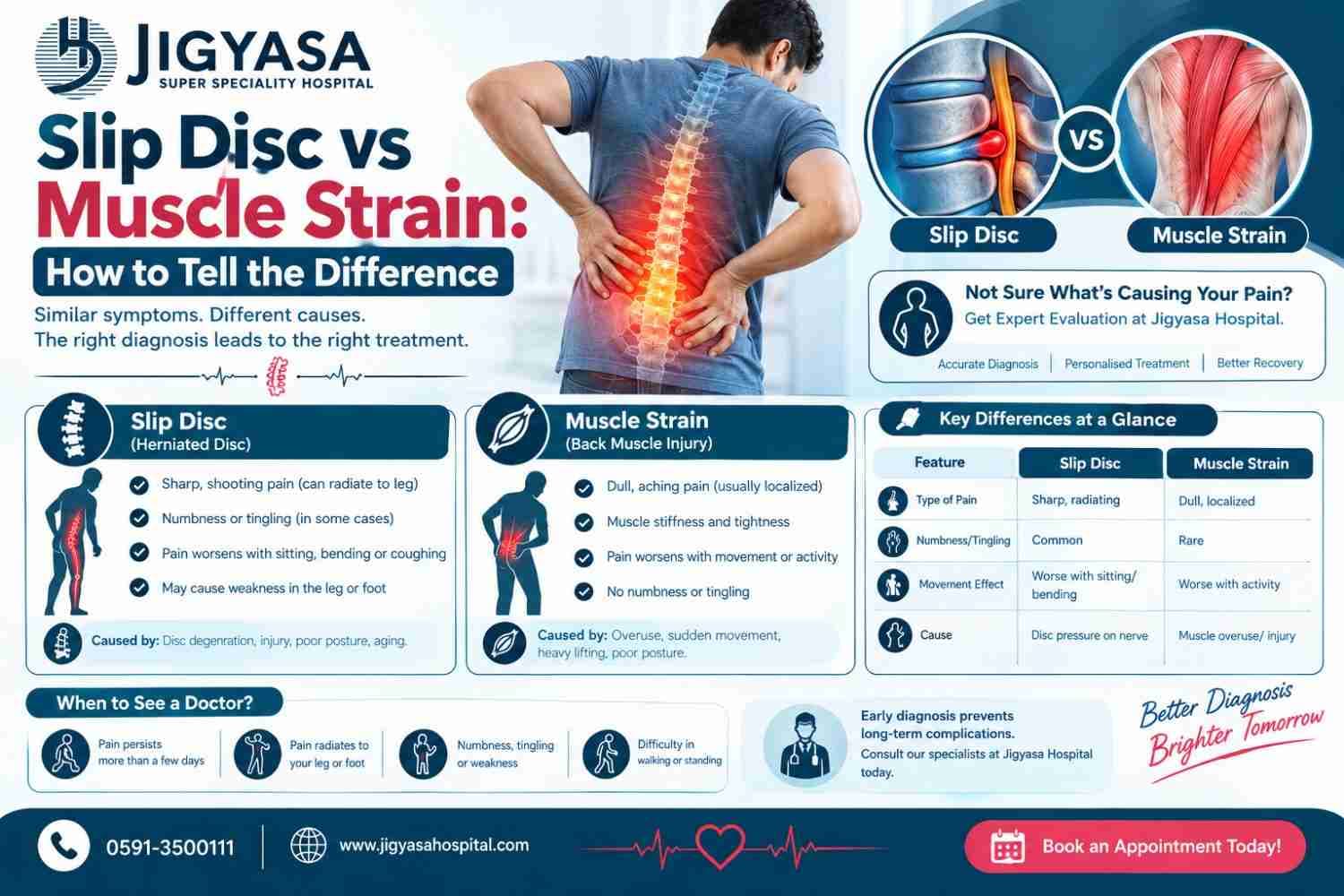
Slip Disc vs Muscle Strain: Know the Difference
Sudden back pain — is it a pulled muscle or a slipped disc? Learn the key differences in symptoms and when to seek treatment.
A muscle strain occurs when the muscles or the connective tissue (tendons) supporting the spine are overstretched or torn, usually due to sudden movement, heavy lifting, awkward twisting, or overuse. This is one of the most common causes of acute back pain and, in most cases, resolves with simple, conservative care within a matter of days to a few weeks. A slipped or herniated disc occurs when the tough outer layer of a disc weakens or tears, allowing the softer inner material to bulge or leak out. This displaced disc material can press on nearby nerves, causing pain that often extends beyond the back itself, along with other characteristic symptoms depending on which nerve is affected.
What Is a Slipped (Herniated) Disc?
The spine's vertebrae are cushioned by discs — soft, gel-like structures that act as shock absorbers between the bones. A slipped or herniated disc occurs when the tough outer layer of a disc weakens or tears, allowing the softer inner material to bulge or leak out. This displaced disc material can press on nearby nerves, causing pain that often extends beyond the back itself, along with other characteristic symptoms depending on which nerve is affected.
Key Differences: Pain Pattern and Location
Muscle Strain
- •Pain is typically localized to one specific area of the back, often described as a dull ache, tightness, or soreness
- •Pain generally doesn't radiate down the leg or arm
- •Discomfort often worsens with movement of the specific strained muscle and improves with rest
- •Muscle spasms may be felt as tight, knotted areas in the back
Slipped Disc
- •Pain often radiates beyond the back itself — commonly down one leg (sciatica) if a lower back disc is affected, or down an arm if a neck disc is involved
- •Pain may follow a specific nerve pathway, sometimes described as sharp, shooting, or burning, rather than a general ache
- •Symptoms may worsen with specific positions, such as sitting, bending forward, coughing, or sneezing, which increase pressure on the affected disc and nerve
- •Numbness, tingling, or weakness in the leg or arm — clearly beyond the back itself — is a hallmark feature not typically seen with simple muscle strain
Key Differences: Onset and Triggers
Muscle Strain
- •Often has a clear, identifiable trigger — an awkward lift, sudden twist, unaccustomed physical activity, or prolonged poor posture
- •Pain typically begins immediately or within a day of the triggering activity
- •Usually occurs in people who recently engaged in unusual physical exertion or sudden movement
Slipped Disc
- •May occur suddenly with a specific triggering movement (such as bending and lifting simultaneously), or can develop more gradually without a single clear triggering event, especially if disc degeneration has been developing over time
- •Can occur even with relatively minor movements if the disc was already weakened from age-related wear
- •More common in individuals with a history of repetitive strain, prolonged poor posture, or previous back issues
Key Differences: Associated Symptoms
Muscle Strain
- •Pain generally stays confined to the back or the immediately surrounding muscles
- •No numbness, tingling, or weakness in the limbs
- •Bruising is uncommon but can occasionally occur with a significant strain or tear
- •No changes in bladder or bowel function
Slipped Disc
- •Numbness or tingling that follows a specific nerve pattern down the leg or arm
- •Weakness in specific muscle groups, such as difficulty lifting the foot (foot drop) or gripping objects, depending on which nerve is compressed
- •In rare but serious cases, loss of bladder or bowel control, which represents a medical emergency requiring immediate attention
- •Reflexes may be reduced or absent on examination in the affected limb
Red Flags That Need Immediate Medical Attention
Regardless of whether the initial suspicion is muscle strain or slipped disc, certain features should prompt urgent evaluation rather than home management:
- •Loss of bladder or bowel control
- •Numbness in the groin or inner thighs (saddle anesthesia)
- •Progressive weakness in the leg or foot
- •Severe pain following significant trauma, such as a fall or accident
- •Fever accompanying severe back pain, which could suggest an infection
- •Unexplained weight loss alongside persistent back pain
- •Back pain in someone with a history of cancer
These features suggest either significant nerve compression requiring urgent intervention, or another underlying condition that needs prompt evaluation, rather than a straightforward muscle strain or typical disc issue.
How Doctors Tell the Difference
1. Detailed History
Understanding exactly how the pain started, what makes it better or worse, and whether it radiates beyond the back provides crucial initial clues. A clear story of radiating leg pain with numbness is very different from localized pain following a specific lifting incident.
2. Physical Examination
Specific tests, such as the straight leg raise test, can help identify nerve irritation consistent with a herniated disc. Checking reflexes, muscle strength, and sensation in the legs or arms helps confirm whether nerve involvement is present.
3. Response to Initial Treatment
Muscle strains typically show noticeable improvement within a few days to two weeks with rest and conservative measures, while disc-related nerve symptoms often persist or fail to improve significantly with the same basic measures.
4. Imaging, When Needed
For most simple muscle strains, imaging isn't required, as the diagnosis is usually clear from history and examination. However, if disc herniation is suspected — particularly with red flag features, significant nerve symptoms, or symptoms that don't improve within a reasonable timeframe — an MRI provides detailed imaging of the discs and nerves to confirm the diagnosis and its severity.
Treatment Approaches
For Muscle Strain
- •Short period of relative rest, avoiding complete bed rest, which can actually slow recovery
- •Ice application in the first day or two, followed by heat as the acute phase settles
- •Anti-inflammatory medication for pain relief
- •Gentle stretching and gradual return to normal activity as pain allows
- •Most cases resolve within a few days to a few weeks with these simple measures
For Slipped Disc
- •Initial conservative management, including activity modification, anti-inflammatory medication, and physical therapy, since a significant proportion of herniated discs improve without surgery
- •Structured physical therapy focusing on specific exercises to relieve nerve pressure and strengthen supporting muscles
- •Epidural or targeted injections in select cases for more significant nerve-related pain that hasn't responded to initial measures
- •Referral for surgical evaluation in cases with severe, persistent symptoms, significant weakness, or red flag features that haven't responded to a reasonable trial of conservative treatment
Why Getting the Diagnosis Right Matters
Treating a slipped disc as if it were a simple muscle strain can lead to prolonged, unnecessary suffering and, in cases with significant nerve compression, potential progression to more serious nerve damage if appropriate treatment is delayed. Conversely, over-investigating or over-treating a straightforward muscle strain adds unnecessary cost and anxiety. This is why an accurate clinical evaluation — rather than self-diagnosis based on how pain "feels" — is valuable, particularly when pain persists beyond a week or two, or when any radiating symptoms are present.
Prevention Tips for Both Conditions
- •Maintain proper lifting technique — bend at the knees, not the waist, and avoid twisting while lifting
- •Strengthen core and back muscles through regular, appropriate exercise
- •Maintain good posture, particularly during prolonged sitting
- •Avoid sudden, forceful movements, especially without warming up
- •Maintain a healthy body weight to reduce mechanical stress on the spine
- •Take regular breaks during activities involving prolonged bending or repetitive back strain
Rheumatology Care at Jigyasa Hospital, Moradabad
- •Comprehensive back pain evaluation with detailed history and physical examination
- •Expert diagnosis and treatment by Dr. Kriti Kishore, Rheumatologist
- •MRI imaging for suspected disc herniation and nerve compression
- •Physical therapy, medications, injections, and surgical referral when needed
Book an Appointment: 7900903333
Address: Near Miglani Cinema, Rampur Road, Moradabad – 244001
Online Appointments: jigyasahospital.com
Slip Disc Treatment | Muscle Strain Care | MRI Imaging | Physical Therapy | Rheumatology Services | Ayushman Bharat Accepted
Key Takeaways
- •Muscle strain causes localized back pain; slipped disc causes radiating pain with numbness/tingling in limbs.
- •Red flags like bladder/bowel control loss, progressive weakness, or saddle anesthesia need immediate emergency care.
- •Muscle strains improve within days to weeks; slipped discs may take longer and sometimes need advanced treatment.
- •MRI is used to confirm disc herniation when nerve symptoms are present or pain doesn't improve.
- •Proper lifting technique, core strengthening, and good posture help prevent both conditions.
Frequently Asked Questions
Can a slipped disc heal without surgery?
Yes, a significant proportion of herniated discs improve with conservative treatment — including physical therapy, medication, and activity modification — often without ever requiring surgery, especially when there's no severe or progressive weakness.
How long should I wait before seeing a doctor for back pain?
If pain is mild and clearly related to a specific activity, a few days of rest and simple home care is reasonable. However, if pain persists beyond one to two weeks, worsens, or is accompanied by numbness, tingling, or weakness in a leg or arm, it's best to get evaluated rather than waiting further.
Is bed rest good for either condition?
Complete bed rest is generally not recommended for either muscle strain or a slipped disc, as prolonged inactivity can actually slow recovery and weaken supporting muscles. Gentle movement and activity, as tolerated, generally supports better recovery.
Can a slipped disc happen without any specific injury?
Yes, particularly if the disc has already undergone some age-related degeneration, a herniation can occur with relatively minor movements or even develop gradually without one specific triggering incident.
Is numbness or tingling always a sign of a slipped disc rather than a muscle strain?
Numbness or tingling radiating into a leg or arm is not typical of simple muscle strain and should prompt evaluation for possible nerve involvement, which is more consistent with a slipped disc affecting a nerve root.
Related Articles

Heart Attack Warning Signs You Must Never Ignore
Recognizing heart attack symptoms early can save your life. Learn the critical warning signs from Dr. Amit Kumar Singh, Senior Interventional Cardiologist at Jigyasa Hospital, Moradabad. Call 7900903333.

5 Early Morning Habits That Prevent Diabetes Naturally
Discover 5 powerful morning habits that naturally prevent diabetes. Expert advice from Dr. C.P. Singh, Senior Consultant Physician at Jigyasa Hospital, Moradabad. Call 7900903333.

Why Summers in UP Are Dangerous for Your Kidneys
UP summers can silently damage your kidneys. Jigyasa Hospital Moradabad explains the hidden risks, warning signs, and how to protect your kidneys this season. Call 7900903333.