
Summer Diarrhea in Children — When to Rush to Hospital
Is your child's loose motion normal or dangerous? Jigyasa Hospital Moradabad explains the exact warning signs that mean it's time to go to the hospital — not wait.
Ask any parent in Moradabad, Rampur, Sambhal, or Amroha — and they will tell you that loose motions in children are as predictable a part of summer as the heat itself. From May through July, paediatric wards across Uttar Pradesh fill with children suffering from diarrhoea, vomiting, fever, and dehydration. In many cases, these children arrive too late — after parents waited one day too long, hoping it would pass on its own. Summer diarrhoea in children is common. But common does not mean harmless. Diarrhoea is the second leading cause of death in children under five years globally, and India accounts for a disproportionately large share of those deaths. The vast majority are preventable — with timely treatment, correct rehydration, and knowing the exact moment when home care is no longer enough. This blog gives every parent in and around Moradabad a clear, practical answer to the most important question: when is it time to stop waiting and go straight to the hospital? At Jigyasa Hospital, our Senior Paediatrician Dr. Sana Ibad Khan and our emergency team manage childhood dehydration and diarrhoea cases throughout the summer. This is the guidance we give parents — clearly and without unnecessary medical jargon.
Why Is Summer Diarrhea So Common in Children?
Several factors combine to make summer the peak season for childhood diarrhoea across North India.
- •Bacterial growth accelerates in heat: Bacteria responsible for diarrhoea — including E. coli, Salmonella, Shigella, and Campylobacter — multiply much faster at temperatures above 35°C. Food left out for even a short period during summer can carry dangerous bacterial loads. Street food, cut fruits sold outdoors, and unrefrigerated dairy are common sources.
- •Contaminated water: Summer puts heavy demand on municipal water supplies. Pipe pressure drops, contamination points increase, and waterborne pathogens — including rotavirus, Giardia, and cholera — spread more easily. In smaller localities around Moradabad, groundwater and tanker water quality is not guaranteed.
- •Children's immune systems are still developing: Infants and toddlers have not yet built immunity to many of the pathogens that cause summer diarrhoea. A viral or bacterial load that an adult shrugs off can overwhelm a two-year-old's system rapidly.
- •Children dehydrate far faster than adults: A child's body contains a higher proportion of water relative to body mass. They also have a higher metabolic rate and surface area-to-weight ratio, meaning they lose fluid proportionally faster. A child who starts the day with mild diarrhoea can reach dangerous dehydration by afternoon.
- •Hand hygiene gaps: Young children touch everything and put their hands in their mouths. Faeco-oral transmission — the route through which most diarrhoeal pathogens spread — is very difficult to prevent completely in a household with small children.
Types of Summer Diarrhea in Children
Not all diarrhoea is the same, and knowing the type can help you communicate clearly with your doctor.
- •Viral gastroenteritis — the most common cause, driven by rotavirus and norovirus. Causes watery stools, vomiting, low-grade fever, and abdominal cramps. Usually resolves within 3 to 7 days with proper hydration, but fluid loss during this period can be severe in young children.
- •Bacterial diarrhoea — caused by E. coli, Salmonella, or Shigella; tends to be more severe with mucus or blood in stools and higher fever. More likely to require medical treatment including antibiotics.
- •Dysentery — diarrhoea with blood and mucus in the stool, usually caused by Shigella or Entamoeba histolytica. Always requires medical evaluation and should not be managed at home beyond the first few hours.
- •Cholera — less common in urban settings but still reported in parts of UP during summer. Causes profuse, watery ('rice-water') stools with rapid and extreme dehydration. This is a medical emergency.
- •Food poisoning — sudden-onset vomiting and diarrhoea within hours of eating a contaminated food. Multiple family members may be affected simultaneously.
The Warning Signs — When to Rush to Hospital Immediately
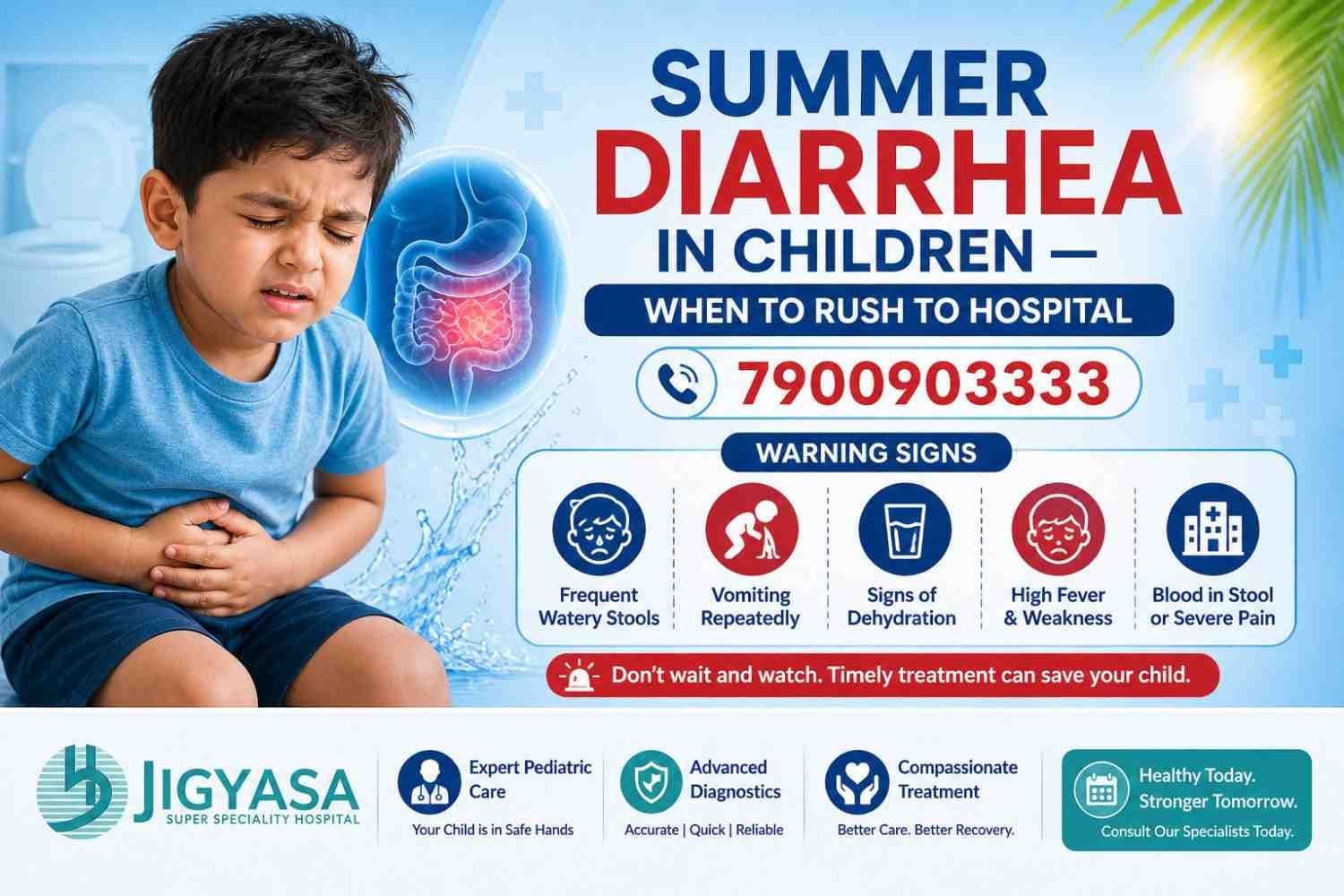
This is the most important section of this blog. Take your child to hospital immediately — without waiting — if any of the following are present:
- •Blood or mucus in the stool: This is never normal. It indicates bacterial dysentery, intussusception (a serious bowel emergency in infants), or another condition requiring urgent diagnosis. Do not manage this at home.
- •No urination for 6 hours or more: In a young child, this means the kidneys are not receiving enough fluid. In infants, check for a dry nappy — if dry for 6 or more hours, go to hospital.
- •Sunken eyes: A reliable visible indicator of moderate-to-severe dehydration. Alongside diarrhoea and vomiting, this constitutes a medical emergency.
- •Sunken fontanelle in infants: The soft spot on top of a baby's head normally sits flat or slightly raised. If it appears sunken, the baby is significantly dehydrated. Go immediately.
- •Crying without tears: Infants and young children cry with tears when adequately hydrated. Crying without producing any tears is a clear dehydration sign.
- •Dry mouth and cracked lips: Combined with diarrhoea and vomiting, this signals the body is running critically low on fluid.
- •Extreme lethargy or unresponsiveness: A child who was irritable and crying but has suddenly become unusually quiet, limp, or difficult to wake is not 'better' — they are worse. Go to emergency care immediately.
- •High fever alongside diarrhoea: Temperature above 102°F (39°C) in an infant under 3 months requires immediate hospital care. In older children, high fever combined with diarrhoea and vomiting accelerates dehydration rapidly.
- •Persistent vomiting preventing ORS intake: If your child vomits back every attempt to give fluids, they cannot rehydrate by mouth. IV fluid replacement is necessary.
- •More than 8 to 10 loose stools in 24 hours: Frequent, high-volume diarrhoea depletes fluids and electrolytes faster than oral rehydration can replace them, particularly with vomiting.
- •Severe abdominal pain or rigid, board-like abdomen: Can indicate intussusception, peritonitis, or appendicitis requiring immediate evaluation.
- •Diarrhoea in a newborn or infant under 6 months: Any significant diarrhoea in a very young infant is grounds for immediate hospital consultation — young infants have almost no reserve and can deteriorate within hours.
What You Can Do at Home — Before and While Getting Help
If you are monitoring at home or arranging transport to hospital, here is what to do in the meantime:
- •Start ORS immediately. The moment a child has loose motions, begin oral rehydration. Give small, frequent sips — a teaspoon every minute or two for a young child, free sipping for an older child. Use WHO-formulated ORS sachets dissolved in one litre of clean, cooled boiled water.
- •Do not give plain water alone to a child with active diarrhoea. Without electrolytes, it does not replace sodium and potassium losses and can worsen hyponatremia, particularly in infants.
- •Do not give carbonated drinks, fruit juices, or sports drinks as a replacement for ORS — they are too high in sugar and too low in sodium, and can worsen diarrhoea.
- •Continue breastfeeding if the child is an infant. Breast milk provides fluid, electrolytes, antibodies, and nutrition. Breastfeed more frequently, not less.
- •Do not give anti-diarrhoeal medicines such as loperamide (Imodium) to children without a doctor's prescription. Do not self-medicate with antibiotics either.
- •Zinc supplementation — 20 mg per day for 10 to 14 days — is recommended by WHO alongside ORS for children above 6 months. It reduces the severity and duration of the episode. Ask your paediatrician.
- •Monitor urine output actively. Check nappies or ask older children to tell you when they urinate. Frequency and colour are your two most important home monitoring tools.
How Doctors Assess a Dehydrated Child at Hospital
When you bring your child to Jigyasa Hospital, our paediatric team will assess hydration status using clinical signs — skin turgor, capillary refill time, pulse rate, blood pressure, eye assessment, fontanelle assessment in infants, and neurological alertness.
- •Mild dehydration (less than 5% body weight loss) — supervised ORS administration and outpatient guidance
- •Moderate dehydration (5 to 10%) — ORS under medical observation with close monitoring
- •Severe dehydration (more than 10%) or when oral rehydration is failing — IV fluid replacement initiated immediately
Blood tests may be ordered to check electrolyte levels — sodium, potassium, and bicarbonate — particularly if the child is confused, excessively weak, or has been unwell for more than 24 hours. Stool tests may be ordered if bacterial infection, dysentery, or cholera is suspected. Treatment decisions are made based on the child's clinical status — not just the stool count.
Prevention: How to Protect Your Child This Summer
- •Safe water at all times: Boil drinking water or use a certified water purifier. In localities around Moradabad where water supply reliability is uncertain, store boiled, cooled water in clean containers.
- •Food safety: Never give children food that has been sitting out in summer heat for more than 90 minutes. Avoid cut fruits from roadside vendors, particularly watermelon and muskmelon kept in standing water. Refrigerate leftovers promptly.
- •Handwashing as a habit: Wash hands with soap and water before preparing food, before feeding children, after using the toilet, and after handling a child's soiled nappy. Handwashing with soap reduces diarrhoea incidence in children by approximately 40%.
- •Rotavirus vaccination: Available under India's Universal Immunisation Programme and at Jigyasa Hospital. Provides significant protection against the most common cause of severe childhood diarrhoea. If your infant has not received it, speak to our paediatrician.
- •Avoid sending sick children to shared spaces: Children with active diarrhoea spread infection easily in crèches, schools, and playgrounds. Keep them home.
- •Keep ORS sachets at home: Every household with children should have 4 to 6 sachets stored through summer. Starting ORS within the first hour of an episode is one of the most effective ways to prevent progression to severe dehydration.
When to Call or Visit Jigyasa Hospital
The most consistent pattern our paediatric team sees every summer is children who arrive at the emergency department after parents waited through one night too many. Childhood diarrhoea can cross from manageable to dangerous within 6 to 12 hours in a young child. The decision to go to hospital is not an overreaction — it is the right call. A doctor can assess your child in minutes and reassure you if things are under control, or intervene immediately if they are not.
You know your child. If something feels wrong — if they are not themselves, if they are too quiet, if they stopped responding the way they usually do — trust that instinct and come in. We are here 24 hours a day, 7 days a week.
Call 7900903333 or come directly to our emergency unit if your child shows any of the warning signs listed in this blog. Walk-in and emergency patients are seen immediately. No prior appointment is needed for emergencies.
📞 Call: 7900903333
📍 Address: Near Miglani Cinema, Rampur Road, Moradabad – 244001
📧 Email: info@jigyasahospital.in
🌐 Website: jigyasahospital.com
✅ 24/7 Paediatric Emergency | IV Fluid Therapy | Rotavirus Vaccination | Ayushman Bharat Accepted
Don't wait for it to get worse. Come to Jigyasa Hospital — and let us take care of your child.
Frequently Asked Questions
How many loose motions per day in a child is considered diarrhoea?
Diarrhoea is defined as three or more loose or watery stools in a 24-hour period that represent a change from the child's normal stool pattern. A single loose stool after eating something unusual is not necessarily diarrhoea. However, if a child has three or more watery stools in a day, especially with vomiting or fever, begin ORS and monitor closely.
My child has loose motions but is active and drinking well — do I still need to see a doctor?
If your child is alert, active, drinking fluids well, urinating regularly, has no blood in the stool, and has no fever above 101°F, you can manage at home with ORS and close monitoring for the first 12 to 24 hours. However, any deterioration — reduced activity, refusing fluids, reduced urination, or onset of any warning sign — means go to hospital without further delay.
Should I stop milk and dairy if my child has diarrhoea?
For breastfed infants, never stop breastfeeding — it should continue and increase during diarrhoea. For older children on cow's milk or formula, temporary lactose intolerance can sometimes follow viral gastroenteritis. Your paediatrician will advise based on the child's age and condition. Do not make this decision independently for infants.
Can I give my child banana, curd, or rice water for diarrhoea?
These are traditional remedies with some basis in fact. Banana provides potassium and pectin which can help firm stools. Plain rice is easy to digest. Curd (plain, unsweetened) provides probiotics that can support gut recovery. These are acceptable supplementary foods in a child old enough to eat solids — but they do not replace ORS. The electrolyte deficit cannot be corrected by food alone during active diarrhoea.
How long does summer diarrhoea in children typically last?
Viral gastroenteritis typically lasts 3 to 7 days with appropriate rehydration. Bacterial diarrhoea may last longer without antibiotic treatment. If diarrhoea in a child persists beyond 7 days, it is classified as persistent diarrhoea and requires medical evaluation to rule out underlying causes including intestinal infections, parasites, or post-infectious complications.
Is it safe to travel with a child who has diarrhoea?
Avoid non-essential travel when a child has active diarrhoea. Travel in summer heat increases dehydration risk and makes monitoring more difficult. If travel is unavoidable, carry ORS sachets, adequate clean water, and have the hospital contact number — 7900903333 — saved on your phone.
What IV fluids are given to dehydrated children at hospital?
The most commonly used IV solution for paediatric dehydration is Ringer's Lactate or Normal Saline, chosen based on the child's electrolyte status and clinical condition. The rate and volume of infusion are calculated based on the child's weight and degree of dehydration. This is determined by the treating paediatrician and should not be attempted at home.
My child's diarrhoea has stopped but they are still not eating — is that normal?
Appetite suppression for 1 to 3 days after an episode of diarrhoea is common. The intestinal lining needs time to recover. Continue offering ORS or fluids, and introduce bland, easy-to-digest foods gradually. If the child is not eating at all for more than 3 days or is losing weight noticeably, consult your paediatrician.
Related Articles

Heart Attack Warning Signs You Must Never Ignore
Recognizing heart attack symptoms early can save your life. Learn the critical warning signs from Dr. Amit Kumar Singh, Senior Interventional Cardiologist at Jigyasa Hospital, Moradabad. Call 7900903333.

5 Early Morning Habits That Prevent Diabetes Naturally
Discover 5 powerful morning habits that naturally prevent diabetes. Expert advice from Dr. C.P. Singh, Senior Consultant Physician at Jigyasa Hospital, Moradabad. Call 7900903333.

Why Summers in UP Are Dangerous for Your Kidneys
UP summers can silently damage your kidneys. Jigyasa Hospital Moradabad explains the hidden risks, warning signs, and how to protect your kidneys this season. Call 7900903333.