
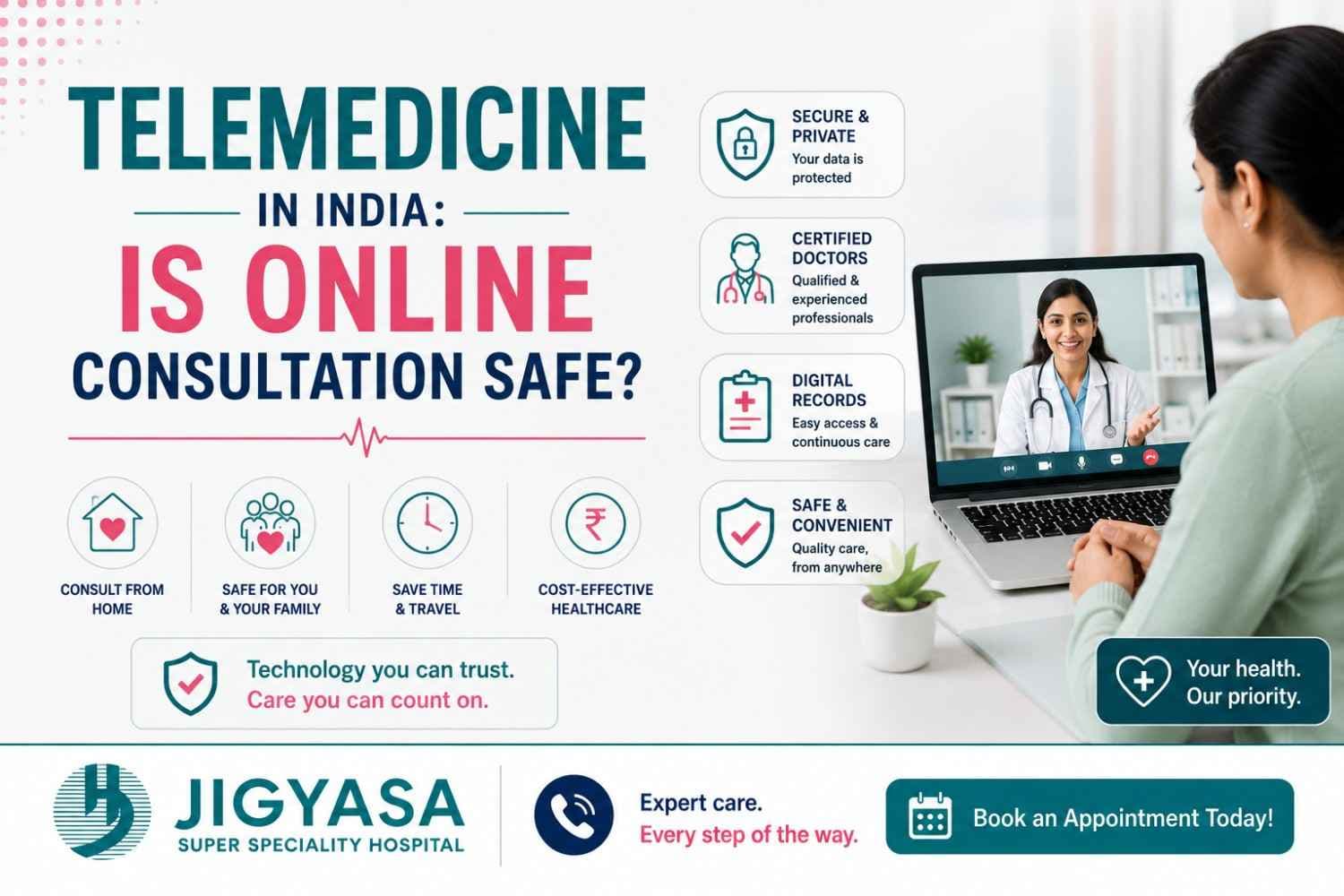
Telemedicine in India: Is Online Consultation Safe?
Is It Safe to Consult a Doctor Online in India? Jigyasa Hospital Moradabad Explains How Telemedicine Works, What It Can and Cannot Replace, and How to Use It Safely and Effectively.
In the years since India's Telemedicine Practice Guidelines were released by the Ministry of Health in 2020, online doctor consultations have gone from a niche convenience to a mainstream healthcare habit for millions of Indians. Whether it is a working professional in Moradabad consulting a specialist in Delhi at 10 PM, or a mother in a rural area seeking advice for her child's fever without travelling 40 kilometres — telemedicine has genuinely expanded access to medical care across India. But with this explosion of digital health platforms — some credible, some not — a critical question deserves a clear, honest answer: Is online consultation actually safe? The short answer is: yes — when used appropriately, with registered doctors, for the right conditions. And no — when it is used as a substitute for physical examination in situations that clearly require one. At Jigyasa Hospital, Moradabad, we offer teleconsultation services as a genuine extension of our patient care — not a replacement for it.
What Is Telemedicine and How Does It Work in India?
Telemedicine is the delivery of healthcare services — consultation, diagnosis, prescription, and follow-up — through digital communication channels: video call, voice call, or text/chat. In India, telemedicine is legally regulated under the Telemedicine Practice Guidelines 2020 issued by the Board of Governors (MCI) and Ministry of Health & Family Welfare — making it one of the few countries with a dedicated, enforceable telemedicine legal framework.
Key provisions of India's telemedicine regulations:
- •Only registered medical practitioners (RMPs) with a valid degree recognised under the Indian Medical Council Act can legally conduct teleconsultations.
- •Doctors must verify patient identity at the start of every consultation.
- •Prescriptions issued via telemedicine must follow the same standards as in-person prescriptions — including the doctor's name, registration number, date, and patient details.
- •Certain medications — including opioids, sleeping pills, and other Schedule X drugs — cannot be prescribed via telemedicine under Indian law.
- •Doctors cannot conduct teleconsultation anonymously — their credentials must be verifiable.
Platforms like Practo, Apollo 24/7, Tata 1mg, DocsApp, and hospital-specific portals all operate within this framework — though the quality of compliance varies significantly across providers.
When Is Telemedicine Genuinely Safe and Appropriate?
Conditions That Do Not Require Physical Examination:
- •Mild fever, cold, cough, and sore throat — symptom assessment, advice, and basic prescriptions for common infections
- •Skin conditions with clear visible symptoms — rashes, acne, eczema, minor fungal infections (via good-quality photo or video)
- •Urinary tract infections (UTIs) — classic symptoms in otherwise healthy women can be assessed and treated remotely with reasonable accuracy
- •Gastric complaints — acidity, IBS, mild nausea, constipation — well-suited for teleconsultation
- •Mental health consultations — therapy, counselling, psychiatric follow-ups, and anxiety/depression management are among the most effective applications of telemedicine globally
- •Chronic disease follow-ups — a patient with well-controlled diabetes, hypertension, or thyroid disease reviewing reports and adjusting medication does not need a physical visit every time
Prescription Renewals and Report Interpretation: Reviewing blood test results, scan reports, or ongoing medication with a doctor you already have a relationship with is entirely appropriate via teleconsultation. It saves significant time — avoids waiting rooms, travel, and lost work hours for what is effectively a 10-minute review.
Second Opinions: Seeking a second opinion on a diagnosis, treatment plan, or surgical recommendation from a specialist who may not be locally accessible is one of the most valuable uses of telemedicine. Patients in Moradabad can now access specialists in AIIMS, PGI, or Apollo-level hospitals for second opinions without travelling to Delhi or Lucknow.
Post-Hospitalisation Follow-Up: After discharge from hospital, routine follow-ups to review healing, manage medications, and address non-urgent concerns are very well-suited to video consultation — particularly for elderly patients or those who find travel difficult.
When Telemedicine Is Not Safe — and Physical Examination Is Non-Negotiable
Emergency and Acute Conditions — Go Directly to Hospital:
- •Chest pain, breathlessness, or suspected heart attack — call emergency services immediately; do not consult online
- •Stroke symptoms — sudden facial drooping, arm weakness, slurred speech — every minute matters; go to the ER
- •Severe abdominal pain — could indicate appendicitis, perforated ulcer, or ectopic pregnancy — all surgical emergencies
- •High fever with stiff neck, skin rash, or altered consciousness — possible meningitis — life-threatening if delayed
- •Severe allergic reaction (anaphylaxis) — breathing difficulty, tongue swelling — call emergency services immediately
- •Major injuries, fractures, or heavy bleeding — require physical assessment, imaging, and hands-on treatment
Conditions Requiring Physical Examination for Accurate Diagnosis:
- •New, unexplained lumps or swellings — require physical palpation and possibly biopsy; cannot be adequately assessed remotely
- •Abdominal or pelvic pain — requires physical examination; causes range from benign to surgical emergency
- •Neurological symptoms — dizziness, numbness, coordination problems — require a proper neurological exam
- •Cardiac symptoms — palpitations, chest tightness, shortness of breath — require ECG, auscultation, and BP measurement
- •Eye problems — vision changes, eye pain, redness with discharge — require slit-lamp and fundus examination
- •Children under 5 with high fever — young children need physical assessment; remote diagnosis of serious paediatric illness is inherently unreliable
First-Time Consultations for Complex or Unknown Conditions: If you have a new, undiagnosed symptom — particularly one affecting multiple systems, lasting more than a week, or worsening over time — an in-person consultation is always the safer starting point. A doctor cannot auscultate your lungs, palpate your abdomen, check your lymph nodes, or examine your retina through a screen — and for many conditions, these physical findings are clinically decisive.
How to Use Telemedicine Safely — 8 Rules Every Patient Should Follow
- •Always verify the doctor's credentials: Confirm the consulting doctor has a valid MBBS or specialist degree and an MCI/NMC registration number — which they are legally required to provide. Platforms should display this information prominently — if they do not, that is a red flag.
- •Use registered, reputable platforms only: Avoid WhatsApp consultations with unknown 'doctors' or social media health advice masquerading as medical consultation. Use government-approved platforms or reputable hospital portals — these operate under the Telemedicine Practice Guidelines 2020. The eSanjeevani platform (Government of India's free teleconsultation service) is a fully legitimate, regulated option.
- •Provide complete and accurate medical history: Before your consultation, prepare: your current symptoms (onset, duration, severity), past medical history, current medications, known allergies, and any relevant recent reports. Incomplete history leads to incomplete advice.
- •Take clear photos or videos if needed: For skin conditions, eye redness, wounds, or visible swellings — take clear, well-lit photos in advance to share with the doctor during the consultation. Good-quality visuals significantly improve the accuracy of remote assessment for visible conditions.
- •Confirm that prescriptions are legally valid: A valid telemedicine prescription in India must include the doctor's name, qualification, and registration number; the patient's name and age; the date; the medicine names with doses and duration; and the doctor's digital or wet signature. Prescriptions without these elements are not legally valid.
- •Never use telemedicine for emergency symptoms: If your symptoms include chest pain, severe breathlessness, sudden weakness or numbness, loss of consciousness, or uncontrolled bleeding — do not open an app. Call 112 or go to the nearest emergency room immediately.
- •Follow up in-person when advised: If the online doctor recommends an in-person visit, blood tests, or imaging — follow through promptly. Remote advice is only as good as the information available — a doctor recommending further assessment is being cautious on your behalf, not evasive.
- •Protect your personal and medical data: Ensure the telemedicine platform you use has a clear data privacy policy compliant with Indian IT laws. Do not share sensitive medical information over unsecured channels (standard SMS, public WhatsApp groups, or unofficial email).
Teleconsultation at Jigyasa Hospital, Moradabad
- •Jigyasa Hospital offers video and phone consultations with our specialist doctors — including cardiology, gynaecology, general medicine, and more — for appropriate cases.
- •Our teleconsultations are conducted strictly under the Telemedicine Practice Guidelines 2020 — by verified, registered specialists, with legally valid prescriptions issued for appropriate conditions.
- •We are transparent about the limits of remote consultation — if your condition requires in-person examination or investigations, we will tell you clearly and assist you in booking a physical appointment without delay.
- •Our goal is not to maximise online consultations — it is to give you the right care at the right time, through the right channel.
Book a Consultation (In-Person or Tele): 7900903333
Address: Near Miglani Cinema, Rampur Road, Moradabad – 244001
Online Appointments: jigyasahospital.com
Video Consultation | Phone Consultation | Cardiology | Gynaecology | General Medicine | Regulated Teleconsultation | Ayushman Bharat Accepted
Key Takeaways
- •Telemedicine in India is legal, regulated, and genuinely useful — when used for the right conditions and through the right platforms.
- •It is safest for mild acute illnesses, chronic disease follow-ups, prescription renewals, second opinions, mental health consultations, and post-hospitalisation reviews.
- •It is never appropriate for emergencies, conditions requiring physical examination, new unexplained symptoms, or children under 5 with acute illness.
- •Always verify the doctor's registration, ensure the prescription is legally valid, and follow up in person when advised.
- •Jigyasa Hospital offers regulated, specialist-led teleconsultations — with complete transparency about when a physical visit is the right call.
Frequently Asked Questions
Is online doctor consultation legal in India?
Yes — telemedicine has been fully legal in India since the Telemedicine Practice Guidelines 2020 were issued by the Ministry of Health & Family Welfare. Only registered medical practitioners can legally conduct teleconsultations and issue prescriptions.
Can a doctor prescribe medicines through an online consultation in India?
Yes, with important restrictions. Most medicines can be prescribed via telemedicine. However, Schedule X drugs (certain psychotropic, sleeping, and narcotic medications) cannot be prescribed remotely under Indian telemedicine law. Prescriptions must meet all standard legal requirements to be valid.
Is eSanjeevani safe to use?
Yes. eSanjeevani is the Government of India's official telemedicine platform — free to use, staffed by registered doctors, and fully compliant with national telemedicine guidelines. It is a legitimate and reliable option for primary care teleconsultation.
Can telemedicine replace my regular doctor?
No. Telemedicine is a supplement to — not a replacement for — a primary care physician who knows your medical history and can examine you. The best use of teleconsultation is within an existing doctor-patient relationship, not as a substitute for one.
What should I do if I am not satisfied with an online consultation?
If you feel your concern has not been adequately addressed, seek an in-person consultation — especially for new, worsening, or unclear symptoms. You are always entitled to a second opinion, in-person or online.
Is telemedicine available for children?
Yes — but with important caveats. For children under 5 with fever, breathing difficulties, or other acute symptoms, in-person examination is strongly preferred. For older children with mild or chronic conditions, teleconsultation with a paediatrician is appropriate.
Related Articles

Heart Attack Warning Signs You Must Never Ignore
Recognizing heart attack symptoms early can save your life. Learn the critical warning signs from Dr. Amit Kumar Singh, Senior Interventional Cardiologist at Jigyasa Hospital, Moradabad. Call 7900903333.

5 Early Morning Habits That Prevent Diabetes Naturally
Discover 5 powerful morning habits that naturally prevent diabetes. Expert advice from Dr. C.P. Singh, Senior Consultant Physician at Jigyasa Hospital, Moradabad. Call 7900903333.

Why Summers in UP Are Dangerous for Your Kidneys
UP summers can silently damage your kidneys. Jigyasa Hospital Moradabad explains the hidden risks, warning signs, and how to protect your kidneys this season. Call 7900903333.