
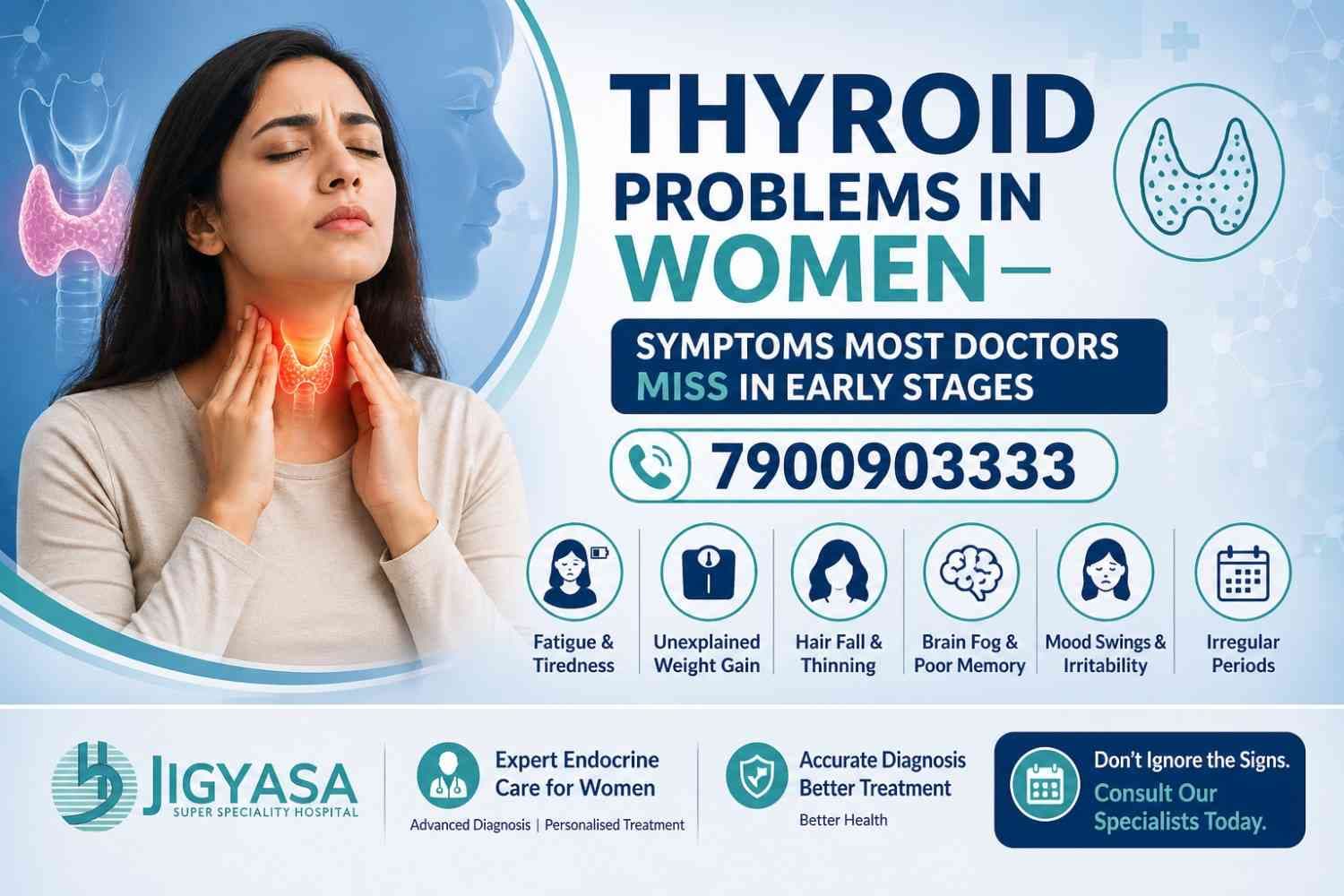
Thyroid Problems in Women — Symptoms Most Doctors Miss in Early Stages
Feeling tired, gaining weight, or losing hair for no reason? These could be early thyroid symptoms in women that most doctors overlook. Expert insight from Jigyasa Hospital Moradabad.
Every day, thousands of women across India visit a doctor complaining of exhaustion, unexplained weight gain, hair thinning, mood swings, or brain fog — and walk away with a prescription for vitamins, antidepressants, or stress counselling. What nobody tells them is that these could all be early signs of a thyroid disorder. The thyroid gland is a small, butterfly-shaped gland sitting at the front of your neck. It produces hormones — primarily T3 and T4 — that regulate metabolism, energy, body temperature, heart rate, mood, menstrual cycle, and even how fast your hair grows. When it stops working correctly, the ripple effects touch almost every system in your body. Women are 5 to 8 times more likely to develop thyroid disorders than men. In India, an estimated 42 million people live with some form of thyroid disease, and a large majority are women who remain undiagnosed for months or even years. At Jigyasa Hospital, Moradabad, our physicians regularly see patients who have been living with thyroid symptoms that were dismissed or misdiagnosed at earlier stages. This blog is for every woman who suspects something is wrong but has been told she is 'just stressed.'
What Is a Thyroid Problem? A Simple Explanation
The two most common thyroid conditions in women are hypothyroidism and hyperthyroidism. In hypothyroidism (underactive thyroid), the gland produces too little hormone. The body slows down — metabolism drops, energy falls, and every process feels sluggish. This is the more commonly missed condition. In hyperthyroidism (overactive thyroid), the gland produces too much hormone. The body speeds up — heart races, weight drops, and anxiety spikes. This is often confused with panic disorder or anxiety.
Hashimoto's Thyroiditis is an autoimmune condition where the body attacks the thyroid gland and is the leading cause of hypothyroidism in women. It can be present for years before TSH levels become abnormal on a standard test — which is exactly why early symptoms get missed.
The Early Symptoms Most Doctors Miss — And Why
1. Persistent Fatigue That Sleep Does Not Fix
This is the most reported and most dismissed symptom. Women with early-stage hypothyroidism often say they sleep 8 to 9 hours and still wake up exhausted. This is not ordinary tiredness — it is cellular-level fatigue caused by a slowing metabolism. Doctors frequently attribute this to anaemia, stress, overwork, or lifestyle factors without ordering a thyroid panel. If you have been fatigued for more than three months without a clear cause, a thyroid test should be part of the workup.
What to ask your doctor: "Can we check my TSH, Free T3, and Free T4 along with my CBC?"
2. Unexplained Weight Gain — Especially Around the Abdomen
When thyroid hormone levels drop, metabolism slows dramatically. Many women notice they are gaining weight despite eating the same amount and exercising regularly. The weight tends to accumulate around the belly, hips, and face. This symptom is often dismissed as poor diet discipline or perimenopause, particularly in women above 35. The key distinction: thyroid-related weight gain does not respond well to diet and exercise changes until the thyroid issue is addressed.
3. Hair Thinning and Hair Fall
Thyroid hormones play a direct role in hair follicle cycling. When levels are disrupted, the hair growth cycle is interrupted, leading to diffuse shedding across the scalp rather than patchy hair loss. Women also notice thinning of the outer third of the eyebrows — a classic, often overlooked sign of hypothyroidism. This symptom is routinely attributed to iron deficiency, postpartum hormonal changes, dandruff, or stress. While those causes are valid, they should not be assumed without ruling out thyroid dysfunction.
4. Cold Intolerance — Feeling Cold When Others Do Not
A low thyroid output means the body cannot generate enough heat through its slowed metabolism. Women with hypothyroidism often feel cold in their hands and feet even in warm weather, need extra blankets, and are uncomfortable in air conditioning while others around them are fine. This symptom, in isolation, is easy to ignore. But combined with fatigue and weight changes, it becomes a significant red flag.
5. Brain Fog and Poor Concentration
Difficulty remembering words mid-conversation, forgetting where you placed things, inability to concentrate at work, mental slowness — these are all neurological effects of hypothyroidism. Thyroid hormones regulate neurotransmitter function. When they are low, cognitive processing slows. This symptom is frequently diagnosed as anxiety, depression, ADHD, or burnout. Many women in their 30s and 40s are started on antidepressants before anyone checks their thyroid.
6. Irregular or Heavy Menstrual Cycles
The thyroid and the reproductive hormonal system are tightly linked. Hypothyroidism can cause heavy, prolonged, or irregular periods. Hyperthyroidism can cause very light or absent periods. Either extreme is a signal. Unfortunately, menstrual irregularity is so common in general gynaecological practice that it often gets treated symptomatically — hormonal pills, iron supplements — without investigating the thyroid. Women living near Moradabad who present with unexplained heavy bleeding or irregular cycles should always receive a thyroid function test as part of their workup.
7. Dry Skin, Brittle Nails, and Puffiness
Thyroid hormones regulate cell turnover and moisture retention in the skin. Low levels cause dry, rough, or yellowish skin that does not respond to moisturisers. Nails become thin, ridged, and break easily. Puffiness, particularly around the eyes and face in the morning, and swelling around the ankles are also features of hypothyroidism — caused by a substance called myxedema that accumulates in tissues when thyroid function is low. These are often attributed to poor sleep or kidney issues without checking the thyroid.
8. Constipation Without a Dietary Cause
The digestive system depends on thyroid hormones to maintain its rhythm. In hypothyroidism, gut motility slows, leading to chronic constipation that does not resolve with fibre intake or laxatives. This is often treated gastrointestinally for months before anyone connects it to the thyroid.
9. Muscle Weakness, Aches, and Cramps
Thyroid hormones influence muscle metabolism. Women with underactive thyroid commonly experience weakness in the thighs (difficulty climbing stairs), aching muscles, and cramps — especially at night. This is frequently attributed to vitamin D deficiency, which can coexist but should not be the only diagnosis.
10. Mood Changes, Anxiety, and Low-Grade Depression
Both hypothyroidism and hyperthyroidism affect mood, but in opposite ways. Hypothyroidism tends to cause depression, emotional flatness, and low motivation. Hyperthyroidism tends to cause anxiety, irritability, and racing thoughts. The psychiatric presentation of thyroid disease is one of the most commonly missed diagnostic opportunities. A woman who presents with depression or anxiety should have a full thyroid panel as part of the initial investigation — not as a last resort after psychiatric treatment fails.
Why These Symptoms Get Missed — The Diagnostic Gap
There are several reasons why early thyroid symptoms in women are consistently overlooked:
- •Normalisation of symptoms: Fatigue, mood swings, and weight gain are considered normal for busy women, new mothers, and women entering perimenopause. There is a cultural tendency — in India and globally — to dismiss these complaints rather than investigate them.
- •Reliance on TSH alone: Many doctors order only TSH (Thyroid Stimulating Hormone) and consider the case closed if it falls within the 'normal' range. However, TSH is a pituitary hormone, not a thyroid hormone. A woman can have suboptimal Free T3 and Free T4 levels — causing every symptom listed above — while her TSH remains technically within range. A complete thyroid panel must include Free T3, Free T4, and ideally TPO antibodies (to detect Hashimoto's).
- •Symptom overlap with common conditions: Anaemia, PCOS, perimenopause, depression, and iron deficiency all share symptoms with thyroid disease. Without systematic testing, the wrong diagnosis is made.
- •Short consultation times: When a doctor has limited time and a patient presents with vague symptoms, it is easy to prescribe a supplement and reassure rather than order a full panel.
Who Is at Higher Risk of Thyroid Problems?
Certain women face an elevated risk and should be screened proactively:
- •Women with a family history of thyroid disease or autoimmune conditions
- •Women who have been pregnant in the last 12 months — postpartum thyroiditis affects approximately 5 to 10 per cent of new mothers and is almost never diagnosed
- •Women above 35 years of age, particularly those entering perimenopause
- •Women with PCOS, type 1 diabetes, or rheumatoid arthritis (shared autoimmune pathways)
- •Women who have experienced radiation to the neck area or who have had thyroid surgery in the past
If you belong to any of these groups, a yearly thyroid function test is advisable even without symptoms.
What Tests Should You Ask For?
If you suspect a thyroid problem, do not settle for TSH alone. Ask for a complete thyroid panel:
- •TSH (Thyroid Stimulating Hormone) — the screening test, but not sufficient alone
- •Free T4 (FT4) — measures the active, unbound form of thyroxine
- •Free T3 (FT3) — the most metabolically active thyroid hormone; often low even when T4 is normal
- •Anti-TPO Antibodies (TPOAb) — elevated levels indicate Hashimoto's thyroiditis, which can be present years before TSH becomes abnormal
- •Anti-Thyroglobulin Antibodies (TgAb) — additional autoimmune marker when Hashimoto's is suspected
- •Thyroid Ultrasound — recommended when a goitre, nodule, or structural abnormality is suspected
At Jigyasa Hospital Moradabad, our physicians can guide you on which combination of tests is appropriate based on your symptoms and history.
Treatment Options for Thyroid Problems in Women
Hypothyroidism is treated with levothyroxine (synthetic T4), a safe, oral medication taken once daily. Dosage is adjusted based on blood tests every 6 to 8 weeks initially, and then annually once stable. Most women feel significantly better within 6 to 12 weeks of starting treatment.
Hyperthyroidism may be treated with antithyroid medications (carbimazole or propylthiouracil), radioactive iodine therapy, or surgery depending on the cause and severity. Our team will recommend the most appropriate approach after full evaluation.
Hashimoto's Thyroiditis is managed by treating the resulting hypothyroidism. Anti-inflammatory dietary changes, selenium supplementation, and regular monitoring are also discussed in a clinical setting.
- •Maintain a diet with adequate iodine, selenium, and zinc
- •Avoid excessive consumption of raw goitrogenic foods (cabbage, cauliflower, soy) if you already have thyroid dysfunction
- •Manage stress through adequate sleep and physical activity
- •Attend regular check-ups to monitor hormone levels
When to See a Doctor at Jigyasa Hospital for Thyroid Symptoms
Do not wait if you experience any of the following:
- •A visible swelling or lump at the front of the neck
- •Difficulty swallowing or breathing
- •A heart rate persistently above 100 beats per minute at rest
- •Sudden severe anxiety with trembling and sweating
- •Extreme weakness or inability to perform daily activities
- •Unexplained significant weight loss over a short period
- •Persistent fatigue, hair loss, or menstrual irregularity lasting more than 3 months
Women in Moradabad and surrounding areas including Sambhal, Rampur, Amroha, Gajraula, and Hapur should be aware that thyroid disease is underdiagnosed across Uttar Pradesh due to limited awareness and inconsistent testing. Many women who visit Jigyasa Hospital for fatigue, infertility, or menstrual irregularities are found to have undiagnosed thyroid dysfunction on their first comprehensive blood workup.
At Jigyasa Hospital, Moradabad, we believe that no woman should spend months or years living with symptoms that have a name and a treatment. Our physicians will listen, investigate thoroughly, and partner with you to restore your health. A simple blood test can change everything.
📞 Call: 7900903333
📍 Address: Near Miglani Cinema, Rampur Road, Moradabad – 244001
📧 Email: info@jigyasahospital.in
🌐 Website: jigyasahospital.com
✅ Thyroid Testing | Women's Health OPD | Internal Medicine | Ayushman Bharat Accepted
Trust your body — and test it. Book your thyroid evaluation at Jigyasa Hospital today.
Frequently Asked Questions
Can thyroid problems cause weight gain even if I eat very little?
Yes. In hypothyroidism, metabolic rate drops significantly. The body retains fluid and burns fewer calories even at rest. Women often report gaining weight despite actively restricting food intake. Weight loss is difficult until thyroid hormone levels are normalised through treatment.
Is thyroid disease permanent? Can it be cured?
It depends on the cause. Hashimoto's thyroiditis and most cases of hypothyroidism require lifelong management with thyroid hormone replacement (levothyroxine). Hyperthyroidism caused by Graves' disease can sometimes go into remission. Postpartum thyroiditis often resolves on its own. Your doctor will advise on the most appropriate plan after diagnosis.
Can my thyroid cause anxiety and depression?
Absolutely. Both conditions are well-documented neuropsychiatric effects of thyroid dysfunction. Hyperthyroidism commonly causes anxiety, palpitations, and panic. Hypothyroidism commonly causes depression, brain fog, and emotional numbness. Treating the thyroid often improves these symptoms significantly.
At what age do thyroid problems typically start in women?
Thyroid dysfunction can occur at any age but is most commonly diagnosed in women between 30 and 60. Postpartum thyroiditis can occur at any childbearing age. There is a notable rise in incidence during perimenopause (typically 45 to 55 years). Younger women with autoimmune conditions or a family history can also be affected.
What does a normal TSH level mean? Can I still have a thyroid problem?
A TSH within the standard laboratory range does not entirely rule out thyroid disease. Free T3 and T4 can still be suboptimal, particularly in Hashimoto's in its early phase. Women whose TSH is in the higher end of the normal range (above 2.5 mIU/L) and who have symptoms should discuss further evaluation with their physician.
Can thyroid problems affect pregnancy or fertility?
Yes, significantly. Uncontrolled hypothyroidism is linked to difficulty conceiving, miscarriage, gestational hypertension, and complications with fetal development. Thyroid function testing is recommended as part of preconception care and early antenatal workup. Jigyasa Hospital's team includes specialists in both endocrinology and gynaecology to support women planning a family.
Is thyroid disease hereditary?
There is a strong genetic component to autoimmune thyroid disease. If your mother, sister, or maternal grandmother had thyroid disease, your risk is meaningfully elevated. Proactive screening is advisable even before symptoms appear.
Where can I get thyroid testing and treatment in Moradabad?
Jigyasa Hospital, Moradabad, offers complete thyroid evaluation — from clinical examination to advanced blood tests including Free T3, Free T4, TSH, TPO antibodies, and thyroid ultrasound. Ayushman Bharat PM-JAY is accepted. Call 7900903333 or visit Near Miglani Cinema, Rampur Road, Moradabad – 244001.
Related Articles

Heart Attack Warning Signs You Must Never Ignore
Recognizing heart attack symptoms early can save your life. Learn the critical warning signs from Dr. Amit Kumar Singh, Senior Interventional Cardiologist at Jigyasa Hospital, Moradabad. Call 7900903333.

5 Early Morning Habits That Prevent Diabetes Naturally
Discover 5 powerful morning habits that naturally prevent diabetes. Expert advice from Dr. C.P. Singh, Senior Consultant Physician at Jigyasa Hospital, Moradabad. Call 7900903333.

Why Summers in UP Are Dangerous for Your Kidneys
UP summers can silently damage your kidneys. Jigyasa Hospital Moradabad explains the hidden risks, warning signs, and how to protect your kidneys this season. Call 7900903333.