
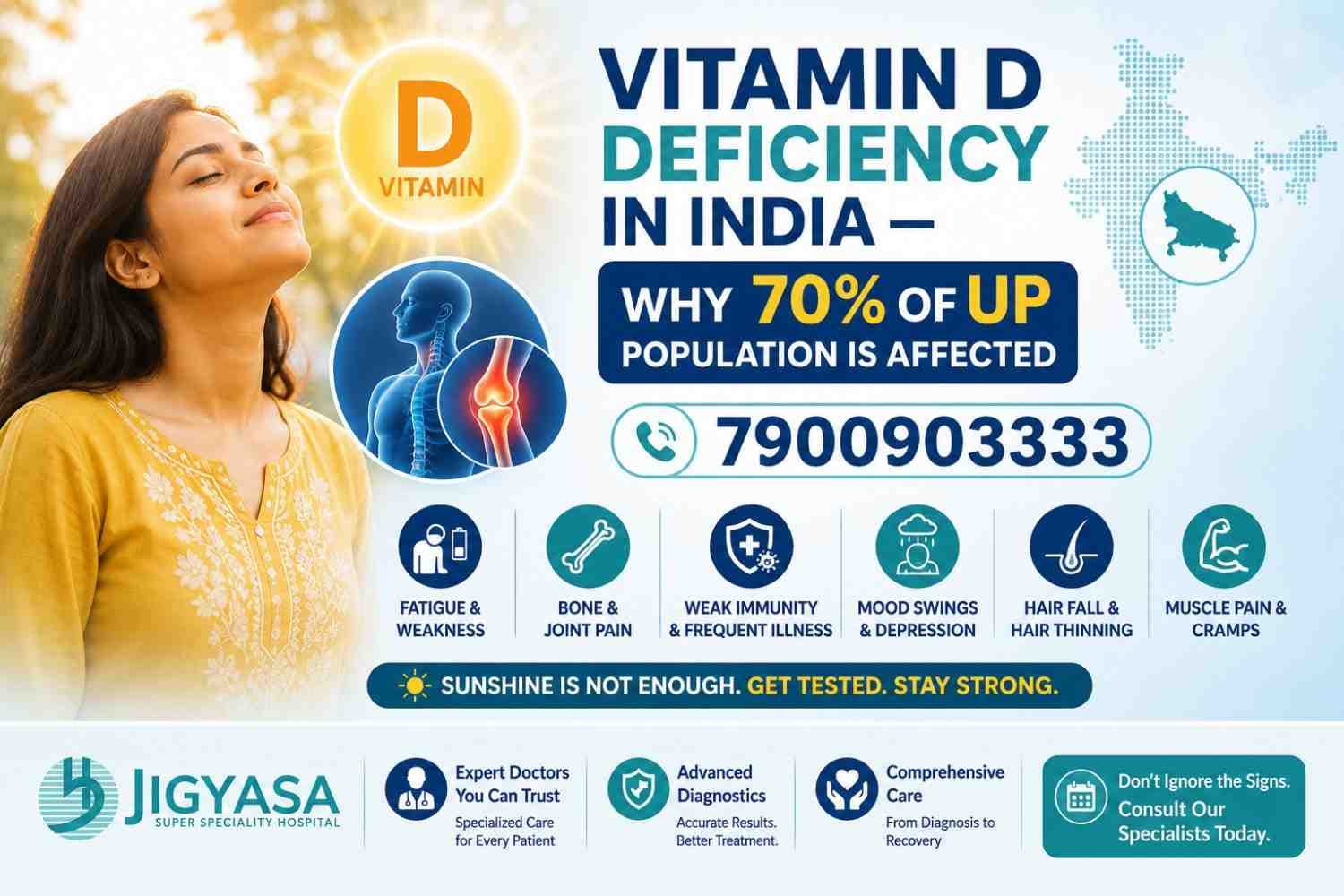
Vitamin D Deficiency in India — Why 70% of UP Population Is Affected
India gets sunlight year-round, yet 70% of people in UP are Vitamin D deficient. Jigyasa Hospital Moradabad explains why — and what to do about it.
India is one of the sunniest countries on Earth. Moradabad receives strong direct sunlight for 9 to 10 months of the year. And yet study after study confirms a striking, counterintuitive reality: India has one of the highest rates of Vitamin D deficiency in the world. Estimates consistently place deficiency rates at 70 to 90 per cent across the country — with Uttar Pradesh among the most severely affected states. This is not a minor nutritional gap. Vitamin D is not a vitamin in the traditional sense — it is a hormone. It regulates calcium absorption, bone density, immune function, muscle strength, mood, cardiovascular health, and blood sugar regulation. When it is chronically low, the consequences touch nearly every system in the body. What makes this problem particularly difficult to address is how invisible it is. Vitamin D deficiency does not announce itself dramatically. It creeps in slowly, disguised as tiredness, body aches, low mood, frequent infections, and hair loss — symptoms so common that most people and many doctors attribute them to other causes, often for years. At Jigyasa Hospital, Moradabad, Vitamin D deficiency is among the most frequently identified findings on routine blood workups. This blog explains what is really going on — why a sunny state like UP produces so many deficient people, what the symptoms actually look like, and what it takes to correct the problem properly.
What Is Vitamin D and Why Does the Body Need It?
Vitamin D is a fat-soluble secosteroid hormone produced in the skin when it is exposed to UVB radiation from sunlight. It undergoes two conversions — first in the liver to 25-hydroxyvitamin D (calcidiol), and then in the kidneys to 1,25-dihydroxyvitamin D (calcitriol), its active hormonal form.
In this active form, Vitamin D regulates calcium and phosphorus absorption in the intestine — without adequate Vitamin D, the body absorbs only 10 to 15 per cent of dietary calcium, compared to 30 to 40 per cent when levels are sufficient. Children with severe deficiency develop rickets — soft, deformed bones. Adults develop osteomalacia — bone softening and pain — and accelerated osteoporosis.
Beyond bone, Vitamin D receptors are found in virtually every tissue in the body — the brain, heart, pancreas, immune cells, muscles, and skin. Research consistently links Vitamin D deficiency to increased risk of type 2 diabetes, hypertension, autoimmune disease, depression, certain cancers, and increased severity of respiratory infections.
Normal, Insufficient, and Deficient — Understanding Your Numbers
Vitamin D levels in the blood are measured as 25(OH)D — serum 25-hydroxyvitamin D — in nanograms per millilitre (ng/mL). The clinical classifications used in India are:
- •Sufficient: above 30 ng/mL — the level at which most physiological functions are adequately supported
- •Insufficient: 20 to 30 ng/mL — below optimal but not yet causing overt symptoms in most people; bone health, immune function, and metabolic processes are suboptimally supported
- •Deficient: below 20 ng/mL — associated with measurable impairment of calcium absorption, bone health, immune function, and increasing risk of associated conditions
- •Severely deficient: below 10 ng/mL — associated with clear clinical symptoms, significant bone loss, muscle weakness, and high fracture risk
The majority of studies conducted across North India, including UP, show mean Vitamin D levels in the population falling between 10 and 18 ng/mL — well within the deficient range, across all age groups including children, adults, and the elderly.
Why Is UP So Severely Affected? The Seven Real Reasons
1. Clothing and Cultural Practices
Across UP — in both rural areas and cities like Moradabad — the majority of women cover most of their body for religious, cultural, or social reasons. Vitamin D synthesis in skin requires UVB exposure on a significant body surface area. Covering 80 to 90 per cent of the skin eliminates most of the potential for synthesis, regardless of how sunny the environment is. This is a primary reason why women in UP are disproportionately more deficient than men.
2. Skin Tone and Melanin
Melanin — the pigment that gives skin its colour — acts as a natural sunscreen, absorbing and scattering UVB radiation before it can trigger Vitamin D production in deeper skin layers. A person with darker skin requires approximately 3 to 5 times longer sun exposure to produce the same amount of Vitamin D as someone with lighter skin. Even when skin is exposed, Indians with darker complexions need significantly longer exposure times — time that most people simply do not spend outdoors in direct sunlight.
3. Time of Day and Angle of Sunlight
UVB radiation — the specific wavelength required for Vitamin D synthesis — only penetrates the atmosphere when the sun is at a sufficiently high angle, generally between 10 am and 3 pm. Most people in Moradabad and across UP who do go outdoors do so early in the morning or in the evening — specifically to avoid midday heat. They receive plenty of UVA (which causes tanning) but very little UVB, meaning almost no Vitamin D is synthesised despite the sun exposure.
4. Air Pollution
The Indo-Gangetic Plain — which encompasses all of UP — consistently records among the worst air quality in the world. Particulate matter, dust, and pollution scatter and absorb UVB radiation before it reaches ground level. Studies in North Indian cities have directly measured significantly reduced UVB ground-level intensity compared to cleaner environments at the same latitude. Pollution is a significant, underappreciated contributor to the Vitamin D deficiency epidemic in UP.
5. Indoor Lifestyles and Glass Barriers
Glass blocks UVB radiation entirely. A person sitting next to a window in sunlight receives UVA but no UVB — and therefore synthesises no Vitamin D. As more people in Moradabad spend their working days indoors — in offices, shops, schools, factories — their effective UVB exposure drops to near zero regardless of how bright the day is outside.
6. Predominantly Vegetarian Diet Low in Vitamin D
Vitamin D is found naturally in very few foods. The richest dietary sources — fatty fish, cod liver oil, and egg yolks — are not staple foods across much of UP. For the significant proportion of the population that follows a vegetarian or predominantly vegetarian diet, dietary Vitamin D intake is negligible. The only plant-based food with meaningful Vitamin D is sun-dried mushrooms — not a routine part of the UP diet.
7. Limited Awareness and Infrequent Testing
Vitamin D testing is not part of routine health checks in most primary care or government health settings in UP. Many people do not know their levels are low. Symptoms are attributed to other causes, and doctors managing fatigue, back pain, or depression may not routinely include a Vitamin D test. At Jigyasa Hospital, we have made Vitamin D testing a standard part of our comprehensive health check packages precisely because it is so commonly deficient and so frequently missed.
Symptoms of Vitamin D Deficiency — What It Actually Feels Like
- •Persistent fatigue and low energy — a generalised, cellular-level exhaustion that does not resolve with rest; multiple studies confirm a direct correlation between low Vitamin D levels and unexplained fatigue
- •Bone pain and body aches — particularly in the lower back, hips, legs, and ribs; a deep ache present at rest that worsens with pressure on bones, frequently misdiagnosed as arthritis or muscular pain
- •Muscle weakness — difficulty climbing stairs, rising from a seated position, or lifting objects; severe deficiency can produce proximal muscle weakness that significantly impairs daily function
- •Frequent infections — recurrent colds, respiratory infections, and slow recovery; Vitamin D stimulates production of antimicrobial peptides in immune cells, and deficient individuals have measurably impaired innate immune responses
- •Depression and low mood — Vitamin D receptors in the brain regulate serotonin production; low Vitamin D is associated with increased rates of depression and generalised low mood
- •Hair loss — Vitamin D receptors in hair follicles regulate the hair cycle; deficiency is associated with alopecia areata and diffuse hair thinning, particularly in women
- •Impaired wound healing — slow healing after cuts or surgical procedures has been linked to low Vitamin D, which regulates the inflammatory and repair phases
- •In children — rickets: soft bones, bowed legs, delayed tooth eruption, poor growth, and distinctive enlargement of wrist and ankle joints; entirely preventable but still recognisable in children across rural UP
- •In elderly individuals — falls and fractures: Vitamin D deficiency significantly increases fall risk through its effects on muscle strength and balance, and fracture risk through effects on bone density
Who Is at Highest Risk in Moradabad and Surrounding Areas?
- •Women — particularly those who cover their bodies for cultural reasons, those who are pregnant or breastfeeding, and women above 40; pregnancy and lactation increase Vitamin D demands substantially, and deficiency in a pregnant mother directly affects fetal bone development
- •Exclusively breastfed infants without Vitamin D supplementation — breast milk contains minimal Vitamin D regardless of the mother's dietary intake; a leading cause of infantile rickets in India
- •Elderly individuals who stay primarily indoors and have reduced skin synthesis efficiency with age
- •People with diabetes — Vitamin D deficiency worsens insulin resistance and impairs pancreatic beta-cell function, creating a bidirectional relationship with type 2 diabetes
- •People with obesity — Vitamin D is fat-soluble and becomes sequestered in adipose tissue, making it less bioavailable; obese individuals require significantly higher doses to achieve adequate blood levels
- •People with kidney or liver disease — since Vitamin D activation occurs in these organs, disease affecting either impairs conversion to the active form regardless of intake
How Is Vitamin D Deficiency Diagnosed?
Diagnosis requires a blood test — specifically serum 25(OH)D (25-hydroxyvitamin D or calcidiol). This is the standard storage form measured in clinical practice and reflects total body Vitamin D status accurately. The test is a simple blood draw, available at Jigyasa Hospital, Moradabad, with results typically available within 24 hours. No special preparation is required.
At Jigyasa Hospital, we recommend including a Vitamin D test alongside calcium, phosphorus, PTH (parathyroid hormone), and a full blood count when evaluating fatigue, bone pain, or muscle weakness — because these conditions frequently coexist and interact. Do not attempt to diagnose or treat Vitamin D deficiency based on symptoms alone, as they overlap significantly with anaemia, hypothyroidism, depression, and other conditions.
Treatment — How to Correct Vitamin D Deficiency Properly
- •For deficiency (below 20 ng/mL): Standard loading regimen — commonly 60,000 IU of cholecalciferol (Vitamin D3) weekly for 8 to 12 weeks, followed by maintenance supplementation. Exact dose and duration are determined by the treating physician based on blood level, age, weight, and kidney function.
- •For insufficiency (20–30 ng/mL): Lower-dose supplementation or maintenance doses are usually sufficient, alongside dietary and lifestyle measures.
- •For maintenance after correction: A daily dose of 1,000 to 2,000 IU is commonly recommended for adults in India, confirmed and periodically monitored with blood tests.
- •Vitamin D3 vs D2: Vitamin D3 (cholecalciferol) is more effective at raising and sustaining blood levels than Vitamin D2 (ergocalciferol) and is the preferred form. Confirm D3 when purchasing supplements.
- •Calcium co-supplementation: When deficiency is severe and dietary calcium is also low, calcium supplementation is often added alongside. The two work together — Vitamin D without adequate calcium does not fully prevent bone loss.
Important: Do not self-supplement with high doses without medical guidance. Vitamin D is fat-soluble and accumulates in the body — toxicity, though rare, is possible with prolonged high-dose supplementation without monitoring. Always test, then treat, then retest. A follow-up blood test 3 months after starting supplementation confirms that levels have corrected and guides the transition to maintenance dosing.
Dietary Sources of Vitamin D — What to Include
While diet alone cannot correct clinical deficiency, adding Vitamin D-rich foods supports overall nutritional status and reduces the maintenance dose required.
- •Fatty fish — salmon, mackerel, hilsa (ilish), and sardines are among the richest natural food sources and are available in Moradabad's markets
- •Egg yolks — contain moderate amounts of Vitamin D and are an accessible source for non-vegetarians
- •Fortified milk and fortified cereals — provide small but consistent amounts when consumed daily
- •Sun-dried mushrooms — mushrooms dried in direct sunlight for several hours develop measurable Vitamin D and are the best plant-based source
For strict vegetarians and vegans, dietary sources are genuinely limited and supplementation is usually necessary.
Book Your Vitamin D Test at Jigyasa Hospital
The single most important step any adult in Moradabad or the surrounding region can take is to know their Vitamin D level. The test is inexpensive, requires no special preparation, and takes minutes. Yet the majority of the population has never had it done. You cannot correct what you do not measure.
At Jigyasa Hospital, Vitamin D testing is available as part of our routine health check packages and as a standalone test. Our physicians — including Dr. C.P. Singh (Senior General Physician), Dr. Amit Kumar Singh (Cardiologist), and Dr. Karishma Singh (Gynaecologist) — regularly review Vitamin D as part of managing fatigue, bone health, diabetes, cardiac risk, hormonal health, and pregnancy care.
One simple number — your serum 25(OH)D level — could explain years of unexplained symptoms and put you on the path to feeling genuinely well.
📞 Call: 7900903333
📍 Address: Near Miglani Cinema, Rampur Road, Moradabad – 244001
📧 Email: info@jigyasahospital.in
🌐 Website: jigyasahospital.com
✅ Vitamin D Testing | Comprehensive Health Checks | Internal Medicine OPD | Ayushman Bharat Accepted
Test first. Then act. Jigyasa Hospital is here to guide every step.
Frequently Asked Questions
Can I get enough Vitamin D just by sitting in the sun for 15 minutes a day?
For most people in UP, no — not reliably. The standard recommendation of 15 minutes of midday sun applies to people with light skin, no air pollution, no glass barriers, and bare skin exposed during peak UVB hours. For darker-skinned individuals in a polluted city like Moradabad who are also partially clothed, the effective Vitamin D synthesis from 15 minutes of sun exposure is minimal. Most people need 45 to 90 minutes of meaningful skin exposure during peak hours — which is not practically achievable for most daily routines.
Is Vitamin D deficiency the same as calcium deficiency?
They are related but distinct. Vitamin D deficiency causes calcium deficiency indirectly — because without adequate Vitamin D, calcium from food is poorly absorbed. Someone can eat a calcium-rich diet and still have low blood calcium if their Vitamin D is severely deficient. Testing both is important, and treatment often addresses both simultaneously.
My bone density scan shows osteoporosis — could Vitamin D deficiency be the cause?
Vitamin D deficiency is a major contributing factor to osteoporosis, particularly in women above 40 and in the elderly. Without adequate Vitamin D, the body cannot absorb enough calcium to maintain bone density over time. Correcting Vitamin D and calcium levels alongside other osteoporosis management is standard practice. If you have received an osteoporosis diagnosis and have not had your Vitamin D levels tested, ask your doctor to include it.
I have been given Vitamin D injections — is that better than tablets?
Intramuscular Vitamin D injections provide a large single dose at once and can raise levels quickly, but the response can be less predictable than oral supplementation and does not allow for fine-tuned dose adjustment. For most patients, oral weekly Vitamin D3 sachets or capsules are effective and are the standard recommended approach. Injections may be appropriate in specific cases — for example, when a patient has malabsorption issues. Your doctor will determine what is most appropriate.
My child has been prescribed Vitamin D drops — how long should I continue them?
For infants, the Indian Academy of Paediatrics recommends Vitamin D supplementation from the first few days of life until at least 1 year, and often longer based on dietary intake and sun exposure. For older children with diagnosed deficiency, supplementation duration is guided by blood tests. Do not stop supplementation in a child without confirming through a follow-up blood test that levels are adequate.
Can Vitamin D deficiency cause weight gain?
There is an association — not a direct causative relationship — between low Vitamin D and weight gain. Vitamin D deficiency is linked to fatigue and reduced physical activity, and deficiency is more pronounced in individuals with obesity due to fat tissue sequestering the vitamin. Correcting deficiency often improves energy and activity levels, which can support weight management indirectly.
How often should I get my Vitamin D levels checked?
For the general population in UP with no known deficiency, testing once a year as part of a comprehensive health check is reasonable given the high background prevalence. For people already on supplementation, a follow-up test 3 months after starting treatment is standard, followed by annual monitoring once levels are stable.
Is Vitamin D deficiency related to diabetes?
Yes, significantly. Vitamin D deficiency impairs insulin secretion and increases insulin resistance — both central mechanisms in type 2 diabetes. Studies in India have found that people with Vitamin D deficiency have a substantially higher risk of developing type 2 diabetes and face more difficulty controlling blood sugar. Checking Vitamin D levels in people with diabetes or prediabetes is recommended at Jigyasa Hospital as part of comprehensive diabetes care.
Related Articles

Heart Attack Warning Signs You Must Never Ignore
Recognizing heart attack symptoms early can save your life. Learn the critical warning signs from Dr. Amit Kumar Singh, Senior Interventional Cardiologist at Jigyasa Hospital, Moradabad. Call 7900903333.
5 Early Morning Habits That Prevent Diabetes Naturally
Discover 5 powerful morning habits that naturally prevent diabetes. Expert advice from Dr. C.P. Singh, Senior Consultant Physician at Jigyasa Hospital, Moradabad. Call 7900903333.
Why Summers in UP Are Dangerous for Your Kidneys
UP summers can silently damage your kidneys. Jigyasa Hospital Moradabad explains the hidden risks, warning signs, and how to protect your kidneys this season. Call 7900903333.