

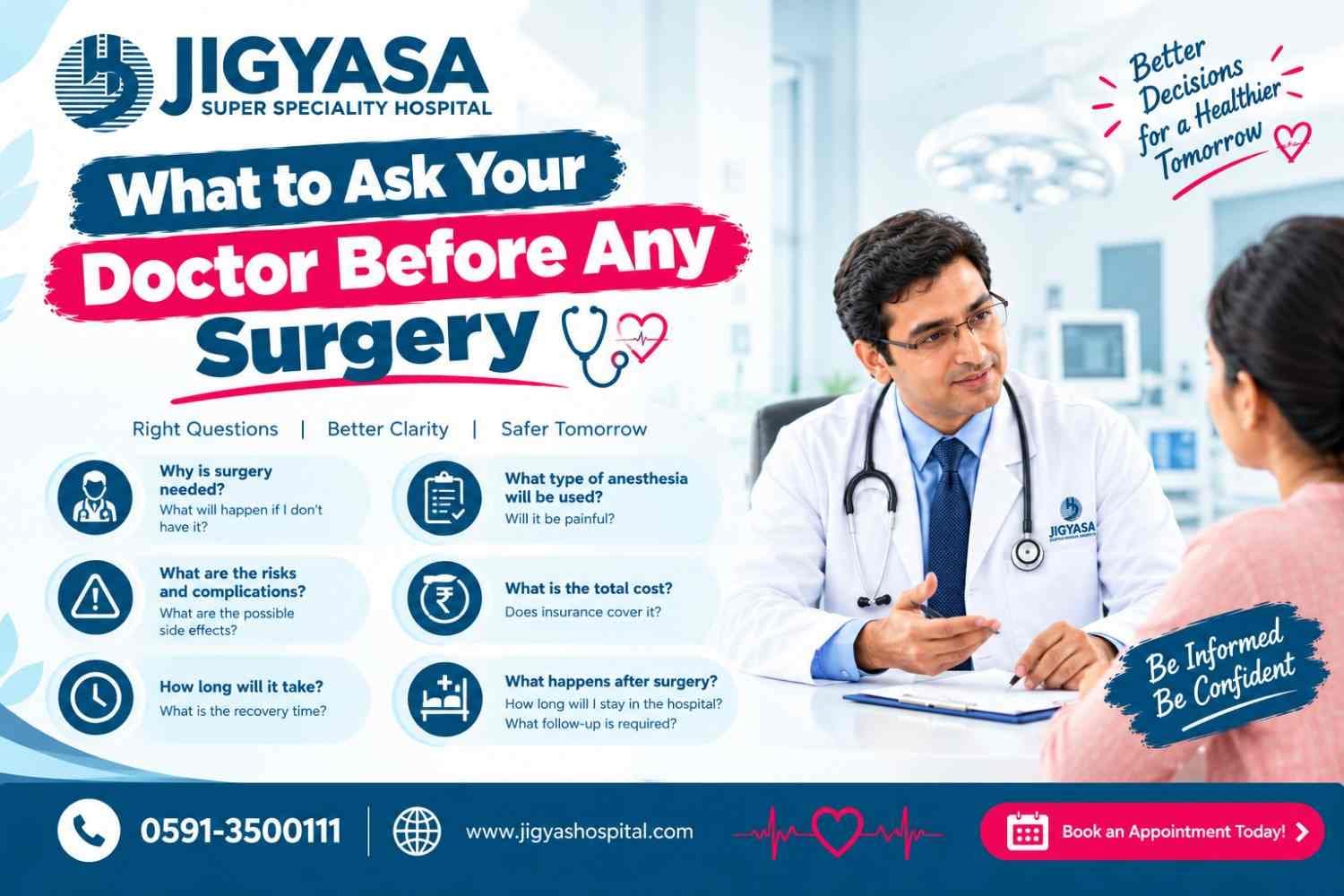
What to Ask Your Doctor Before Any Surgery
Preparing for surgery? Use this checklist of questions to ask your surgeon and anesthetist about risks, recovery, costs, and aftercare, from Jigyasa Hospital, Moradabad.
Most people spend more time comparing mobile phones than preparing for an operation. When a doctor says "you need surgery," fear and worry often crowd out the questions that would help the most. Consultations are short, medical words are unfamiliar, and many patients leave the room realising they forgot to ask something important. The result is anxiety, surprises during recovery, and sometimes regret. At Jigyasa Hospital, Moradabad, we encourage patients and families to come prepared. This checklist covers what to ask, why it matters, and how to get clear answers before any surgery, whether it is small or major.
Before You Go: Prepare for the Conversation
- •Write your questions down. Stress makes it easy to forget
- •Bring a family member who can listen and take notes
- •Carry all reports, scans, and a list of your current medicines
- •Ask the doctor to explain things in simple language, and to repeat anything unclear
- •It is fine to ask for key points in writing, or to record notes with permission
Questions About the Diagnosis and the Need for Surgery
- •1. What exactly is my diagnosis, and how was it confirmed? Ask which tests or scans show the problem.
- •2. Is surgery truly necessary? Some conditions have non-surgical options such as medicines, physiotherapy, or monitoring.
- •3. What happens if I do not have the surgery, or if I wait? Ask how urgent it is, and whether days, weeks, or months are safe.
- •4. What are my alternatives, and why do you recommend surgery over them?
- •5. What is the goal of the operation? A cure, pain relief, better function, or preventing a complication. Each has a different meaning of success.
If the answers leave you uncertain, a second opinion for planned surgery is a reasonable step.
Questions About the Procedure
- •6. What exactly will be done during the operation? Ask for a simple description, and a diagram if possible.
- •7. Is there more than one way to do it? For example, minimally invasive versus open surgery. Ask why your doctor prefers one.
- •8. How long will the operation take, and how long will I stay in hospital?
- •9. Who will perform the surgery, and who else will be on the team?
- •10. How often does the surgeon or hospital perform this procedure? Experience with a specific operation is relevant.
- •11. Could the plan change during surgery? Ask what could make the surgeon switch approach, and how consent for that is handled.
Questions About Risks and Benefits
- •12. What are the main benefits, and how likely am I to achieve them?
- •13. What are the common risks and the serious but rare ones?
- •14. Do my other conditions raise my risk? Diabetes, heart disease, high blood pressure, kidney or lung problems, obesity, and smoking can all matter.
- •15. What are the chances I will need another operation?
- •16. What would the team do if a complication occurred? Ask about facilities for emergencies and intensive care.
A good doctor will give balanced answers, not only reassurance.
Questions About Anesthesia
Anesthesia is a major part of safety, and many patients never meet the anesthetist until just before surgery. Ask:
- •17. What type of anesthesia is planned: general, spinal, regional, or local? And why that one?
- •18. Who will give the anesthesia, and can I speak to the anesthetist beforehand?
- •19. Does my medical history, snoring, allergies, or past reactions to anesthesia change the plan?
- •20. What are the side effects, such as nausea, sore throat, or drowsiness, and how long do they last?
- •21. What are the fasting instructions? Ask exactly when to stop food and water.
Questions About Preparing for Surgery
- •22. Which tests do I need before surgery? Blood tests, ECG, chest X-ray, or others.
- •23. Which of my medicines should I continue, and which should I stop, and when? Blood thinners, aspirin, diabetes medicines, blood pressure medicines, herbal products, and supplements all need specific advice. Never stop or change medicines without your doctor's instruction.
- •24. Should I stop smoking or alcohol before surgery? Both affect healing and anesthesia safety.
- •25. Do I need to improve my sugar, blood pressure, or weight before surgery?
- •26. Is there anything I should do at home to prepare? Exercises, diet, or arranging help.
- •27. What should I bring to hospital, and when should I arrive?
- •28. Will I need blood, and should family members be ready as donors?
Questions About Consent
- •29. Please explain the consent form before I sign. Understand what you are agreeing to, including the possibility of extra procedures.
- •30. Can I ask more questions after reading it? Consent should be informed, not rushed.
Questions About the Day of Surgery
- •31. What will happen from arrival to the operating theatre?
- •32. Can a family member wait nearby, and how will they receive updates?
- •33. Who will speak to my family after surgery?
- •34. Where will I recover, in a ward, high-dependency area, or ICU?
Questions About Recovery
- •35. What will recovery feel like, and how much pain should I expect?
- •36. How will pain be managed, and what can I take at home?
- •37. When can I eat, walk, bathe, and return to normal activities?
- •38. When can I return to work, driving, travel, and exercise?
- •39. Will I need physiotherapy or rehabilitation, and for how long?
- •40. Will I need help at home? Ask about wound care, dressings, and mobility.
- •41. What diet or restrictions apply during recovery?
Questions About Warning Signs and Aftercare
- •42. Which symptoms mean I should call or return urgently? Common examples include fever, spreading redness, worsening pain, heavy bleeding, breathing difficulty, calf pain or swelling, and persistent vomiting. Ask your doctor for your own list.
- •43. Whom do I contact after discharge, and how, including at night?
- •44. When are my follow-up visits, and what happens at them?
- •45. Will there be pathology or test results, and when will I get them?
- •46. Do I need long-term medicines, lifestyle changes, or monitoring after surgery?
Questions About Costs and Insurance
- •47. What is the estimated total cost, and what does it include? Surgeon, anesthesia, theatre, room, implants or devices, medicines, and tests.
- •48. What could increase the bill? Longer stay, ICU, complications, or extra procedures.
- •49. Are implants or devices needed, and what are the options and costs?
- •50. Is my treatment covered by insurance or a government scheme? Ask the hospital's insurance desk about pre-authorisation, cashless eligibility, and what you may have to pay yourself. See our guide on cashless versus reimbursement claims.
Questions to Ask Yourself
- •Do I understand what is being proposed, in my own words?
- •Do I feel heard, and are my concerns being taken seriously?
- •Is this a planned procedure where I can take time, or an emergency where delay is risky?
- •Do I want a second opinion?
- •Is my family aware and prepared to support me?
If You Feel Rushed or Unsure
It is reasonable to say, "I would like a little time to think and discuss this with my family." For planned surgery, a short pause is usually safe, and your doctor can tell you how long. In true emergencies, such as a heart attack, severe injury, or bowel obstruction, delay can be harmful, and quick treatment is the priority.
How to Make the Most of the Conversation
- •Ask one question at a time and wait for the full answer
- •Repeat back what you understood: "So you are saying that..."
- •Ask for printed instructions or reliable information to read at home
- •Write down answers, especially medicine instructions and warning signs
- •Share any worries openly, including fears, past bad experiences, or religious or personal preferences
- •Tell the team about all medicines, allergies, previous surgeries, and anesthesia reactions
How Jigyasa Hospital Supports Patients Before Surgery
At Jigyasa Hospital, patients are encouraged to ask questions and take part in decisions. Our team aims to explain the diagnosis, the plan, the risks, and recovery in plain language, support pre-operative evaluation, and help families understand costs and insurance steps. Patients are welcome to bring this checklist to their consultation. For emergencies, our 24/7 emergency care is available.
Surgery Preparation Support at Jigyasa Hospital, Moradabad
- •Pre-operative evaluation and counselling in plain language
- •Anesthesia consultation and risk assessment
- •Insurance desk for pre-authorisation, cashless, and PM-JAY guidance
- •24/7 emergency care for urgent surgical needs
Book an Appointment: 7900903333
Address: Near Miglani Cinema, Rampur Road, Moradabad – 244001
Online Appointments: jigyasahospital.com
Surgery Preparation | Pre-Operative Counselling | Anesthesia Consultation | Patient Education | Ayushman Bharat Accepted
Key Takeaways
- •Come prepared: write questions down, bring a family member, carry all reports/scans and medicine list, and ask for simple explanations.
- •Core questions: Is surgery truly necessary? What happens if I wait? What are the alternatives? What is the goal of the operation?
- •Ask about the procedure (approach, duration, surgeon experience), risks/benefits (including how your diabetes/heart/kidney conditions affect risk), and anesthesia (type, fasting rules, side effects).
- •Recovery questions matter: pain management, return to work/driving, physiotherapy, home help, and warning signs requiring urgent return (fever, spreading redness, breathing difficulty).
- •Don't forget costs and consent: get a full estimate including implants/ICU/complications, understand the consent form fully, and never stop medicines on your own. It's okay to ask for time to think for planned surgery.
Frequently Asked Questions
Is it rude to ask my surgeon so many questions?
No. Good surgeons welcome questions, because informed patients usually cooperate better and recover with fewer surprises.
Should I meet the anesthetist before surgery?
It is a reasonable request. A pre-anesthesia check is a normal part of planning, and it helps your team choose the safest option for you.
Can I eat or drink before surgery?
Only as instructed. Fasting rules depend on the type of anesthesia and the time of surgery, so follow the exact instructions you are given.
Should I stop my regular medicines before surgery?
Some medicines need to be continued and others paused, and the advice differs for each person. Ask your doctor for a written list and never stop medicines on your own.
What if I forget to ask something before the operation?
Contact your doctor's team before the surgery date. Questions about consent, fasting, medicines, and recovery can be clarified at any point beforehand.
Related Articles

Heart Attack Warning Signs You Must Never Ignore
Recognizing heart attack symptoms early can save your life. Learn the critical warning signs from Dr. Amit Kumar Singh, Senior Interventional Cardiologist at Jigyasa Hospital, Moradabad. Call 7900903333.

5 Early Morning Habits That Prevent Diabetes Naturally
Discover 5 powerful morning habits that naturally prevent diabetes. Expert advice from Dr. C.P. Singh, Senior Consultant Physician at Jigyasa Hospital, Moradabad. Call 7900903333.

Why Summers in UP Are Dangerous for Your Kidneys
UP summers can silently damage your kidneys. Jigyasa Hospital Moradabad explains the hidden risks, warning signs, and how to protect your kidneys this season. Call 7900903333.